Collabstr vs. Insense: Which Influencer Platform Is Right for UGC Campaigns?
- Key Takeaways
- Collabstr vs. Insense: Which Platform Is Better for UGC Campaigns?
- What Is UGC and Why Are DTC Brands Investing in It?
- UGC Trends on Collabstr: What the Data Shows
- How To Find UGC Creators for Your Brand
- Collabstr Platform Overview
- Insense Platform Overview
- FAQs: Best Platfforms for UGC Campaigns
Key Takeaways
-
UGC campaigns on Collabstr grew 133% year over year and now make up 35% of all influencer engagements on the platform.
-
The average UGC collaboration costs $154, and 80% of all brand engagements come in under $300.
-
For most small and mid-sized brands testing or scaling UGC for paid social, Collabstr offers the fastest, most flexible entry point. Insense makes more sense once you're running 10+ campaigns a quarter and need integrated ad deployment workflows.
Collabstr vs. Insense: Which Platform Is Better for UGC Campaigns?
UGC has become the default content type for brands running paid social ads and the platform you use to source it shapes everything from cost to speed to creative quality. Collabstr and Insense are two of the most established UGC creator marketplaces, but they're built for different stages of brand maturity, budget commitments, and campaign workflows.
This guide breaks down how each platform compares for UGC campaigns, what UGC actually costs in 2026, where to find UGC creators, and which platform makes more sense depending on whether you're sourcing UGC for paid social ads, video ads, or a broader creator marketing program.
What Is UGC and Why Are DTC Brands Investing in It?
UGC (user-generated content) is content created by real people rather than a brand's internal team. In the context of paid social and creator marketing, UGC typically refers to short-form video or photo content produced by creators who are hired to film product demos, testimonials, unboxings, tutorials, or lifestyle content featuring a brand's product.
When usage rights are secured, brands can repurpose UGC across paid ads, product pages, email campaigns, and organic social.
DTC brands have leaned into UGC heavily because it solves two problems at once. First, it's cheaper and faster to produce than traditional branded creative. Second, it performs. According to Adweek, UGC content drives 29% higher conversions than non-UGC campaigns. Audiences scroll past polished brand ads. They stop for content that looks like something a friend would post.
That combination — lower production cost and stronger conversion performance — is why UGC has moved from a nice-to-have to a core pillar of paid social strategy for DTC brands at every stage.
UGC for paid social ads
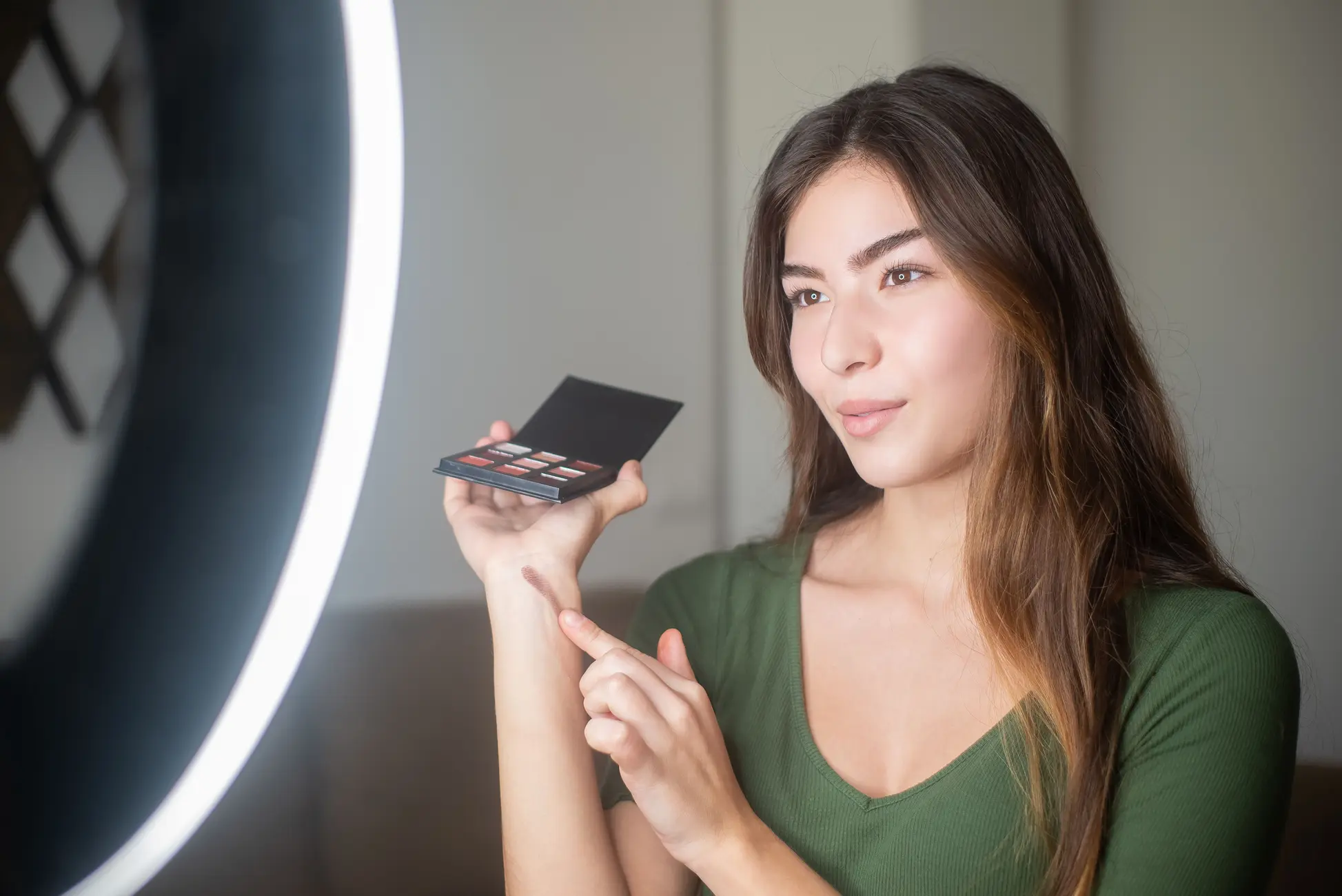
The most common use case for UGC is paid social creative. Brands commission short-form videos from creators and run them as ads on Meta (Instagram and Facebook) and TikTok. These videos are designed to blend into the feed rather than interrupt it.
The format works because social platforms reward content that keeps users engaged, and UGC-style ads have a native feel that polished brand spots don't. A creator filming a skincare routine in their bathroom mirror will outperform a studio-lit product shot in most paid social contexts. These videos work because they feel native to the feed, rather than like traditional brand ads.
UGC for video ads
Video dominates UGC. On Collabstr, the most-requested content types are Instagram Reels, TikTok videos, and YouTube Shorts — all short-form video formats. This tracks with broader industry trends: video content drives higher reach and engagement than static posts across every major platform.
The takeaway for brands: short-form UGC video is your reach play. If you want engagement depth, longer-form creator content on YouTube still punches above its weight.
How much does UGC content cost?
Less than most brands expect.
On Collabstr, the average UGC collaboration costs $154. That's the actual payout — what brands pay after negotiation, not the listed rate on a creator's profile. For context, UGC creators list their packages at an average of $180, but final costs tend to come down through negotiation and campaign-specific scoping.
On Collabstr, UGC packages are listed at an average of $180, while actual UGC payouts average $154 after negotiation and campaign-specific scoping. Year over year, the average cost of UGC campaigns on Collabstr dropped 5.7%, from $209 to $197.
Eighty percent of all influencer engagements on Collabstr cost under $300. Only 2% exceed $1,000. For a DTC brand testing UGC for the first time, three to five videos at $150–$200 each is a realistic starting budget — a fraction of what a traditional video production shoot would cost.
UGC Trends on Collabstr: What the Data Shows
The shift toward UGC isn't anecdotal. Collabstr's 2026 Influencer Marketing Report analyzed more than 21,000 collaborations and 200,000 creators on the platform, and the data tells a clear story.
The types of companies driving this growth are telling. Over 40% of UGC campaigns come from small businesses with budgets under $5,000. Another 33% come from mid-market companies spending between $5,000 and $50,000. UGC isn't an enterprise play — it's being adopted fastest by brands with lean budgets who need high-quality creative without high-cost production.
Three reasons this pattern makes sense for smaller brands: UGC is an affordable way to produce content without an in-house creative team, it provides instant social proof that builds credibility for brands without name recognition yet, and every piece of content can be repurposed across ads, email, product pages, and organic social — stretching every dollar further.
How To Find UGC Creators for Your Brand
The fastest path is through a UGC creator marketplace — a platform where creators list their services, set their rates, and brands can browse, filter, and hire directly.
On Collabstr, the process works like this: search by niche, platform, content type, location, or follower count. Every creator has visible pricing so you know what you'll pay before you reach out. Post a campaign brief and creators apply to you, or browse the marketplace and book directly. Payments are held in escrow until you approve the content, so there's no risk of paying for work that doesn't meet the brief.
The key when evaluating creators for UGC specifically: follower count matters less than content quality. You're hiring for their ability to produce authentic, scroll-stopping video — not their audience. Look at their portfolio work, the production quality of their past UGC, and whether their style matches the tone you're going for. A creator with 2,000 followers who makes great product videos is more valuable for UGC than a creator with 200,000 followers whose content doesn't fit your brand.
Collabstr Platform Overview
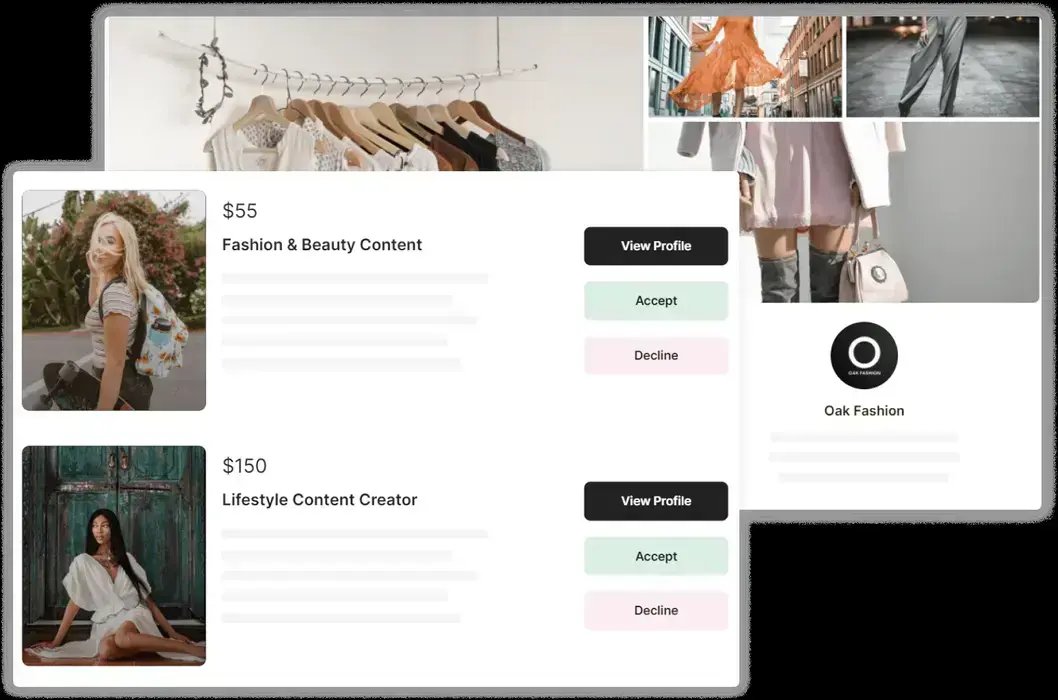
Collabstr is a self-serve creator marketplace. Brands search, hire, and pay creators directly for UGC and influencer content across Instagram, TikTok, YouTube, and other platforms. There's no subscription required to get started, and the marketplace is built around transparency — creator rates are public, payments are escrowed, and campaign management happens in-platform.
Best for
Small and mid-sized brands sourcing UGC and influencer content without committing to a monthly subscription. Particularly strong for brands buying 2–10 videos per month, testing UGC as a channel, or running lean campaigns where cost control and speed matter more than enterprise workflow features.
Starting price
Free to browse and search creators. Paid plans start at $249/month (Pro) and $333/month (Premium), which add campaign management features, advanced filters, audience reports, and reduced hiring fees. On the free plan, a 10% hiring fee applies to each creator booking.
Key features
The marketplace includes over 940,000 creators across all major platforms. Brands can search by niche, location, platform, follower count, and content type. Campaign briefs can be posted for creators to apply to, or brands can browse and book directly. Escrow payments protect both sides — funds are released only when the brand approves the content. Built-in analytics track impressions, engagement, and campaign performance. The UGC rate calculator and public pricing benchmarks give brands data to inform their budgets before they spend anything.
Insense Platform Overview
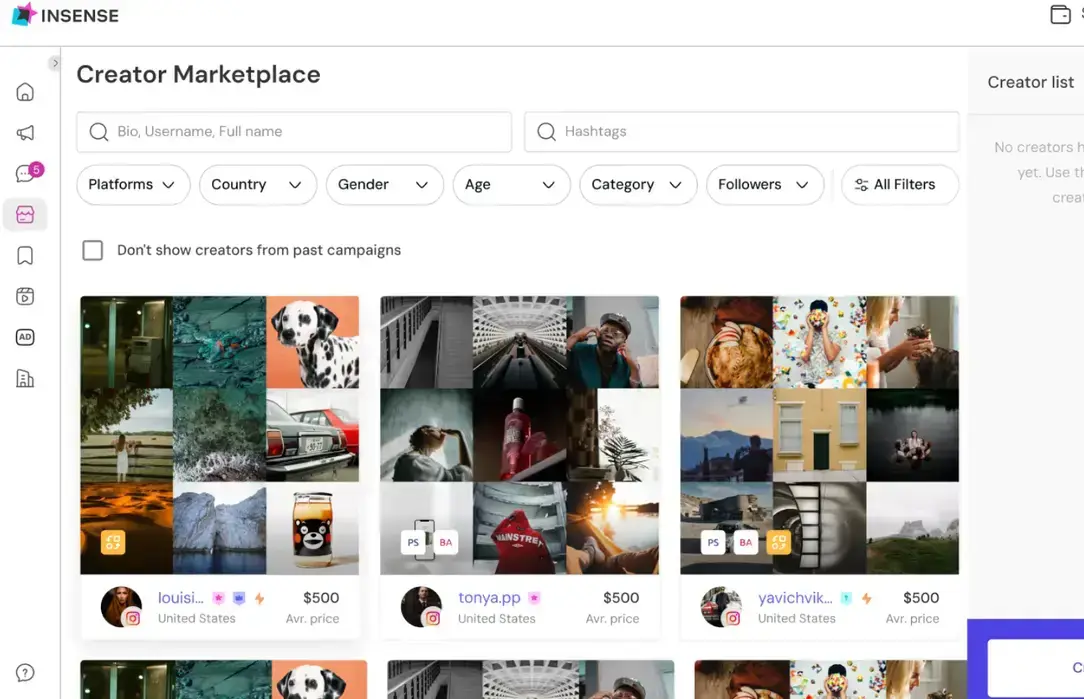
Insense is a creator marketing platform designed for brands running UGC and influencer campaigns as part of a broader paid social strategy. It combines a creator marketplace with integrated ad-deployment tools, enabling content sourcing and paid ad activation within the same platform.
Best for
DTC brands and agencies running coordinated paid social campaigns at volume — typically 10+ campaigns per quarter — who need native integrations with Meta and TikTok ad platforms. Also suited to brands running product seeding, affiliate campaigns, or TikTok Shop programs alongside UGC.
Starting price
Insense’s self-service Brand plan starts at $500 per month, billed quarterly at $1,500. Creator payments are not included in the subscription and must be budgeted separately. Insense also charges a marketplace fee on creator payments, ranging from 7% to 20% depending on the plan tier: 20% on Trial, 10% on Brand, and 7% on Agency.
Insense’s Trial plan costs $650 for one month and includes a 20% marketplace fee. After the trial period, the account automatically upgrades to the quarterly Brand plan unless cancelled at least 48 hours before the trial ends. For managed support, Insense currently lists dedicated platform management from $2,500 per month, with ready-to-go UGC packages priced separately.
Key features
Insense’s creator marketplace includes 80,000+ vetted creators across 35+ countries. The platform supports multiple campaign types: content-only UGC, influencer posting, product seeding, affiliate campaigns, TikTok Shop, Meta Partnership Ads, and TikTok Spark Ads. Brief templates and automated legal agreements streamline campaign setup. The Meta Partnership Ads integration lets brands find influencers and request account-level access for whitelisted ads within 48 hours. Spark Ad codes can be delivered directly through the platform. Payments and content usage rights are handled through an automated workflow.
Start Your Next UGC Campaign on Collabstr
UGC is the fastest-growing content type on the Collabstr platform for a reason. It's affordable, it converts, and it gives brands content they can own and reuse everywhere.
Whether you're commissioning your first three UGC videos or scaling an existing program, Collabstr gives you the tools to find creators, set your budget, and get content delivered — without a subscription, without quarterly commitments, and without guessing what anything costs.
Browse UGC creators on Collabstr and start your next campaign today.
Frequently Asked Questions Best Platforms for UGC Campaigns
What is UGC and how is it used in marketing?
UGC stands for user-generated content — content created by real people rather than a brand's in-house team. In marketing, UGC is most commonly used as paid social ad creative, product page content, email assets, and organic social posts. Brands hire UGC creators to produce authentic-looking videos and photos — product demos, testimonials, unboxings, tutorials — that they own and can deploy across channels. UGC performs well because audiences trust content from real people more than polished brand advertising.
How much does UGC content cost?
On Collabstr, the average UGC collaboration costs $154, and 80% of all influencer engagements come in under $300. UGC creators typically list packages starting around $180, but final costs often come down through negotiation. Year over year, UGC pricing has dropped as more creators enter the market. For a brand testing UGC for the first time, a realistic starting budget is $500–$1,000 for three to five short-form videos.
What's the difference between UGC and influencer marketing?
The key difference is where the content lives and what it's used for. Influencer marketing involves a creator posting branded content on their own social media channels to reach their existing audience. UGC is content created by a creator that the brand owns and controls — it's used as ad creative, on product pages, in emails, or wherever the brand wants to deploy it. With UGC, you're hiring for content quality, not audience reach. A creator's follower count matters far less than their ability to produce compelling, authentic video.
How do I find UGC creators for my brand?
The most efficient way is through a UGC creator marketplace like Collabstr, where you can search creators by niche, platform, content type, and budget. Every creator has visible rates, so you can shortlist before reaching out. You can also post a campaign brief and let creators apply to you. When evaluating UGC creators specifically, prioritize portfolio quality and style fit over follower count — you're buying content, not distribution.
What makes a good UGC ad?
A good UGC ad feels native to the platform it runs on. It should look like something a real person posted, not something a brand produced. The most effective UGC ads open with a strong hook in the first two seconds, feature the product being used in a real context, and keep production values intentionally low-fi — good lighting and clear audio, but no studio setups or heavy editing. The goal is to stop the scroll by blending in, not standing out.