
Earned Media Value Starts With the Ad Rate You Choose
- Key Takeaways
- What Is Earned Media Value?
- How Do You Calculate Earned Media Value?
- How Many Impressions Does a Collaboration Need for EMV to Match Its Cost?
- How to Calculate Earned Media Value for Your Own Campaign
- What Are the Limits of Earned Media Value?
- What This Means for Brands
- FAQ
- Methodology
Key Takeaways
• Earned media value (EMV) puts a dollar figure on a post's reach. It values the post's impressions at what the same impressions would cost you as ads, using your cost per 1,000 impressions (CPM).
• The CPM you pick decides the answer, so name it, its source and its date in every report.
• Example: at a $10 CPM, an average Instagram collaboration on Collabstr, which cost $193 in 2025 (Collabstr, 2026), needs 19,300 impressions before its EMV equals what it cost.
• EMV estimates what reach would have cost to buy. Revenue and return on investment (ROI) come from measured results, reported alongside it.
Earned media value (EMV) is the dollar figure marketers put on reach they did not buy as ads. Here is how it works, in four steps with hypothetical numbers:
1. A creator's post gets 100,000 impressions, the number of times it was shown.
2. Your own ads cost $10 per 1,000 impressions. That figure is your CPM.
3. 100,000 impressions is 100 blocks of 1,000, and 100 × $10 = $1,000. That $1,000 is the post's EMV.
4. Compare it with what the collaboration cost. If you paid $193, the average for an Instagram collaboration on Collabstr in 2025 (Collabstr, 2026), the post needs 19,300 impressions before its EMV equals that cost, because $193 ÷ $10 = 19.3 blocks of 1,000.
Some versions of EMV put a set value on each like, comment or share instead of using impressions.
What Is Earned Media Value?
Earned media value is an estimate of what the exposure from unpaid or creator-led content would have cost to buy as advertising. In influencer marketing, EMV turns a post's views or impressions into one dollar figure, so a campaign can be compared with paid media.
A post with a large EMV can drive no sales, so outcomes such as sales and sign-ups are measured and reported on their own lines.
How Is Earned Media Value Different From ROI?
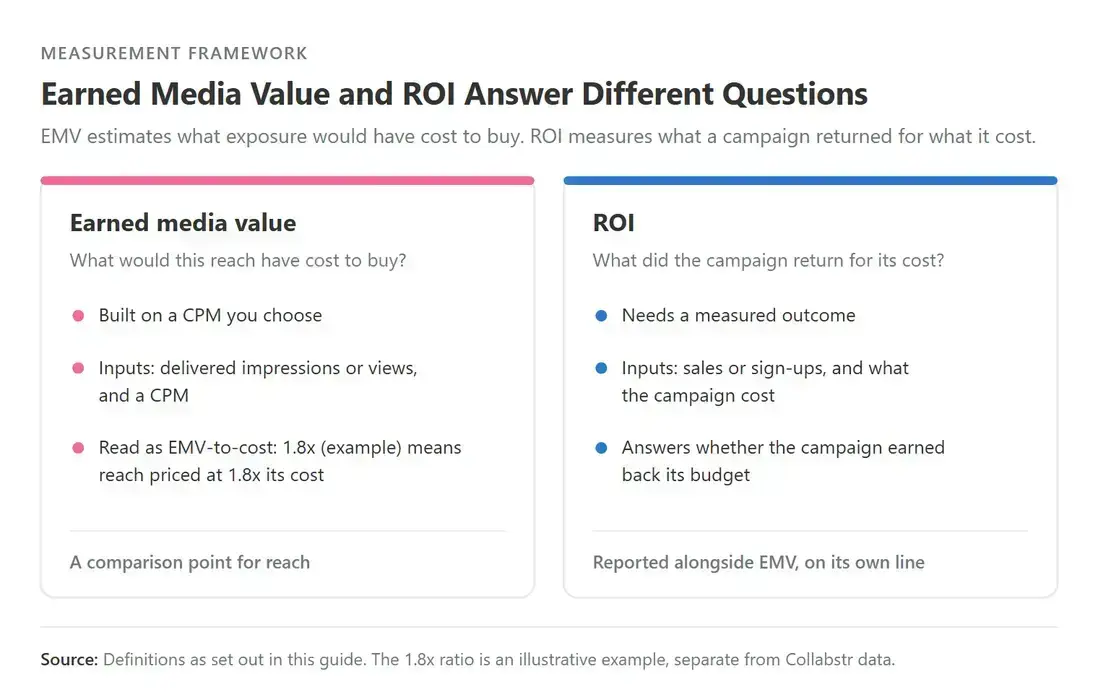
EMV estimates what exposure would have cost to buy, and ROI measures what a campaign returned for what it cost. EMV is built on a CPM you choose. ROI needs a measured outcome, such as sales or sign-ups.
The EMV-to-cost ratio is EMV divided by what you paid. A ratio of 1.8x, for example, means the post's impressions, valued at your chosen CPM, were worth 1.8 times what you paid. Whether the campaign earned back its budget is an ROI question, covered in our guides to influencer marketing ROI and influencer marketing key performance indicators (KPIs). Our guide to influencer marketing measurement shows where EMV sits among the other metrics.

How Do You Calculate Earned Media Value?
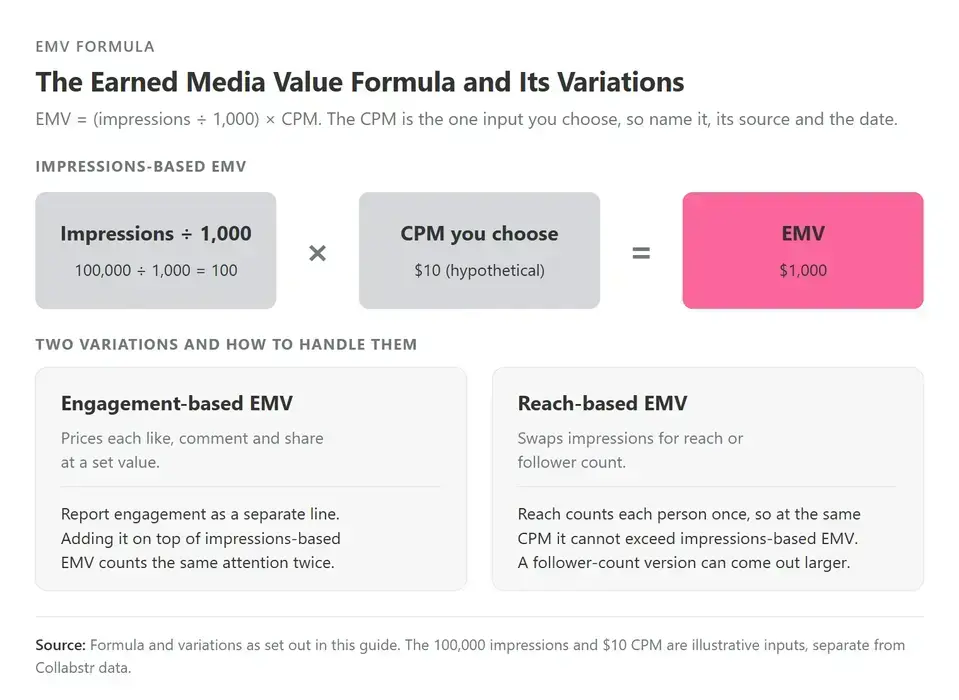
You calculate earned media value by dividing impressions by 1,000 and multiplying the result by a CPM: EMV = (impressions ÷ 1,000) × CPM. Impressions come from the platform's analytics.
Why the CPM Decides the Answer
In the impressions formula, the CPM is the only number you pick yourself, since the impressions come from the platform. Two teams can report different EMVs for the same post by picking different CPMs, so name the CPM, its source and the date in any EMV report.
Engagement-Based and Reach-Based EMV
Engagement-based EMV prices each like, comment and share at a set, weighted value. Reach-based EMV swaps impressions for reach, the number of people who saw the post, or for follower count. Each variation needs its own handling:
• Engagement-based EMV. Adding engagement value on top of an impressions-based EMV can price the same viewers twice, so report engagement as a separate line.
• Reach-based EMV. Reach counts each person once, while impressions count every view, so at the same CPM a reach-based EMV is never higher than one based on impressions. A version based on follower count can be higher, because a creator's followers can outnumber the people who saw the post.
How Many Impressions Does a Collaboration Need for EMV to Match Its Cost?
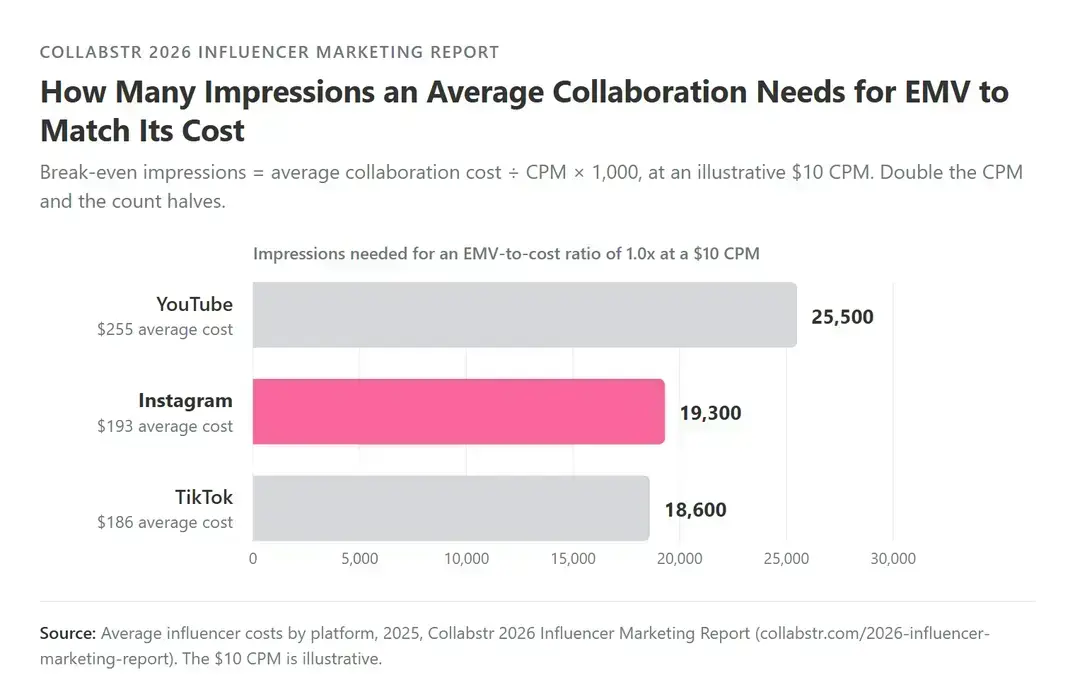
A post's EMV equals what the collaboration cost, a ratio of 1.0x, once its impressions reach the cost divided by the CPM, times 1,000. Collabstr's 2026 Influencer Marketing Report lists average influencer costs by platform for 2025. It calls these figures payouts and defines a payout as the final negotiated cost to the brand (Collabstr, 2026). At an illustrative $10 CPM, those averages set these break-even points:
|
Platform |
Average collaboration cost, 2025 |
Impressions for a 1.0x EMV-to-cost ratio at a $10 CPM |
|---|---|---|
|
YouTube |
$255 |
25,500 |
|
|
$193 |
19,300 |
|
TikTok |
$186 |
18,600 |
Source: Collabstr 2026 Influencer Marketing Report, average influencer costs by platform, 2025. The $10 CPM is illustrative.
The lower the CPM, the more impressions you need. At a $5 CPM the counts double, and at a $20 CPM they halve, so an average Instagram collaboration would need 9,650 impressions. A report that uses a higher CPM therefore makes the same post look like better value.
If you also send the creator free product, add its cost to the collaboration, and the impressions you need rise by the same share.
Engagement Rates Differ by Format
If you price engagements instead of impressions, the format changes the result. Collabstr's 2026 report lists engagement rates of 6% for YouTube videos, 5% for Instagram Reels, 4.5% for YouTube Shorts, 3.5% for Instagram posts and 2% for TikTok videos (Collabstr, 2026). Because the rates differ, the same value per engagement gives a YouTube video a larger EMV than a TikTok video with the same views, so compare posts within one format. To check one creator's engagement, try the Instagram engagement rate calculator. It divides by followers rather than views, so compare its result only with other follower-based rates. The report names the interactions it counts but gives no formula.
How to Calculate Earned Media Value for Your Own Campaign
To calculate EMV for a campaign, collect delivered views, price them at your own ad CPM, and divide the result by what the collaboration cost.
Step by Step
Five steps take you from delivered views to a reportable ratio:
1. Collect delivered impressions or views per post. Use platform insights, pulled after the post has run, and record the date. Use the same unit as your ad CPM.
2. Price the views at your paid-media CPM. Multiply by the CPM from your own ad account on the same platform and month. For example, 100,000 impressions at a hypothetical $10 CPM is $1,000.
3. Record what the collaboration cost. Use the amount you paid, including any product you sent. When planning, Collabstr's influencer price calculator shows average creator rates by platform, category and follower count.
4. Divide EMV by cost. A ratio above 1.0x means the impressions were worth more than you paid, valued at your CPM, and a ratio below 1.0x means they were worth less. Record your delivered CPM (cost ÷ delivered views × 1,000) too, so you can compare creators with each other.
5. Report the ratio with its inputs. Name the CPM, its source and date, so anyone reading the report can check the figure.
A Worksheet That Works as an Earned Media Value Calculator
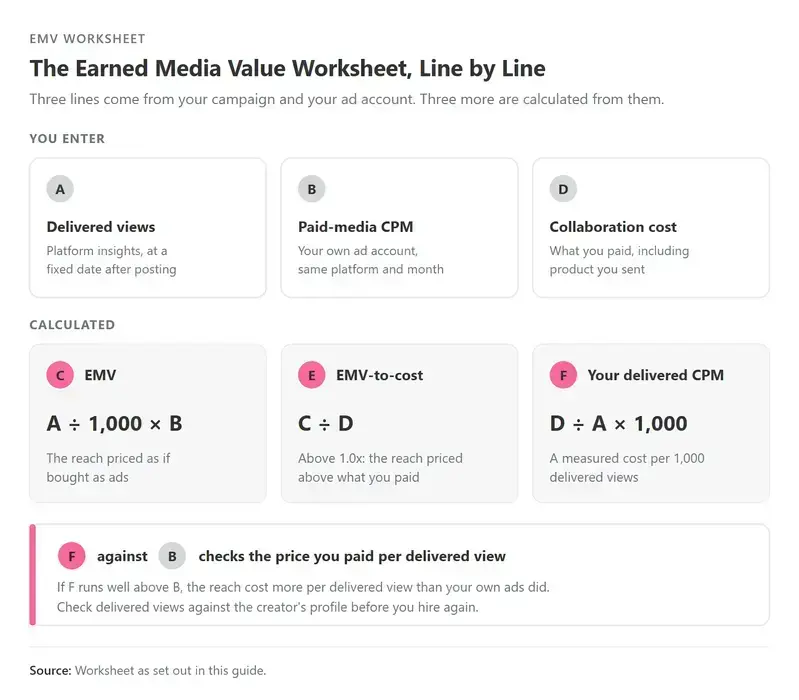
The table below works as an earned media value calculator for one post. You enter lines A, B and D, and the other lines are calculated. C depends on the CPM you pick, while F uses only what you paid and what the post delivered.
|
Line |
What to enter |
Where it comes from |
|---|---|---|
|
A. Delivered views |
Views or impressions on the post |
Platform insights, pulled at a fixed date after posting |
|
B. Paid-media CPM |
Your cost per 1,000 impressions or views on the same platform, in the same unit as A |
Your own ad account, same month |
|
C. EMV |
A ÷ 1,000 × B |
Calculated |
|
D. Collaboration cost |
What you paid, including product you sent |
Your records |
|
E. EMV-to-cost |
C ÷ D |
Calculated |
|
F. Your delivered CPM |
D ÷ A × 1,000 |
Calculated |
How to Read the Results
Line E shows how the reach compares with buying the same impressions as ads. Line F is your cost per 1,000 delivered views, the figure to compare across creators and campaigns.
If EMV is below what you paid (E under 1.0x), you also paid more per 1,000 views than your ads cost (F above B). Check delivered views against the creator's profile before you hire again.
What Are the Limits of Earned Media Value?
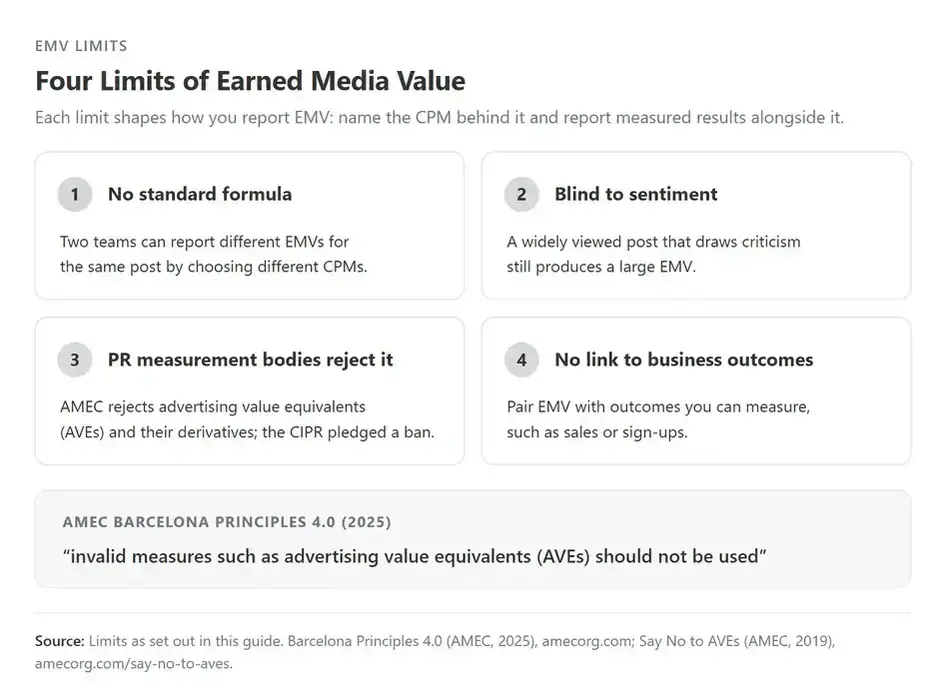
Earned media value has four limits: there is no standard formula, it ignores sentiment, public relations (PR) measurement bodies reject it, and it says nothing about business results. Each one shapes how you report it:
• There is no standard formula. Two teams can report different EMVs for the same post by choosing different CPMs.
• It is blind to sentiment. A widely viewed post that draws criticism still produces a large EMV.
• PR measurement bodies reject it. The International Association for the Measurement and Evaluation of Communication (AMEC) rejects advertising value equivalents (AVEs), the older PR version of the same idea, and their derivatives as a measure of value, and Britain's Chartered Institute of Public Relations (CIPR) pledged in 2017 to ban AVEs for its members (CIPR, 2017).
• It says nothing about business outcomes. Pair it with outcomes you can measure.
For sales, our guide to influencer discount codes shows how many code sales it takes to cover a collaboration.
What AMEC Says About AVEs
Principle 5 of AMEC's Barcelona Principles 4.0 states that "invalid measures such as advertising value equivalents (AVEs) should not be used" (AMEC, 2025). AMEC's Say No to AVEs campaign also covers AVE derivatives (AMEC, 2019), and the Barcelona Principles 4.0 guidance lists earned media value among the variations to avoid (AMEC, 2025).
AVEs estimate the advertising cost and space of earned media coverage, and EMV applies similar logic to creator content. Treat EMV as a pricing reference and report measured results alongside it.
When Earned Media Value Is Useful
EMV is useful as context in three situations, with outcomes leading the report.
• Comparing creators or posts inside one campaign, under the same CPM rules.
• Explaining creator reach to a finance team that thinks in paid-media terms.
• Checking a price before you hire, by dividing the creator's price by their typical views per post, multiplying by 1,000 and comparing the result with what 1,000 views cost you in ads.

What This Means for Brands
Brands get an EMV they can defend by naming the CPM behind it and setting the result against what the collaboration cost. The CPM sets the bar: at $10, an average Instagram collaboration needs 19,300 impressions before its EMV equals its $193 cost (Collabstr, 2026).
When planning, start with the cost side: Collabstr shows each creator's starting price for each content type before you hire, and payment is released when you approve the work.
When results come in, report EMV beside the measured results, as set out in our guide to influencer marketing reporting.
FAQ
What Is Earned Media Value in Influencer Marketing?
Earned media value in influencer marketing is an estimate of what a creator post's exposure would have cost to buy as advertising. In its impressions-based form, it divides delivered impressions by 1,000 and multiplies the result by a CPM you choose; other versions put a set value on each engagement. The figure is a comparison point for paid media, reported alongside measured outcomes such as sales or sign-ups.
Is Earned Media Value the Same as ROI?
They measure different things: earned media value estimates what exposure would have cost to buy, using a CPM you choose, and ROI compares a measured outcome, such as sales or sign-ups, with what the campaign cost. An EMV-to-cost ratio above 1.0x means the impressions were worth more than you paid, valued at your CPM. Money returned against money spent is measured through ROI.
What Is a Good Earned Media Value?
A good earned media value is worth more than the collaboration cost: an EMV-to-cost ratio (EMV divided by cost) above 1.0x, with the CPM named. There is no universal EMV target, since the answer depends on the CPM used.
What Is the Difference Between EMV and AVE?
Advertising value equivalents (AVEs) estimate the advertising cost and space of earned media coverage, and EMV applies similar logic to social and creator content, using impressions and a CPM or a value per engagement.
Both are pricing estimates. AMEC's Barcelona Principles 4.0 say AVEs should not be used, and its guidance lists earned media value among the variations to avoid (AMEC, 2025). Pair either one with outcome metrics.
Methodology
• Average collaboration costs (YouTube $255, Instagram $193, TikTok $186) come from Collabstr's 2026 Influencer Marketing Report, "Average influencer costs by platform", covering 2025. The report calls these figures payouts and defines a payout as the final negotiated cost to the brand. Read from the live report on September 16, 2026.
• Engagement rates by format come from the same report, which names the interactions it counts but gives no formula.
• Break-even impressions = average collaboration cost ÷ CPM × 1,000, at an illustrative $10 CPM.
• Illustrative inputs: the 100,000 impressions, the $10 CPM and the 1.8x ratio are examples for illustration.