A 20% Influencer Discount Code Can Triple the Sales You Need to Break Even
- Key Takeaways
- How a Discount Code Changes What You Earn per Sale
- What Counts as Your Collaboration Cost?
- The Break-Even Formula for Any Discount Code
- How Much Discount to Give Influencers
- How to Set Up Influencer Discount Codes
- How to Disclose a Discount Code Partnership
- What the Break-Even Model Means for Your First Campaign
- FAQ
- Methodology
Key Takeaways
• A discount code lowers what you earn on every sale it brings in, so each collaboration has a break-even point: the number of code sales that earns back what you paid the creator.
• Example: you pay a creator $193, the average cost of an Instagram collaboration on Collabstr in 2025 (Collabstr, 2026), to promote a $75 shampoo. With a 50% margin and a 15% code, you keep $26.25 per sale, so you need eight code sales to earn the $193 back.
• The bigger the discount and the thinner your margin, the more sales you need. On a product with a 30% margin, a 20% code means you need three times as many sales as you would at full price.
• Give every creator a unique code and a tagged link, cap and date the code, and require a clear disclosure of the brand relationship.
Influencer discount codes, also called influencer promo codes, are unique checkout codes a brand gives each creator, so every sale that uses one counts toward that creator's collaboration.
Every sale that uses a code earns you less than a full-price sale, because the discount comes out of your profit. Before launch, work out how many code sales it takes to earn back what you paid the creator. This guide walks through that math with one example, then shows how margin and discount size change it.
How a Discount Code Changes What You Earn per Sale
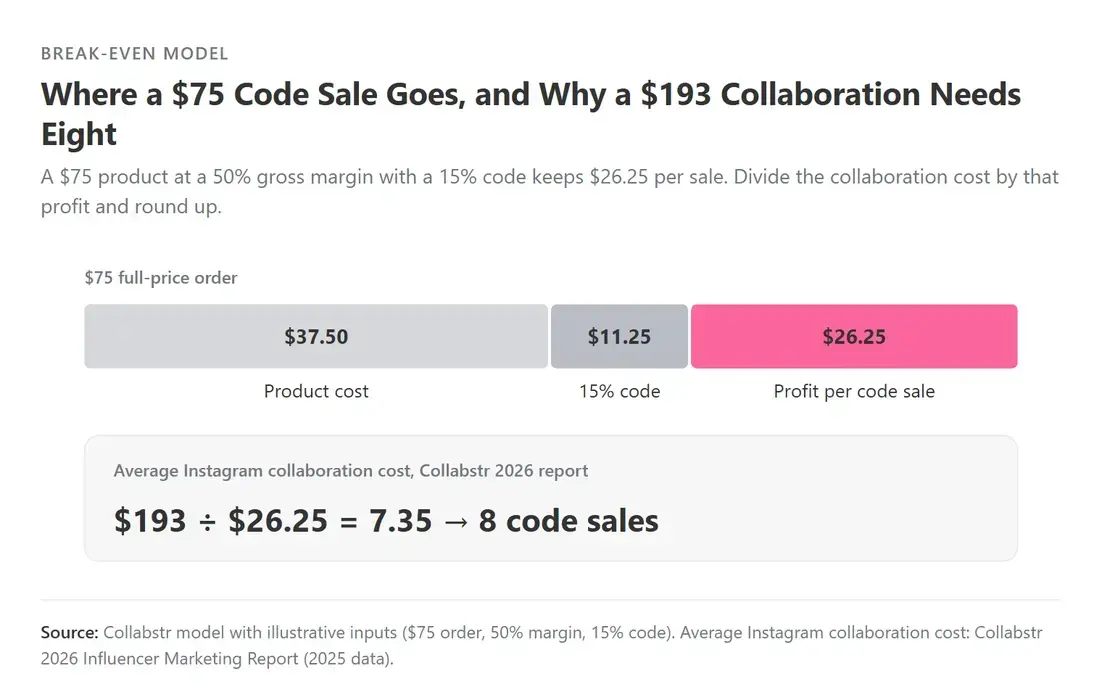
Imagine you sell a $75 shampoo. It costs you $37.50 to make and ship, so you keep $37.50 on a full-price sale. That is a 50% gross margin, the share of the price you keep.
You hire a creator for $193, the average cost of an Instagram collaboration on Collabstr in 2025 (Collabstr, 2026), and give their audience a 15% code. Here is what happens on each code sale:
1. The customer pays $63.75. The code takes 15% off the $75 price, which is $11.25.
2. Your cost stays at $37.50. The discount does not make the shampoo cheaper to produce.
3. You keep $26.25. That is $63.75 minus $37.50.
To earn back the $193, divide it by the $26.25 you keep per sale. That gives 7.35, and since a sale cannot be split, you round up: eight code sales pay back the collaboration.
Without a code, you would keep the full $37.50 per sale. $193 divided by $37.50 is 5.15, so six sales would cover it, and the 15% code adds two sales to your target.
What Counts as Your Collaboration Cost?
Your collaboration cost is everything you spend to run the collaboration: the cWhat the Model Leaves Out reator's price plus anything else you send, such as free product. In the example, $193 is what the creator charges.
If you also send the creator a bottle of shampoo, add its $37.50 cost. That makes the collaboration $230.50, and $230.50 divided by $26.25 is $8.78, so the target rises from eight code sales to nine. To see average creator rates by platform, category and follower count, use the influencer price calculator.
Our guide to the influencer rate card shows how creators price each line.
The Break-Even Formula for Any Discount Code
The example follows one formula you can reuse for any product. Your margin is the share of the price you keep, and the discount is the share you give away, so what is left is what you keep on each code sale:
Profit per code sale = Full price x (Gross margin - Discount)
Break-even code sales = Collaboration cost / Profit per code sale (round up)
In the example, 50% minus 15% leaves 35%, and 35% of $75 is $26.25. Always use the full price before the code.
Break-Even Sales by Order Value and Margin
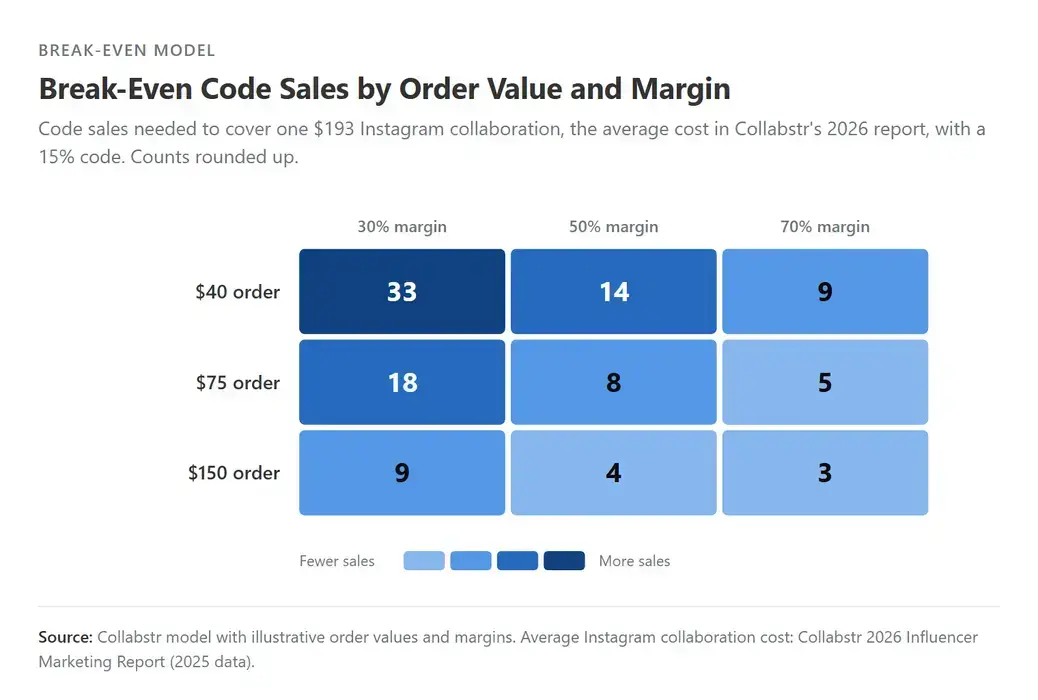
The table runs the same math for other prices and margins, with a 15% code and a $193 collaboration. A $40 product with a 30% margin needs 33 code sales, and a $150 product with a 70% margin needs three. Raising the margin from 30% to 50% cuts the sales you need by at least half at every price.
|
Full-price order value |
30% margin |
50% margin |
70% margin |
|---|---|---|---|
|
$40 |
33 sales |
14 sales |
9 sales |
|
$75 |
18 sales |
8 sales |
5 sales |
|
$150 |
9 sales |
4 sales |
3 sales |
Code sales needed to cover one $193 Instagram collaboration, the average cost in Collabstr's 2026 report, with a 15% code. Counts rounded up.
How Much Discount to Give Influencers
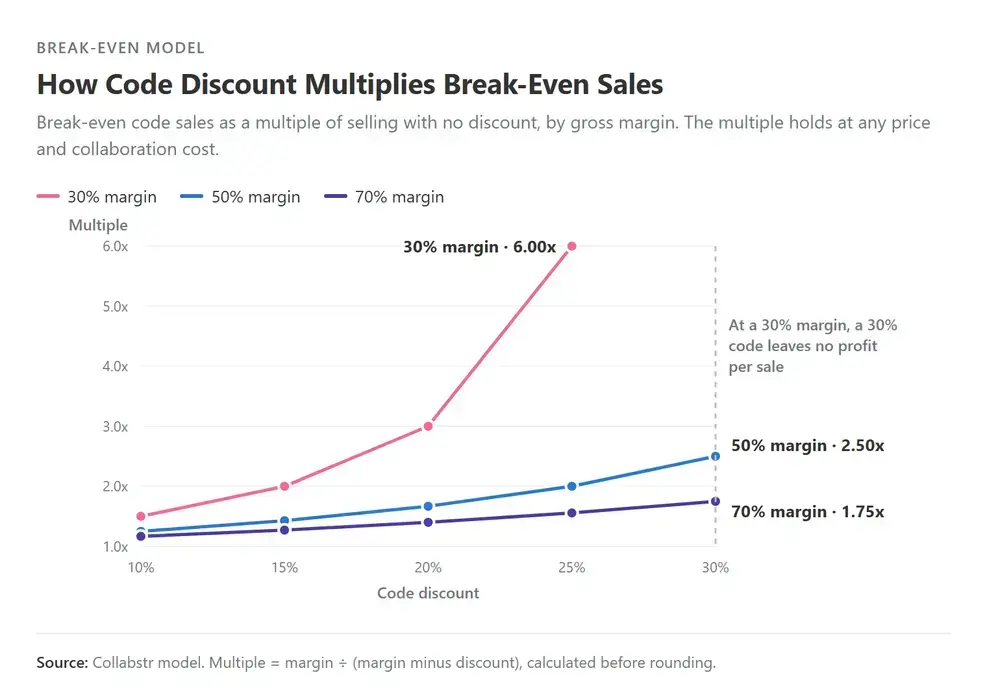
The smaller your margin, the more a discount hurts. A 20% code on a product with a 70% margin still leaves you 50% of the price on each sale. The same code on a product with a 30% margin leaves you only 10%, so each sale earns a third as much and you need three times as many sales to break even.
The table below shows how many times more sales a code requires than selling at full price. It works for any product price and any collaboration cost, because it depends only on your margin and the discount. For example, 2.00x means the code doubles the sales you need, and 1.40x means you need 40% more.
|
Code discount |
30% margin |
50% margin |
70% margin |
|---|---|---|---|
|
10% |
1.50x |
1.25x |
1.17x |
|
15% |
2.00x |
1.43x |
1.27x |
|
20% |
3.00x |
1.67x |
1.40x |
|
25% |
6.00x |
2.00x |
1.56x |
|
30% |
No profit per sale |
2.50x |
1.75x |
Sales needed with the code, as a multiple of the sales needed at full price. Calculated before rounding.
Lower-Cost Alternatives to a Large Discount
If your margin is around 30%, a smaller code, a fixed dollar amount off with a minimum spend, or a free gift with purchase keeps the sales target within reach. A free-shipping code costs you the shipping label on every sale, so treat the label cost as the discount and run it through the same formula.
Paying a Commission on Top of Base Pay
On Collabstr, every campaign pays the creator a fixed fee, called base pay. A campaign cannot pay commission alone, but a brand can add a commission on code sales on top of the base pay.
A commission lowers what you keep on each sale. In the example, a 10% commission on the $63.75 sale pays the creator about $6.38, your profit per sale falls to about $19.88, and you need 10 code sales instead of eight. Our guide to influencer affiliate marketing covers how to combine base pay and commission.
How to Set Up Influencer Discount Codes
Set up influencer discount codes in six steps. Shopify's discount code settings cover the code name, valid dates, usage limits and product restrictions (Shopify Help Center, 2026).
1. Create unique discount codes for influencers. Give each creator one code, such as their handle plus the discount, with no special characters, so every sale traces to one creator.
2. Set the discount from your margin. Run your full price, margin and discount through the break-even formula first.
3. Add limits. Set start and end dates, allow one use per customer, cap total uses, and restrict the code to campaign products where you can.
4. Pair every code with a tagged link. Add UTM parameters such as utm_source=instagram and utm_campaign=springlaunch; Google recommends always including source, medium and campaign (Google Analytics Help, 2026). Shopify can also build a shareable link that applies the discount automatically (Shopify Help Center, 2026).
5. Put it in writing. The code, link, dates and disclosure go in the campaign brief. Add commission terms to the influencer contract yourself, since its payment terms cover hourly and flat fees.
6. Log redemptions against cost. Each week, record code sales next to the collaboration cost and break-even number. Our guide to tracking influencer ROI covers the ROI formula and the metrics to track.
Influencer Discount Code vs Affiliate Link
A code works where no one can click, such as podcasts, long videos and livestreams, and it survives screenshots and later purchases on another device. A tagged link works in link stickers and bios, and a link with no discount keeps your full margin. Use both, since each misses sales the other catches.
How to Keep Codes From Leaking
Keep codes from leaking with an expiry date, a total-use cap, one use per customer and a fresh code for each campaign. A code posted publicly can spread beyond the creator's audience. A leaked code lowers your profit, because shoppers who never saw the creator get the discount, and it inflates the creator's sales count.
Watch for redemptions that spike when the creator has not posted or continue after the campaign ends, then retire that code and issue a new one.
A column for each code in your influencer marketing spreadsheet makes that pattern easy to spot.
How to Disclose a Discount Code Partnership
Creators need to disclose a material connection to a brand, such as payment, free product or commission, clearly and where the audience will see or hear it (FTC, 2023). A personalized discount code may signal a relationship with the brand, but the FTC says it is less clear that a code tells the audience the creator is paid, and it recommends erring on the side of disclosure.
Put the disclosure in the brief: said out loud and shown on screen for video, said out loud for audio.

What the Break-Even Model Means for Your First Campaign
The math gives you a sales target before launch, so you can pick a discount and a creator whose audience can plausibly reach it. It is a planning number, not a prediction of any creator's sales.
What the Model Leaves Out
The math leaves out returns, payment processing, shipping and customers who would have bought anyway, each of which raises the real break-even, and it leaves out the value of the content itself. Rerun the counts on your own collaboration cost.
What to Write Down Before Launch
Write down four numbers before your first campaign: the collaboration cost, the full price, your gross margin and the discount. On Collabstr, you see starting prices before you hire and pay when you approve the work. See plans on the pricing page.
Code sales are one result. Our guide to influencer marketing measurement covers what to track at every stage.
FAQ
How Do Influencer Discount Codes Work?
A brand creates a unique code for each creator, such as the creator's handle plus the discount. Shoppers enter it at checkout for a lower price, and each redemption is recorded against that code. That count shows how many sales the brand can credit to the creator and sets the base for any commission.
How Much Discount Should You Give on an Influencer Code?
Base it on your gross margin, the share of the price you keep. On a product with a 30% margin, a 20% code leaves you 10% of the price per sale, so you need three times as many sales to break even. On a product with a 70% margin, the same code leaves you 50%, so you need 40% more sales.
How Many Code Sales Does an Influencer Collaboration Need to Break Even?
Divide what you paid the creator by what you keep on each code sale. For a $75 product with a 50% margin and a 15% code, you keep $26.25 per sale, so a $193 collaboration, the average Instagram cost in Collabstr's 2026 report, needs eight code sales. Run the same math on your own collaboration cost, including any product you send.
Do Influencers Get Paid for Discount Code Sales?
They can, on top of their fixed fee. On Collabstr, every campaign includes base pay, and a brand can add a commission on code sales in addition to it. Put the commission in the contract and count it as a cost on each sale when you work out break-even.
Is a Personalized Discount Code Enough of a Disclosure?
The FTC says a personalized code may signal a relationship with the brand, but it is less clear that the code tells the audience the creator is paid. It recommends erring on the side of disclosure, so ask creators to disclose the relationship clearly in the post.
Methodology
• Average Instagram collaboration cost ($193) comes from the Collabstr 2026 Influencer Marketing Report, "Average influencer costs by platform", which covers collaborations on Collabstr in 2025. The report calls the figure a payout and defines a payout as the final negotiated cost to the brand. Read from the live report on September 16, 2026.
• The base-pay rule (every campaign includes base pay; a commission can be added on top, but a campaign cannot pay commission alone) is stated in Collabstr's influencer affiliate marketing article, read on September 16, 2026.
• Break-even model: profit per code sale = full price (before the code) × (gross margin minus discount); break-even code sales = collaboration cost ÷ profit per code sale, rounded up to the next whole sale. The $75 shampoo, its $37.50 cost, discount sizes and the 10% commission are illustrative inputs. Multiples are calculated before rounding. The model excludes returns, payment processing, shipping and sales that would have happened without the code.
• Scope: this article models what a code costs you per sale. It makes no claim about code redemption rates, conversion rates or how codes and links perform against each other.