AI Influencer Marketing: What Brands Pay and Where AI Creators Work
- Key Takeaways
- What Is AI Influencer Marketing?
- How Common AI Influencers Are on a Creator Marketplace
- Which Niches AI Influencers Work In
- What AI Influencers Cost Compared With Human Creators
- Where AI Creators Are Based
- What Could Change These Numbers
- Disclosure Rules for AI Influencer Campaigns
- How to Brief an AI Creator
- What This Means for Brands
- FAQ
- Methodology
If you are deciding whether to hire an AI creator, this guide covers how common they are, which niches they work in, what brands paid for them and what to put in the brief.
Key Takeaways
• AI-flagged creators made up 0.13% of the live creator marketplace in Collabstr's data, fewer than one creator in 700 (Collabstr platform data, July 2026).
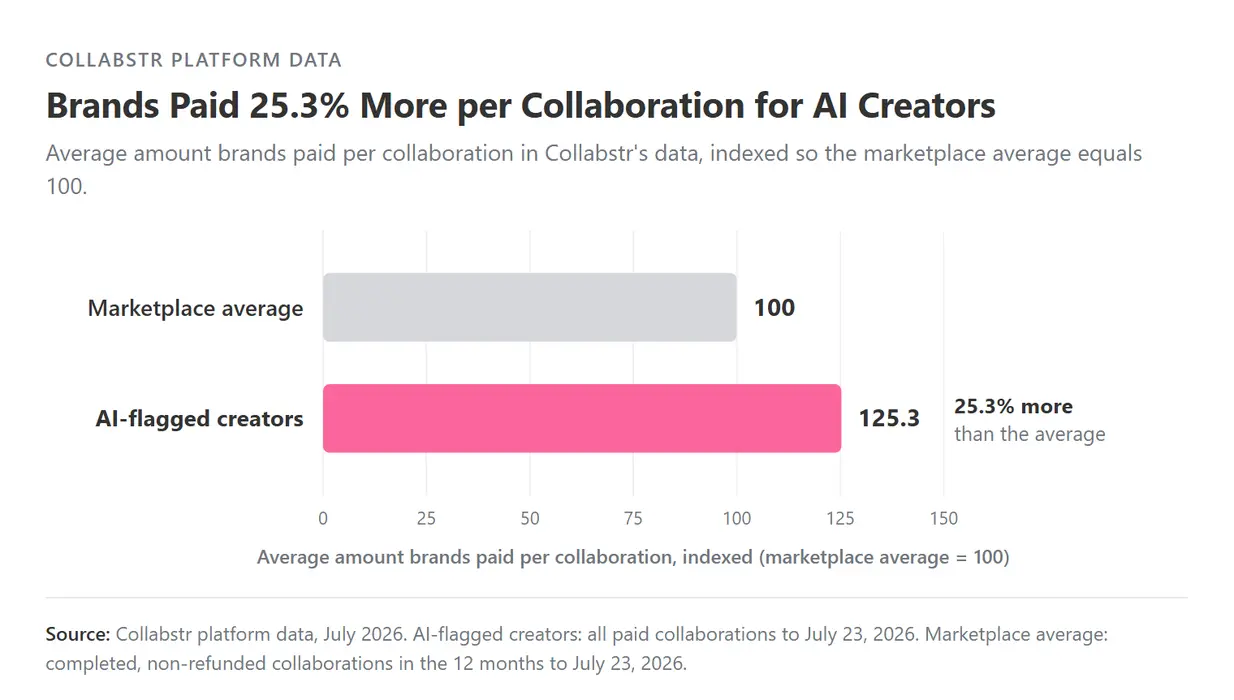
• Brands paid 25.3% more per collaboration with AI-flagged creators than the marketplace average (Collabstr platform data, July 2026).
• Beauty and Lifestyle hold the most AI listings, 13.14% each, but Technology is where AI creators are most over-represented: 9.49% of AI listings, several times its share of creators overall (Collabstr platform data, July 2026).
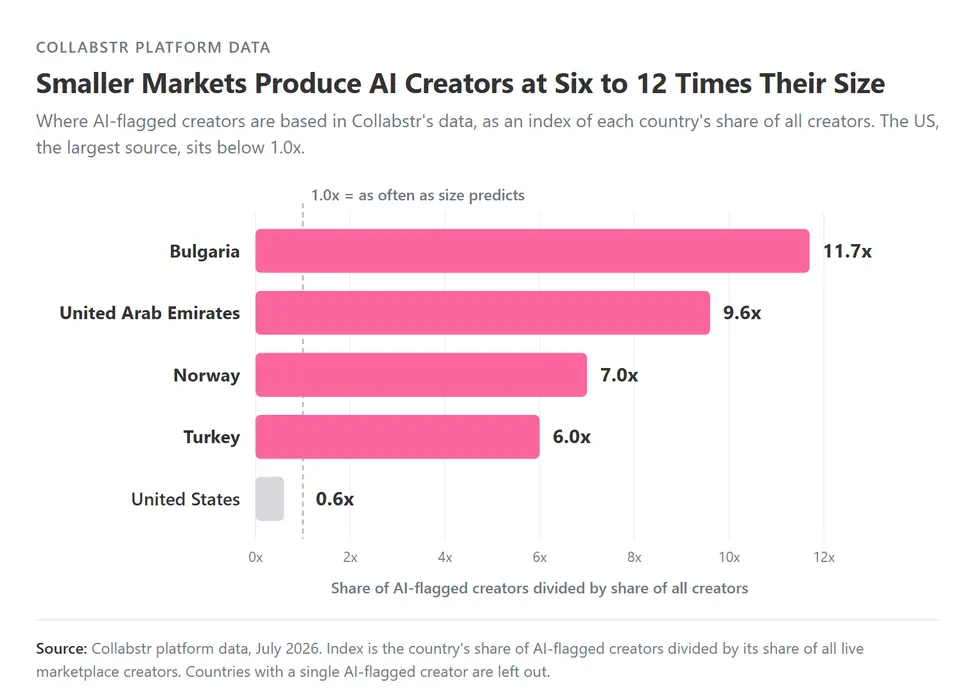
• Bulgaria, the United Arab Emirates, Norway and Turkey each produce AI creators at six to 12 times their share of all creators, while the US produces fewer than its size predicts (Collabstr platform data, July 2026).
AI influencer marketing is a brand hiring an AI-generated creator, a persona built with generative tools and run by a person or studio, to make sponsored content. In Collabstr's data, these creators are rare, and brands paid more to hire them than the average collaboration.
What Is AI Influencer Marketing?
AI influencer marketing is a collaboration in which a brand hires a creator whose face, voice or whole persona is generated by AI. The brand buys what it buys from any creator: posts, videos and the right to reuse them. A person still writes the captions, designs each image and keeps the persona consistent.
In Collabstr's data, brands paid 25.3% more per collaboration with these creators than the marketplace average (Collabstr platform data, July 2026). That runs against the usual reason given for AI, which is that it lowers cost.
"Virtual influencer" usually means the same thing, a created character in place of a filmed person, and this guide treats the two terms as one group.
How Common AI Influencers Are on a Creator Marketplace
AI-flagged creators were 0.13% of the live marketplace in Collabstr's data, fewer than one in 700 verified, active creator profiles (Collabstr platform data, July 2026). For a brand, the useful signal is that these creators already exist as hireable profiles with prices attached.
We flagged a profile as AI when the creator described it that way, with phrases such as "AI influencer," "virtual influencer" or "AI-generated." Collabstr has no separate AI category, so a persona that never says it is AI is not counted, and a human creator who mentions AI-generated work can be. The true share may differ in either direction.
Which Niches AI Influencers Work In
Beauty and Lifestyle hold the most niche listings on AI-flagged profiles, 13.14% each, followed by Fashion at 10.22% (Collabstr platform data, July 2026). A profile can list more than one niche, so these shares are of niche listings.
|
Niche |
Share of niche listings on AI-flagged profiles |
|---|---|
|
Beauty |
13.14% |
|
Lifestyle |
13.14% |
|
Fashion |
10.22% |
|
Technology |
9.49% |
|
Comedy & Entertainment |
8.03% |
|
Art & Photography |
7.30% |
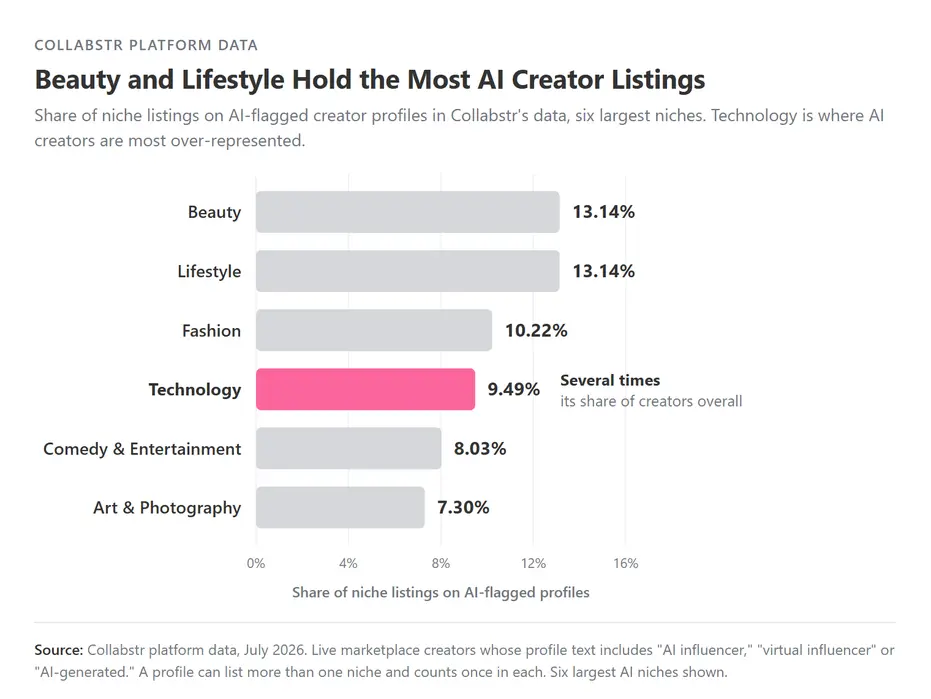
Two patterns sit in that table:
• Large, image-led niches. Beauty, Lifestyle and Fashion are among the largest niches on Collabstr, so much of their lead reflects size. Skincare, makeup and clothing content also leans on still images, which AI tools can generate.
• Skill-led niches. Technology holds 9.49% of AI listings, several times its share of creators overall, and Art & Photography and Comedy & Entertainment also appear more often among AI creators than their size predicts. The likeliest reason: these niches attract people with the technical and visual skill to build a persona.
A technology or art and photography shortlist is more likely to include an AI creator, relative to the size of the niche, than a beauty one.
What AI Influencers Cost Compared With Human Creators
Brands paid 25.3% more per collaboration with AI-flagged creators than the average collaboration in Collabstr's data (Collabstr platform data, July 2026). That is about a quarter more for every paid collaboration.
Cost is the usual case for AI. In IAB's 2026 report on AI in advertising, cost efficiency became the most cited benefit of AI, named by 64% of the advertising executives surveyed, up from fifth place in 2024 (IAB, 2026). IAB reads that as advertisers using AI to cut their own production and costs.
Hiring an AI creator is a different purchase, so that saving does not carry over. The brand pays for the content and for the persona that carries it. Two likely reasons push that price up:
• Short supply. At 0.13% of creators, there is little competition among AI creators to pull prices down.
• Consistency work. A persona has to look and sound the same across every deliverable and every post in a campaign. Someone is paid to hold that together, and that cost moves into the price.
To compare any quote with typical creator rates, use the influencer price calculator or our influencer marketing price guide.
Where AI Creators Are Based
The US is the largest single source of AI creators in Collabstr's data, at 30%, but it produces fewer than its size predicts. Close to half of all creators on Collabstr are in the US, 47.76%, which gives it an index of 0.6x (Collabstr platform data, July 2026).
The index divides a country's share of AI creators by its share of all creators, so 1.0x means AI creators appear exactly as often as the country's size predicts.
Four smaller markets produce AI creators at six to nearly 12 times their share of all creators:
|
Country |
Share of AI creators |
Share of all creators |
Index |
|---|---|---|---|
|
Bulgaria |
2.86% |
0.24% |
11.7x |
|
United Arab Emirates |
12.86% |
1.34% |
9.6x |
|
Norway |
2.86% |
0.41% |
7.0x |
|
Turkey |
2.86% |
0.48% |
6.0x |
|
United States |
30.00% |
47.76% |
0.6x |
For a brand, location matters less for an AI creator than for a filmed one, because the persona has no fixed place to shoot. Check instead which audience the persona speaks to, and in which language.
What Could Change These Numbers
Five things shape these figures:
• Small counts. At 0.13% of creators, a handful of profiles can move a niche's or a country's share. Read the overall pattern, and give less weight to the exact ranking.
• Self-description. Only profiles that call themselves AI are counted, so personas that do not say so are missing.
• Niche mix. AI creators cluster in niches with different price levels, which accounts for a small part of the gap.
• Different time windows. The AI figure covers all paid collaborations to date and the marketplace average covers the last 12 months, so the two are not measured over the same period.
• Early supply. A premium measured at 0.13% of supply may shrink as more AI creators list and compete on price.
Read the 25.3% as the direction of the price, with its exact size open to these caveats.
Disclosure Rules for AI Influencer Campaigns
An AI influencer campaign can need two disclosures: that the post is paid, and, where the content could pass as real, that it is AI-generated. The first applies to every creator collaboration. The second is new.
In the US, the Federal Trade Commission's 2023 update to its Endorsement Guides revised the definition of an endorser to cover parties that only appear to be people, a change the FTC said addresses virtual influencers (FTC, 2023). So the same paid-partnership disclosure you ask of any creator applies to an AI one.
In the EU, Article 50 of the AI Act applies from August 2, 2026. It requires businesses that use AI to create images, audio or video that would falsely appear real to disclose it clearly, at the latest on first exposure (European Commission, 2026). An invented persona can fall under that rule when its audience could take it for a real person, so a photorealistic persona reaching EU audiences is the case to check with your legal team.
Put both disclosures in the brief, so the creator knows how to label each post before it goes live.
How to Brief an AI Creator
Brief an AI creator the way you brief any creator, then add the persona questions below. For the standard parts of a brief, see how to brief a UGC creator.
1. Match the format to the persona. Review the persona's recent posts and ask for the formats it already makes well before you commission long, unscripted video.
2. Ask how the persona stays consistent. Find out who runs it and how its face, voice and style carry across every deliverable in the campaign.
3. Write disclosure into the brief. Spell out the paid-partnership label and any AI label, platform by platform.
4. Settle usage rights. Name where you may reuse the content and for how long, and confirm that the persona's owner grants those rights.
5. Price against the market. Expect AI quotes to run above the average and compare each one with the rates for that niche.
To find AI creators, search by niche in Collabstr's influencer search and read each profile's description. On Collabstr, you see a creator's price before you hire, and payment is released when you approve the work.
What This Means for Brands
AI influencer marketing is small, and it already has a price: 0.13% of the marketplace in Collabstr's data, hired at 25.3% above the average collaboration. AI creators list most in the largest niches, and they are most over-represented in skill-led niches such as Technology and in several smaller markets.
Disclosure rules in the US and the EU now reach AI creators and AI-generated content, a sign the category is maturing. Brands that test AI creators now, with clear briefs and clear labels, learn how they perform while supply is still small. For where AI creators fit alongside the rest of a creator plan, see our influencer marketing strategy framework.
FAQ
Do AI Influencers Cost Less Than Human Creators?
No. In Collabstr's data, brands paid 25.3% more per collaboration with AI-flagged creators than the marketplace average (Collabstr platform data, July 2026). Short supply and the work of keeping a persona consistent across a campaign are the likeliest reasons, and the two figures cover different time windows.
Do AI Influencers Have to Disclose That They Are AI?
Sponsored posts from AI influencers need the same paid-partnership disclosure as any creator: the FTC's 2023 Endorsement Guides update covers endorsers that only appear to be real people, which the FTC said addresses virtual influencers. In the EU, Article 50 of the AI Act, applying from August 2, 2026, requires businesses to label AI-generated images, audio or video that could pass as real. Put both labels in the brief.
What Niches Use AI Influencers Most?
Beauty and Lifestyle hold the most AI niche listings in Collabstr's data, 13.14% each (Collabstr platform data, July 2026). Relative to size, Technology leads: it holds 9.49% of AI listings, several times its share of creators overall.
How Many Influencers Are AI?
AI-flagged creators made up 0.13% of the live creator marketplace in Collabstr's data, fewer than one in 700 profiles (Collabstr platform data, July 2026). The count covers profiles that describe themselves as AI, so the true share may differ.
How Is AI Used in Influencer Marketing Beyond AI Creators?
Brands also use AI as a production tool inside ordinary campaigns. In IAB's 2026 report, cost efficiency was the most cited benefit of AI in advertising, named by 64% of the advertising executives surveyed (IAB, 2026). This guide covers the other use, hiring a creator who is AI.
Methodology
• Collabstr platform data: production data generated July 23, 2026. Internal and test accounts are excluded.
• AI-flagged creators: live marketplace creators, meaning verified, public and active profiles, whose profile text includes "AI influencer," "virtual influencer" or "AI-generated." Collabstr has no separate AI category, so profiles that do not describe themselves this way are not counted.
• Niche shares: share of niche listings on AI-flagged profiles. A profile can list more than one niche and counts once in each. "Share of creators overall" compares against each niche's share of niche listings across creators on Collabstr.
• Country shares: share of AI-flagged creators by the creator's country, against each country's share of all live marketplace creators. Countries with a single AI-flagged creator are left out of the table, since one profile swings the index.
• Price: average amount brands paid per collaboration. The AI figure covers all paid collaborations with AI-flagged creators to July 23, 2026. The marketplace average covers completed, non-refunded collaborations in the 12 months to July 23, 2026.
• Third-party sources: IAB, "The AI Ad Gap Widens," January 2026; Federal Trade Commission, Endorsement Guides update, June 2023; European Commission, Article 50 AI Act FAQ, July 2026.
• Earlier publication: these findings were first reported in The AI Journal in September 2026.