Influencer Pay Comes Down to Five Checks Before You Book
- Key Takeaways
- The Number That Makes Influencer Pay Comparable
- Check 1: Start With What Deals Actually Cost
- Check 2: Price Everything in the Quote, Not Just the Post
- Check 3: Judge Reach on Recent Views
- Check 4: Set Your Maximum CPM Before You Negotiate
- Check 5: Pick the Deal Type That Fits
- Three Habits Before You Book
- What These Numbers Can and Cannot Tell You
- What This Means for Brands
- FAQ
- Methodology
Influencer pay has no standard rate card: two creators with similar audiences can quote very different amounts. This guide covers five checks to price any deal before you book, from what deals cost to influencer CPM, the price per 1,000 views you set as your maximum.
Key Takeaways
• The average sponsorship price listed on Collabstr is about $220, and what the deal includes moves the price from there.
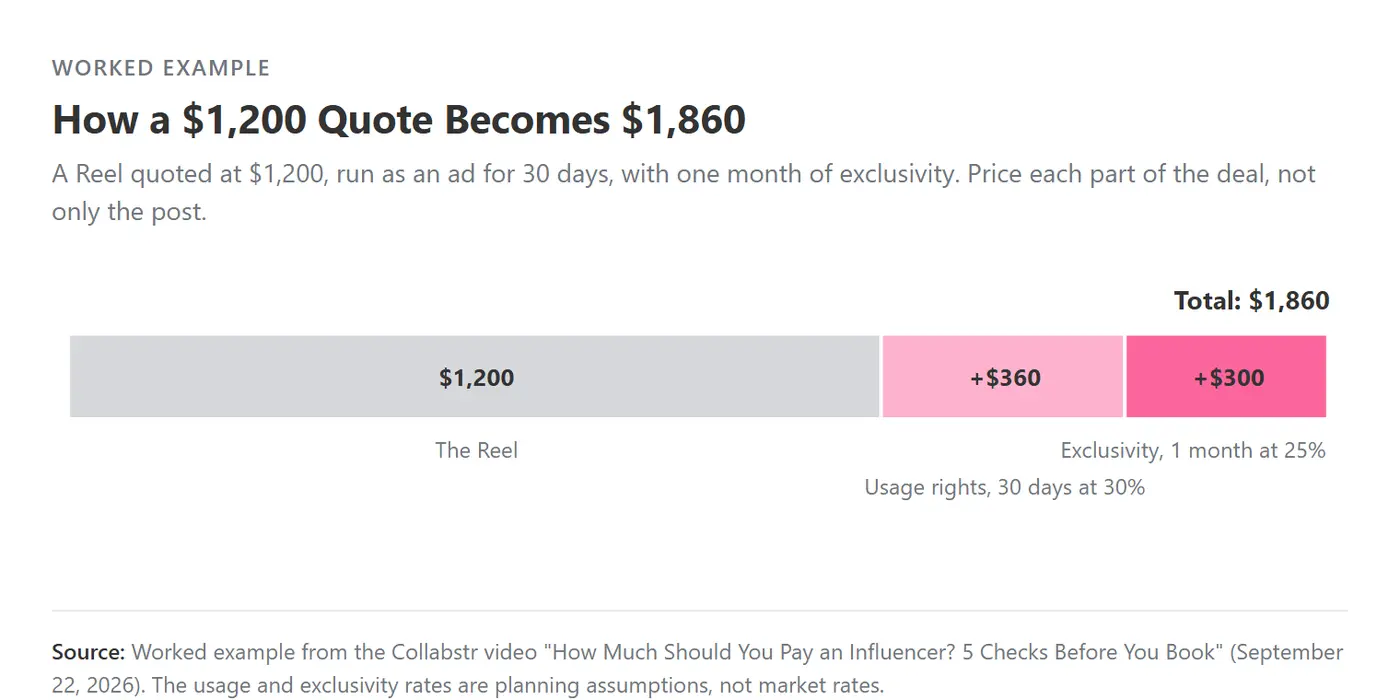
• A quote can carry three prices: the post, the right to reuse it in ads, and exclusivity. In the video's example, a $1,200 Reel becomes $1,860 once all three are counted.
• Judge reach on a creator's median recent views, not followers, then divide the fee by those views to get the CPM.
• Set your maximum CPM before you negotiate. If a quote is over it, cut the scope rather than squeezing the rate.
• Every deal on Collabstr includes base pay, starting at a $50 package (Collabstr video, 2026), and a commission can sit on top.
The Number That Makes Influencer Pay Comparable
That number is CPM. CPM means cost per thousand impressions (Google Ads Help). For an influencer deal, use views: the creator's fee divided by the views you expect, multiplied by 1,000.
Say a creator charges $193 and their recent posts get about 20,000 views. $193 ÷ 20,000 × 1,000 = $9.65 per 1,000 views. Use the same formula on every quote below.
CPM tells you how much attention you are buying for the money, a comparison that works across creators of every size.
Check 1: Start With What Deals Actually Cost
Without market context, every quote looks either cheap or expensive depending on your mood. Two shortcuts fill that gap. They use a follower formula, such as a hypothetical $10 per 1,000 followers, which prices a 50,000-follower account at $500 a post. Or they pay whatever the creator asks. The first prices audience size, and the second prices the creator's hopes. Neither tells you what a deal like yours closes at.
Collabstr's listings give a starting point. Across 1.2 million listed packages, the average listed sponsorship price is about $220 (Collabstr video, 2026).
Treat that as a benchmark, and expect to pay more for a longer video, a niche audience or more involved deliverables.
The listed price can also move before the deal closes, usually because the scope or terms change along the way. On Collabstr, prices sit on each creator's profile, so you see the asking price before you reach out.
Check 2: Price Everything in the Quote, Not Just the Post
A quote can grow once the rest of the deal is written down. There are up to three parts to price:
• The post itself: the content, published to the creator's audience.
• Usage rights: your right to reuse the content, for example in paid ads.
• Exclusivity: the creator agrees not to promote competitors for a set time.
In the video's worked example, a creator quotes $1,200 for a Reel, and you want to run it as an ad for 30 days. The video puts paid usage at 20% to 50% of the base fee. Rates vary by creator and channel, so treat it as a planning range. At 30%, usage adds $360. One month of exclusivity at 25% adds $300. The real cost is $1,860, not $1,200.
Extras can also work in your favor. In another of the video's examples, a $150 Reel that includes usage rights, raw footage and a revision can be better value than a $100 Reel with none of them. Compare price alongside what is included. On Collabstr, each package lists its inclusions, and our guide to content usage rights covers how to agree them in writing.
One caution for the CPM math: usage rights buy you an ad asset, not organic views. When you judge the post on CPM, use the fee for the post itself, and judge the usage fee against what it would cost to make an ad of the same quality.
Check 3: Judge Reach on Recent Views
Follower count gives you audience context, and engagement rate shows how responsive that audience is. Both try to answer the same question: how many people are likely to see the post? Recent views answer it more directly.
Open the creator's recent content and note the typical views. Use the median, not the average. One viral post can pull the average up and hide what the creator normally delivers. For example, if the last 10 videos got 4,000 to 12,000 views and one got 400,000, the median sits in that 4,000 to 12,000 range, and that is what to expect.
Compare like with like, too. Engagement differs by format: in Collabstr's 2026 report, YouTube videos showed 6%, Instagram Reels 5%, YouTube Shorts 4.5%, Instagram posts 3.5% and TikTok videos 2% (Collabstr, 2026). A 3% rate sits above the report's TikTok figure and below its YouTube figure. On Collabstr, engagement numbers sit on the creator's profile next to the price, so you can check both before you send a message.
Check 4: Set Your Maximum CPM Before You Negotiate
Decide the most you would pay for 1,000 views before you read a single quote. Start from what 1,000 views cost you in your own paid social ads, then decide how much more creator content is worth to you. Then every quote gets the same test:
1. Estimate views from the creator's median recent views.
2. Calculate the CPM: fee ÷ expected views × 1,000.
3. Compare it with your maximum. Under it, book. Over it, change the scope.
Back to the $1,200 Reel. If the creator's median is 20,000 views, the post alone works out to $60 per 1,000 views, about six times the $9.65 in the first example. That can be worth it for a niche audience you cannot reach elsewhere. Otherwise, rethink the deal.
If a quote is over your maximum, reduce the scope to bring the price into range, instead of pushing the creator's rate down:
• Shorten the usage period.
• Drop exclusivity.
• Ask for fewer variations.
• Give a longer deadline.
Same creator, smaller scope, fair price, and nobody feels squeezed. Once a tracked post is live, Collabstr shows the creator's CPM in the campaign report (Collabstr video, 2026), so you can compare the CPM you expected with the one you paid.
Check 5: Pick the Deal Type That Fits
There are two common ways to pay. A flat fee is predictable, and if the post flops, you carry the risk. A commission pays the creator a share of the sales they bring in, so the brand carries less of it.
Commission sounds better for the brand until you are a brand creators have not heard of. Creators will often work on commission for a brand they know. For an unknown brand, commission-only is a day of work for possibly nothing, so they usually pass.
That is why every deal on Collabstr includes base pay (Collabstr, 2026), and the smallest package is $50 (Collabstr video, 2026). A practical structure is a base fee that covers the content, plus a commission on top. The base pays for the work, and the commission gives the creator upside if it sells. Our guide to performance-based influencer marketing covers how to structure it.
Then rebook the winners. Read the campaign report, find the creators with the best CPM, and hire them again, especially if their content was strong and they were easy to work with. When you book several posts at once, ask for a bundle rate: 71% of the influencers Sprout Social surveyed offer discounts when partnering with brands on multiple posts (Sprout Social, 2024).
Three Habits Before You Book
1. Build the full campaign budget. Add the creator fee, platform fees, product, shipping, usage rights, ad spend and your own time.
2. Put an end date on usage rights. Agree 30 to 90 days, then renew the content that performed.
3. Treat your first campaign as a test. Book three to 10 smaller creators, learn what works, and put more behind the winners. Ten small deals teach you more than one big one.

What These Numbers Can and Cannot Tell You
The $220 average comes from packages listed on Collabstr, mixing platforms, niches and formats, and the engagement rates by format come from Collabstr's 2026 report. Your category can sit well above or below them, so read the pattern, not the exact figure.
CPM measures the price of attention, not its quality. A creator with a higher CPM can still be the better buy if their audience matches your customer more closely. Use CPM to compare quotes, then use your judgment on content and fit.
What This Means for Brands
With the average listed package at about $220, the money at stake in a single booking is modest, and the bigger risk is setting influencer pay without a method. Price the full quote, convert it to a CPM on median views, and hold every creator to the same maximum. Collabstr shows prices and packages before you hire and tracks performance on your plan's live posts once the campaign is running, so the same test works before and after you book. For broader price benchmarks, see what influencers cost in 2026 or try the influencer price calculator. Once the campaign is live, our guide to ROAS vs ROI covers how to report what it earned.
FAQ
How Do You Calculate Influencer CPM?
Divide the creator's fee by the views you expect, then multiply by 1,000. A $193 fee on 20,000 expected views is $193 ÷ 20,000 × 1,000 = $9.65 per 1,000 views. Use the creator's median recent views, not their follower count.
What Is a Good CPM for Influencer Marketing?
There is no single benchmark, because CPM varies by platform, niche and format. Set your own maximum by starting from what 1,000 views cost you in paid social ads, then decide how much more creator content is worth to you. Judge every quote against that number.
What Affects Influencer Pay?
Platform, format, audience size and niche, and the scope of the deal. Usage rights, exclusivity and extra revisions add to the base fee, and so does a short deadline.
How Much Should You Pay an Influencer?
It depends on the deal. Across 1.2 million packages listed on Collabstr, the average listed sponsorship price is about $220. Price the post, usage rights and exclusivity separately, then check the post's CPM against your maximum.
Do Usage Rights Cost Extra?
Usually, yes. Usage rights let you reuse a creator's content, for example in paid ads, and are often priced as a percentage of the base fee for a set period. The video uses 20% to 50% as a planning range. Agree the channels and an end date in writing.
Should You Pay Influencers a Flat Fee or Commission?
A flat fee is predictable but leaves the performance risk with you. Creators who do not know your brand often decline commission-only offers. On Collabstr, every deal includes base pay, so a common structure is a base fee plus a commission on top.
Methodology
• Engagement by format: Collabstr 2026 Influencer Marketing Report, based on 2025 marketplace data, read September 22 and October 14, 2026.
• Average listed sponsorship price ($220 across 1.2 million listed packages), the $50 smallest package and CPM in the campaign report: stated by Collabstr in the video "How Much Should You Pay an Influencer? 5 Checks Before You Book," published September 22, 2026.
• Base pay on every deal: Collabstr's influencer affiliate marketing guide, read October 14, 2026.
• CPM definition: Google Ads Help, "Cost-per-thousand impressions (CPM): Definition", read October 14, 2026.
• Multi-post discounts (71%): Sprout Social, "How to negotiate influencer rates," July 9, 2024.
• Worked examples from the video ($1,200 Reel, 30% usage, 25% exclusivity, $193 at 20,000 views, $150 and $100 Reels): illustrative figures chosen to show the arithmetic. The 20% to 50% usage range is the video's planning range, not a market rate.
• Our own illustrations ($10 per 1,000 followers on 50,000 followers, the median example, $1,200 at 20,000 views = $60): hypothetical figures, labeled in copy.