Build Your Influencer Marketing Strategy on Real Numbers, Not Best Practices
- Key takeaways
- Strategy is a set of decisions, not a checklist
- Decision one: what are you actually buying?
- Decision two: which platform?
- Decision three: which creator tier?
- Decision four: how do you structure the collaboration?
- Decision five: a campaign or a program?
- How to measure the strategy
- Put it together: a $2,000 quarterly strategy
- Frequently asked questions
- Make the decisions, and you have a strategy
Key Takeaways
-
Most influencer marketing strategy guides are checklists that could describe any channel. A real strategy is a sequence of specific decisions, and each has a right answer in the data.
-
Decide what you're buying first. In our 2026 report, UGC made for ads is the fastest-growing type (up 133% and 35% of campaigns), while reach on a creator's own feed, led by Instagram at 40% of campaigns, is the other large share.
-
Match the platform to the niche. YouTube runs $255 a collaboration and Instagram $193, but YouTube's premium only holds in information-rich niches.
-
Weight toward micro and nano creators. They cost the least and engage more, and crossing 100,000 followers doubles the price.
-
Plan to repeat. Ongoing structures are rare, only 7% of campaigns add a performance component, so the brands that build a program compete against a field that starts over every time.
Strategy Is a Set of Decisions, Not a Checklist
Search for an influencer marketing strategy and you get the same advice everywhere. Define your goals. Pick influencers who fit. Align with your business objectives. It is all true, and none of it helps, because it could describe any marketing channel ever invented. A checklist isn't a strategy.
A real influencer marketing strategy is a short sequence of specific decisions, and the useful thing is that each decision has a right answer you can read from data rather than guess. This guide walks the decisions in order, with the real marketplace number behind each one. Make these five calls well and you have a strategy. Skip them and you have a checklist.
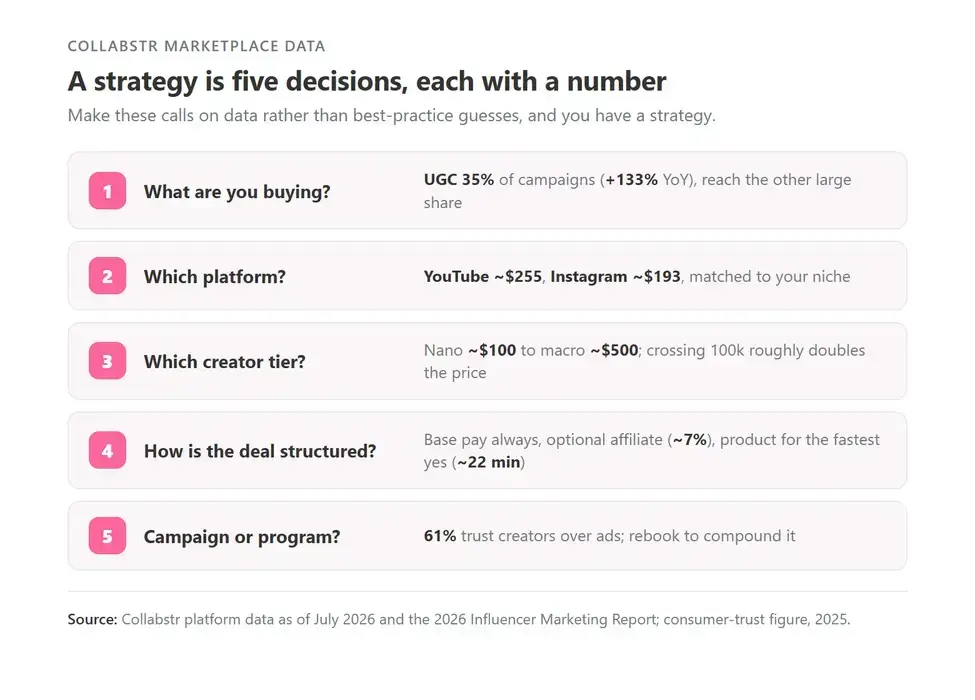
The five decisions, each with the number behind it. Collabstr marketplace data.
Decision One: What Are You Actually Buying?
Before you pick a creator, decide what you want out of the campaign, because influencer marketing is really three different products.
In our 2026 report, UGC made for ads is the fastest-growing campaign type, up 133% year over year and 35% of all campaigns. The classic sponsored post that lives on a creator's own feed, which is reach, is led by Instagram at 40% of campaigns. Local and in-person work is a smaller, growing slice. Those aren't three flavors of the same thing. They're three different goals. So answer this first. If you want advertising you own and can run as paid media, you're buying UGC, and the creator's follower count barely matters. If you want to borrow a trusted audience, you're buying reach, and the audience is everything. (see our influencer marketing examples guide)
Decision Two: Which Platform?
Platform is a budget decision as much as an audience one, and the rates are clear. In Collabstr's 2026 Influencer Marketing Report, the average brand pays $255 for a YouTube collaboration, $193 on Instagram, $186 on TikTok, and $154 for standalone UGC. YouTube sits in its own tier.
But the premium isn't universal, and this is where most platform decisions go wrong. YouTube commands its higher price in information-rich niches, where a creator explains or reviews, such as business, health, and travel. In visual-first niches like fashion, Instagram is actually the higher-priced and often better-fitting platform. Match the platform to how your category is consumed, not to a general reputation. (see our Instagram and YouTube guides)
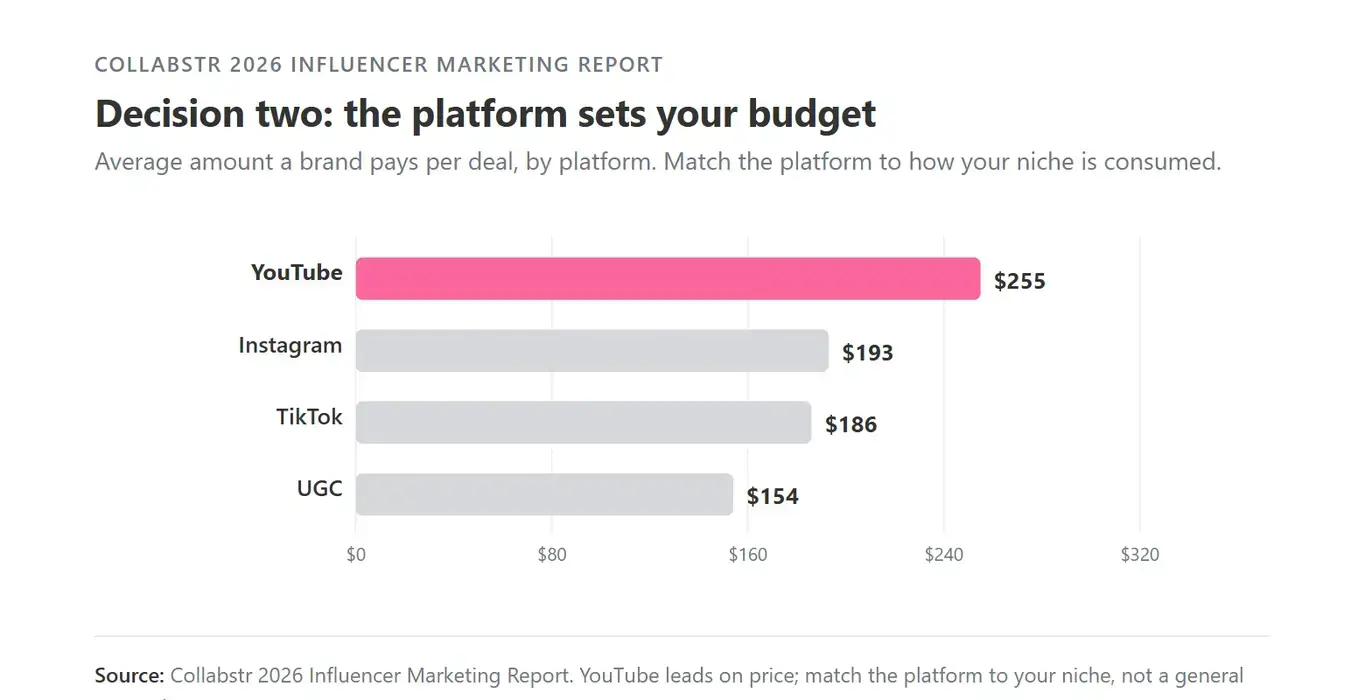
Average amount a brand pays per collaboration, by platform. Collabstr 2026 Influencer Marketing Report.
Decision Three: Which Creator Tier?
Tier is where budgets are won and lost. Creator price climbs steeply with audience size: nano creators are the most affordable, and each step up, micro to mid to macro, costs more. The jump from micro to mid, which is crossing 100,000 followers, doubles the price, and no other step moves the number as much.
That curve has a strategic consequence. The same budget buys very different campaigns, and the market shows most brands keep budgets small.
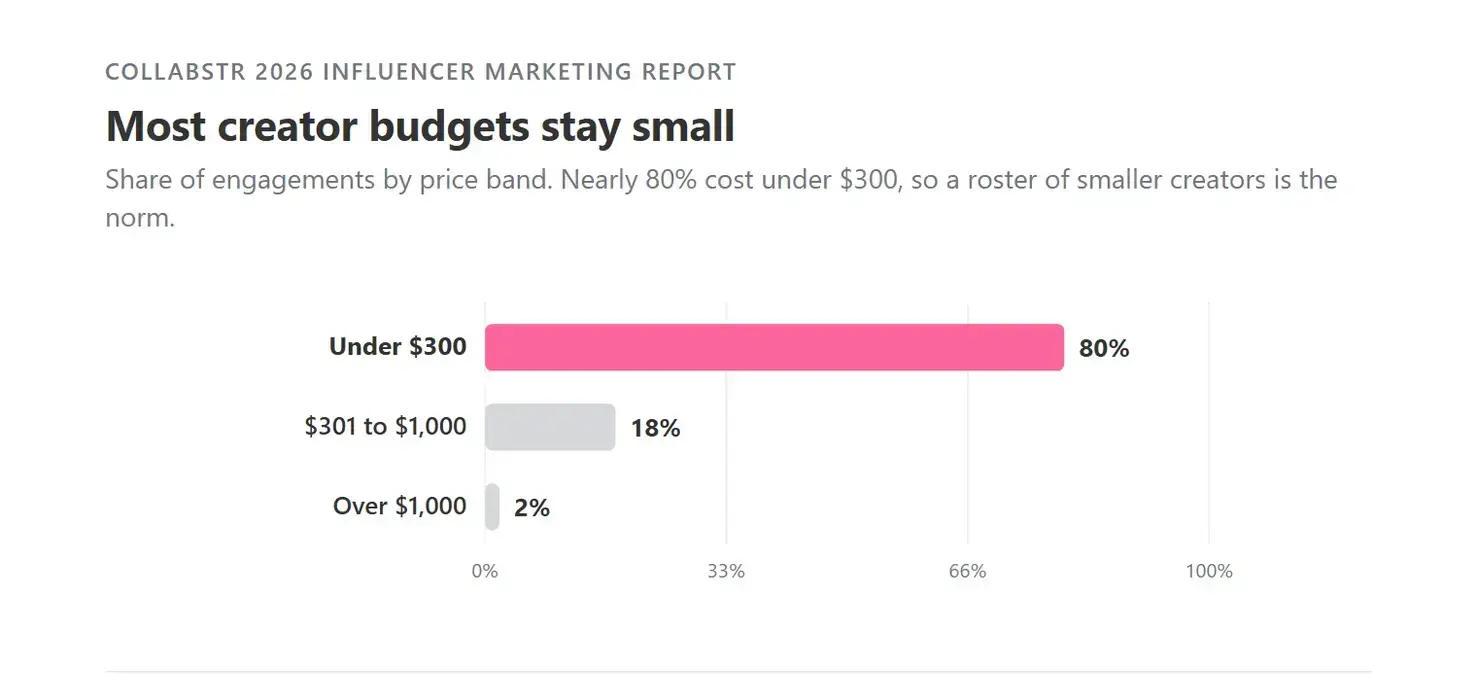
Share of engagements by price band. Nearly 80% cost under $300, so a roster of smaller creators is the norm. Collabstr 2026 Influencer Marketing Report.
Smaller creators aren't the compromise choice. They cost less and engage more, with verified engagement in the mid-single digits in the top niches, higher than most large accounts. Unless you specifically need the reach of a large account, weight your roster toward micro and nano and buy volume and engagement instead of a single expensive name. (see our Instagram influencer marketing guide)
Decision Four: How Do You Structure The Collaboration?
Once you know the platform and tier, decide how the collaboration is built. Three components, in order.
Base pay is the foundation, and in our data it isn't optional. A campaign can't run without it, because a post you don't pay for is a post you can't count on.
A performance component is the optional layer. Only 7% of campaigns add an affiliate or commission arrangement on top of base pay, which makes it both underused and a way to keep a creator invested past a single post. (see our influencer affiliate marketing guide)
Product is the accelerant. Shipping a creator your product, on top of paying them, produces the fastest response of any campaign type, a median of 22 minutes to the first application. Gifting works as a component of a paid campaign, not as a replacement for paying. (see our influencer gifting guide)
Decision Five: a Campaign or a Program?
This is the decision almost everyone gets wrong by never making it. Ongoing structures are rare: only 7% of campaigns are built to repeat with a performance component, and most brands run a campaign, collect the content, and start over next time from scratch. That is a strategic gift to anyone who does the opposite. A creator you hire again is already vetted, already trusted by their audience for your brand, and already fluent in your product. The second post lands on an audience that remembers the first, and the third reads as a genuine preference rather than an ad. Decide up front whether you're running a one-off campaign or building a program, and if the answer is a program, rebook your best performers on a cadence. (see our brand ambassador program guide)
How To Measure The Strategy
Measure on the numbers that hold up. Cost per thousand views, or CPM, is the reliable efficiency metric: use the projected CPM shown on a creator's profile to compare options before you hire, and your own achieved CPM to judge the campaign after. Verified engagement, read against the niche benchmark on creator profiles, tells you whether an audience is real and responsive. And the share of your spend going to creators you've hired before, tracked against your own baseline, tells you whether you're building a program or just buying content. When that share climbs, your strategy is compounding. Our guide to influencer marketing measurement sets out what to track before hiring, during delivery and after posting.
Purchase attribution is weak across the whole channel, so don't build the strategy on it. Anchor on CPM and engagement, and treat any sales tracking you can add as a bonus rather than the foundation.
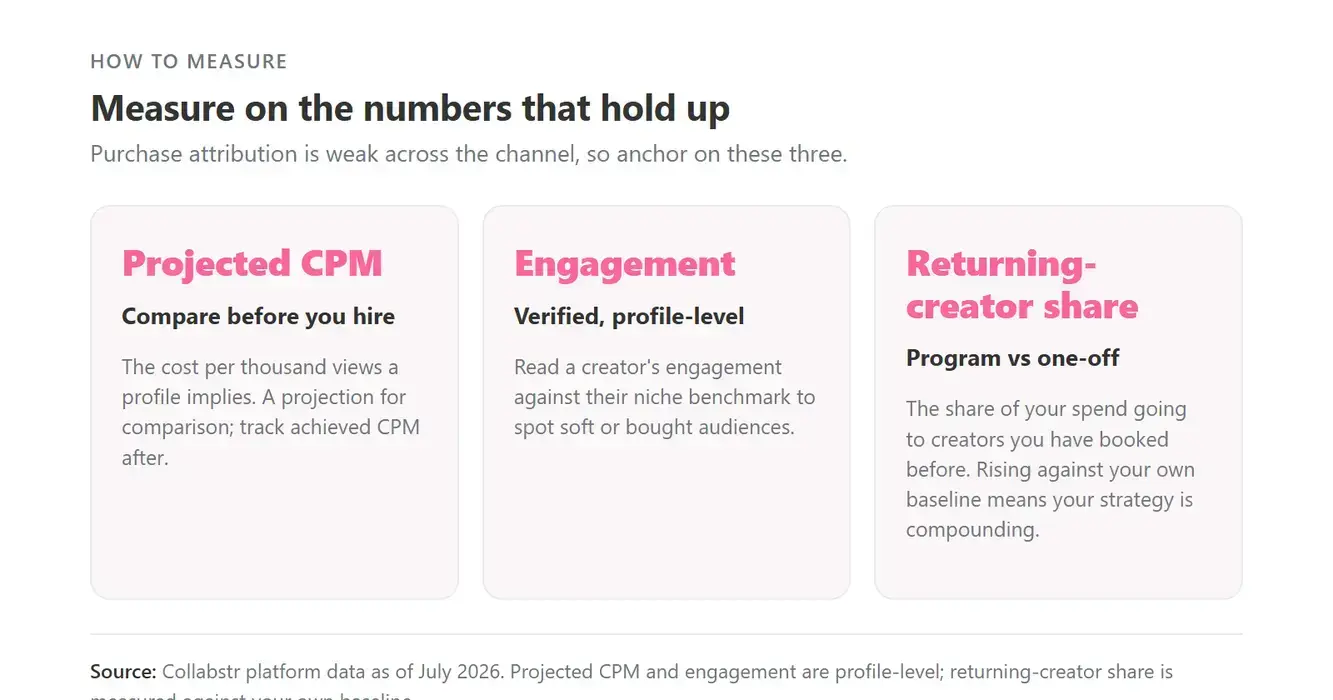
The three metrics that hold up: projected CPM, engagement, and returning-creator share. Collabstr.
Put Iit Together: a $2,000 Quarterly Strategy
Here's how the five decisions combine for a consumer product with a $2,000 quarterly budget and an awareness goal.
Buy reach and reusable content, so brief creators for posts you can also run as ads. Lead with Instagram at $193 a collaboration, and add a niche YouTube integration only if your category is information-rich. Weight the roster toward micro and nano creators for engagement and volume, with one mid creator for reach. Structure every collaboration with base pay, ship product to the nano creators to get the fastest turnaround, and add an affiliate code. Then, at the end of the quarter, rebook the two best performers to start a program instead of a campaign. That is a strategy, and every choice in it came from a number.
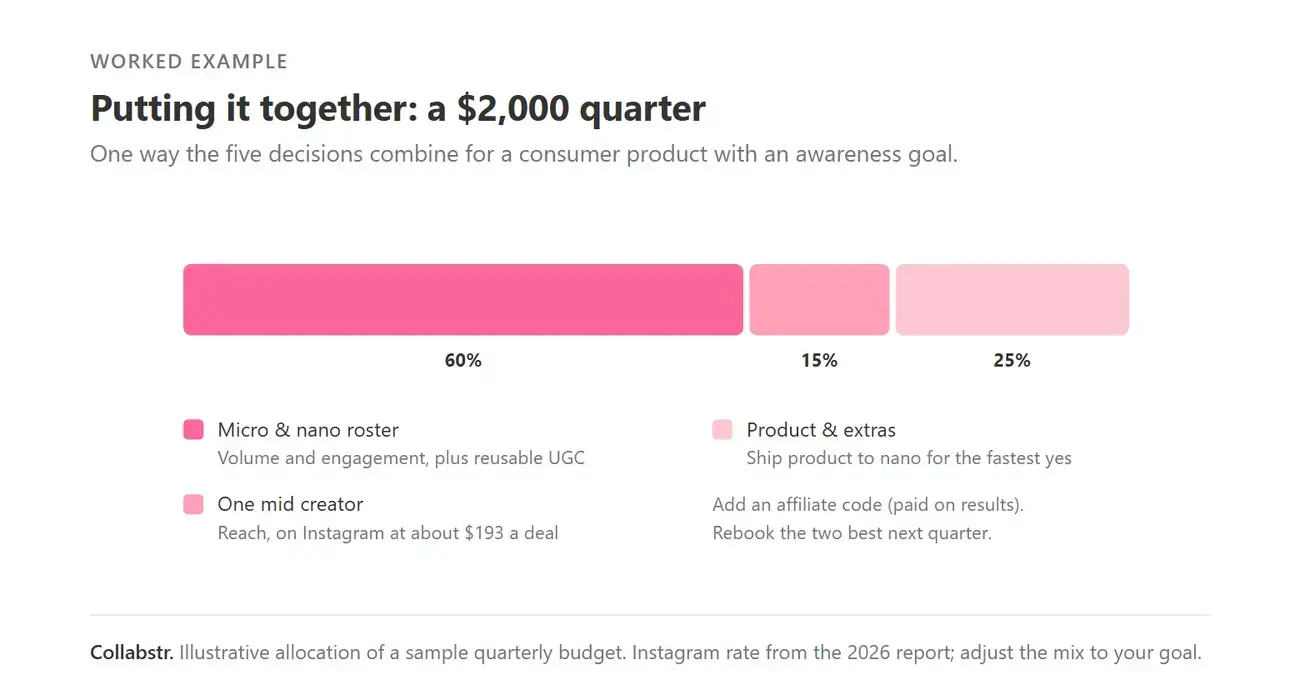
A $2,000 quarterly budget, allocated across the five decisions. Collabstr.
Frequently Asked Questions
What is an influencer marketing strategy?
It is the set of decisions behind a campaign: what you're buying, on which platform, with which creator tier, structured how, and whether it repeats. Each decision has a data-backed answer.
How do I choose the right platform?
Match it to your niche. YouTube costs more, at $255 a collaboration, and earns it in information-rich niches. Instagram, at $193, is competitive and often better for visual categories.
How big should my influencers be?
Usually smaller than you think. Micro and nano creators cost the least and engage more. Crossing 100,000 followers doubles the price.
How much should I budget for influencer marketing?
Size it on the tradeoff, not a fixed rate. The same budget buys many small creators or a few large ones, so the right number depends on whether you want volume or reach.
How do I measure influencer marketing?
Anchor on CPM and verified engagement against the niche benchmark, plus the share of spend going to creators you've booked before. Treat purchase attribution as a bonus, since it is weak across the channel.
Make The Decisions, And You Have a Strategy
An influencer marketing strategy isn't a checklist to copy. There are five decisions to make: what you're buying, which platform, which tier, how the collaboration is structured, and whether it repeats. Each one has a number behind it, and now you have them. With HypeAuditor projecting the global influencer market to reach $31 billion by 2027, the brands that decide on data rather than habit are the ones that will spend it well. The next step is to make the first decision and hire a creator.
Methodology: Platform rates are from Collabstr's 2026 Influencer Marketing Report; shares and medians are drawn from platform activity over the last 12 months as of July 2026. Tier figures are representative, not a single-niche guarantee. Verified engagement is platform-computed from live creator profiles. External projection: HypeAuditor.