Influencer Negotiation Starts With the Collaboration Request
- Key Takeaways
- Start With a Complete Collaboration Request
- Average Prices Move by Quarter, so Negotiate From Recent Prices
- What to Negotiate With Influencers Besides Price
- How to Negotiate With Influencers, Step by Step
- What the Report's Posted Prices and Payouts Show
- What This Means for Brands
- FAQ
- Methodology
If you are the brand answering a creator's quote, this guide covers what to put in the request, how prices move and what you can trade besides price.
Key Takeaways
• A complete collaboration request settles scope, timeline, usage, price and product up front, so a creator can say yes in one read.
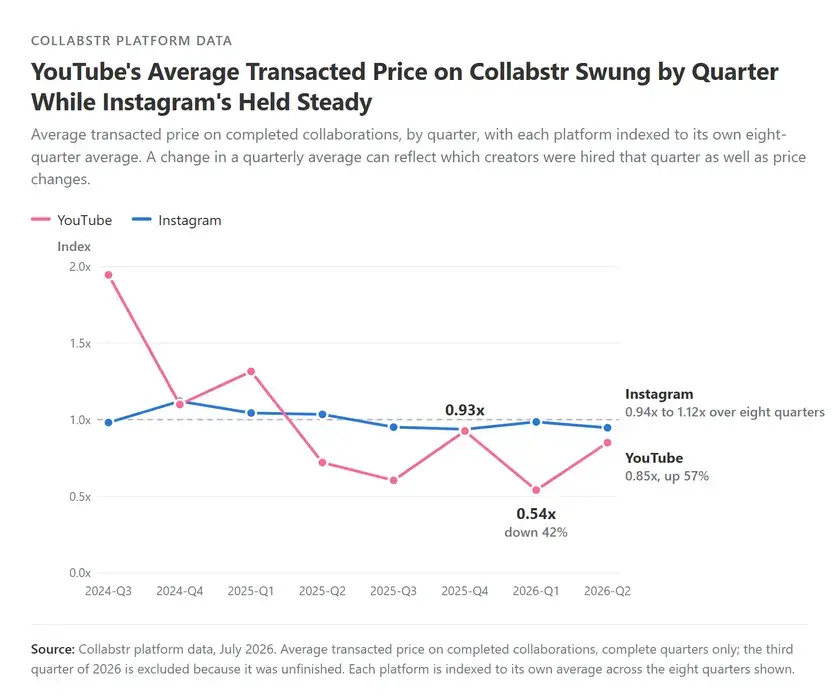
• Average prices move. YouTube's average price paid on completed collaborations fell 42% from the fourth quarter of 2025 to the first quarter of 2026, then rose 57% in the second quarter, while Instagram's highest quarter was no more than 20% above its lowest across eight quarters (Collabstr platform data, July 2026).
• When a quote is over budget, change the scope, such as fewer deliverables or narrower usage, instead of asking for the same work at a lower price.
Influencer negotiation starts with the collaboration request. Say a creator's package is two Reels and three Stories for $500, and your budget is $400. Instead of asking for the same package at a lower price, you ask for one Reel and three Stories at $400, with 30 days of organic use on the creator's account, and offer the second Reel next month at the package price. The creator gets a fair rate for less work, and you stay on budget.
That request is where the negotiation starts, before anyone discusses price.
Start With a Complete Collaboration Request
A creator decides whether to reply from what your request says. A request that answers their questions up front needs no round of follow-up messages before a yes.
What a Complete Collaboration Request Covers
A complete request answers every question a creator needs to say yes in one read. It covers five terms:
• Scope: the exact deliverables, formats, lengths and number of revision rounds.
• Timeline: draft date, posting date and how long you need to review.
• Usage: where the content will run, for how long, and whether it will run as paid ads.
• Price: one number tied to that scope.
• Product: what ships, when, and whether the creator keeps it.
The campaign brief template covers deliverables, timeline, payment and product details in one shareable brief. Add your usage terms so every term is settled.
Average Prices Move by Quarter, so Negotiate From Recent Prices
The average price paid on completed collaborations changes from quarter to quarter, so the most useful benchmark is a recent one. YouTube's average swung by more than 40% between back-to-back quarters, while Instagram's highest quarter was no more than 20% above its lowest (Collabstr platform data, July 2026). A price from last year, or a per-follower rule of thumb, can sit far from today's market.
How Much YouTube's Average Price Moved
YouTube's average price fell 42% from the fourth quarter of 2025 to the first quarter of 2026, then rose 57% in the second quarter (Collabstr platform data, July 2026). The rise started from a lower base, so the second-quarter average stayed below the fourth quarter of 2025.
How Steady Instagram Prices Were
Instagram's highest quarter was no more than 20% above its lowest across the eight complete quarters from the third quarter of 2024 to the second quarter of 2026 (Collabstr platform data, July 2026). On Instagram, a quote near recent prices is normal, so spend your negotiating time on the scope.
The chart shows each quarter as a multiple of that platform's own eight-quarter average. For example, 1.95x means that quarter's YouTube average was 1.95 times YouTube's eight-quarter average.
Check Rates for the Creator's Size
Pay also changes with follower count. Before you set a budget, check average creator rates for the platform, category and follower range in the price calculator. The influencer pricing guide has fuller benchmarks.
What to Negotiate With Influencers Besides Price
Besides price, a brand can negotiate deliverables, revisions, usage rights, whitelisting, exclusivity, timeline, bundles, product value and performance bonuses. Each one changes what the collaboration is worth to both sides.
Deliverables, Revisions and Usage
Deliverables and revisions set the work itself. Agree the number of assets, formats and revision rounds up front. A second cut of the same shoot, such as a shorter vertical edit, adds an asset without a second shoot.
Usage rights set where the content runs. A post on the creator's own account is a smaller purchase than running the content in your ads for a year, so name the channels and the duration. Our guide to content usage rights covers the options.
Whitelisting means running ads through the creator's handle. Agree it separately, with its duration and what spend and results the creator will see. The whitelisting guide explains how it works.
Exclusivity, Timeline and Bundles
Exclusivity limits who else the creator can work with, so ask only for what you need: a named set of competitors for a defined window.
Timeline can be traded too, since a flexible posting date is easier for a creator to fit in. Bundles of several deliverables, or a series over a few months, give the creator predictable work.
Product Value and Performance Bonuses
Product value belongs in the request whenever a product ships. State its retail value so the creator can weigh it alongside the fee.
Performance bonuses sit on top of base pay, the fixed fee every campaign on Collabstr includes. Tie a bonus to a metric both sides can see. More on structuring it in influencer affiliate marketing.
How to Negotiate With Influencers, Step by Step
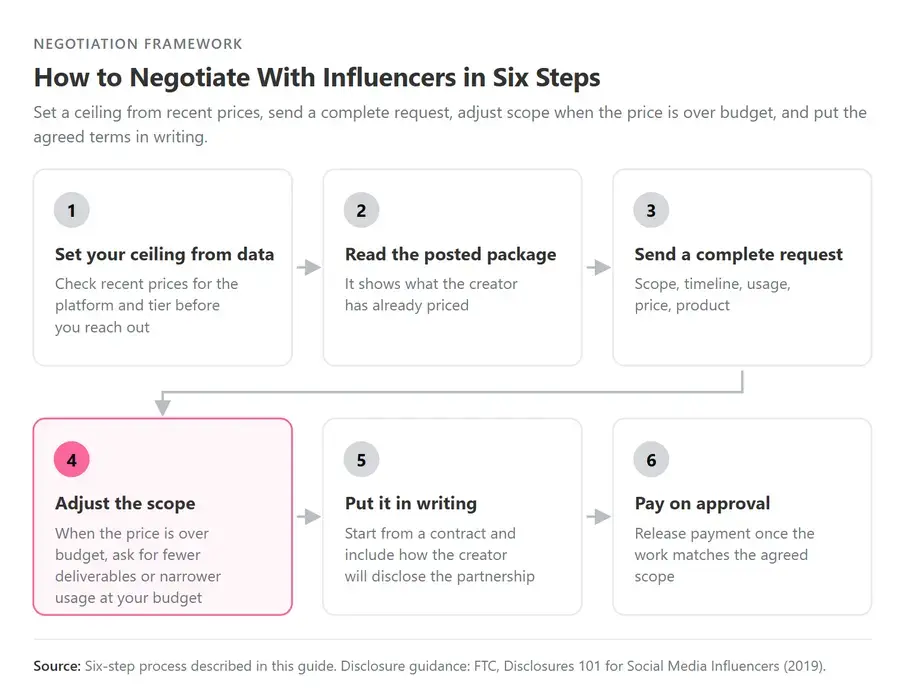
To negotiate with an influencer, set the most you will pay from recent prices, send a complete request, adjust scope when the price is over budget, and put the agreed terms in writing.
1. Set the most you will pay. Check recent prices for the platform and the creator's follower range before you reach out. Our guide on how much to pay influencers walks through it.
2. Read the creator's packages. The fixed-price packages on a creator's profile show what they have already priced.
3. Send a complete request. Scope, timeline, usage, price, product.
4. Adjust the scope when the price is over budget. Ask for fewer deliverables or narrower usage at your budget.
5. Put it in writing. Start from the contract template and include how the creator will disclose the partnership, following the Federal Trade Commission (FTC) guide Disclosures 101 for Social Media Influencers (FTC, 2019).
6. Pay on approval. Release payment once the work matches the agreed scope.
A Counter-Offer You Can Adapt
Here is the counter-offer from the introduction as a message you can adapt:
Hi [name], thanks for sending your rate. We'd love to work with you on this. Our budget for this collaboration is $[amount].
At that budget, could we do one Reel and three Stories with organic usage only for 30 days? If a second Reel matters to you, we could add it next month at your package rate. Happy to adjust the timeline if that helps.
Red Flags That the Terms Are Still Open
Terms are still open when price, usage or payment timing has no specifics attached. Watch for these before you sign:
• A price with no deliverables attached.
• Usage rights or exclusivity with no channels, competitors or end date named.
• The full fee due before you have seen any work.
• No plan for disclosing the partnership.
What the Report's Posted Prices and Payouts Show
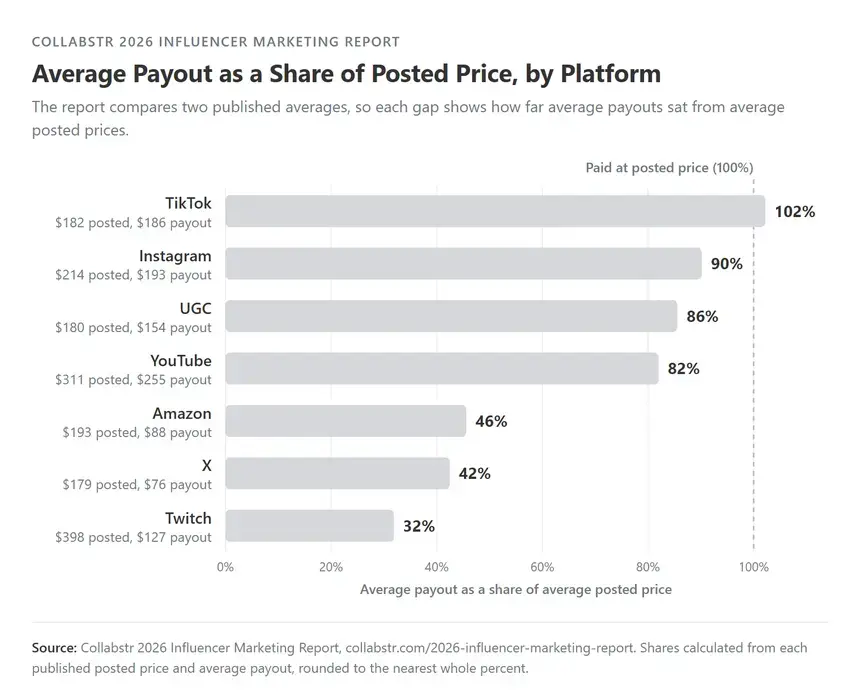
Collabstr's 2026 Influencer Marketing Report compares the average price creators post on their packages with the average payout, which the report defines as the final negotiated cost to the brand, by platform (Collabstr, 2026). TikTok payouts averaged $186 against a posted $182, Instagram $193 against $214, and Twitch $127 against $398. In the report's words, the gap "hints that brands are actively negotiating."
|
Platform |
Posted price |
Average payout |
Payout as share of posted price |
|---|---|---|---|
|
TikTok |
$182 |
$186 |
102% |
|
|
$214 |
$193 |
90% |
|
UGC |
$180 |
$154 |
86% |
|
YouTube |
$311 |
$255 |
82% |
|
Amazon |
$193 |
$88 |
46% |
|
X |
$179 |
$76 |
42% |
|
Twitch |
$398 |
$127 |
32% |
Source: Collabstr 2026 Influencer Marketing Report. Shares calculated from the published figures.
Where the Gaps Are Widest
The widest gaps are on Twitch, X and Amazon, where payouts averaged 32% to 46% of posted prices (Collabstr, 2026). These platforms carry a small share of campaigns. X was 1% of campaigns in 2025, and Twitch and Amazon do not appear in the report's platform mix.
The platforms where most campaigns run sit closer to posted prices. Instagram (40% of campaigns in 2025), UGC (35%) and TikTok (21%) all paid out at more than 85% of the posted price. On those platforms, expect to pay close to the posted price and negotiate on scope.
How to Read the Comparison
Each gap is the report's comparison of two published averages. It shows how far payouts sat from posted prices, and the report does not break down the reasons.
The report notes that custom engagements and negotiations can change final payouts, which may help explain why TikTok payouts sit above posted prices. Twitch, X and Amazon have fewer collaborations, so their averages swing more. Read them as a pattern, and expect their exact positions to shift.
What This Means for Brands
For brands, influencer negotiation starts before a price is discussed. Send a complete request, compare quotes with recent prices for the platform and the creator's size, and trade on scope, usage, exclusivity and timing when the number is over budget.
Collabstr keeps those terms visible. You see a creator's price before you hire, so the conversation starts from a number the creator set, and payment is released when you approve the work.
FAQ
Can You Negotiate With Influencers?
Yes. On Collabstr's Pro and Premium plans you can chat with creators who apply to your campaign and agree deliverables, timelines and usage rights before any payment changes hands. You can trade scope, usage, exclusivity and timeline alongside price.
How Do You Ask an Influencer to Lower Their Rate?
Change the scope to fit your budget. State your budget, propose fewer deliverables or narrower usage at that number, and offer to add the rest later at the creator's package rate. A clear request tied to clear scope is easier for a creator to accept.
How Much Should You Offer an Influencer?
Start from recent prices paid on the platform, and check average creator rates for the creator's follower range in Collabstr's price calculator. Average prices shift by quarter, so base your offer on the most recent quarter.
What Should a Collaboration Request Include?
Five terms: the exact deliverables and revision rounds, the draft and posting dates, where and for how long the content will run, one price tied to that scope, and the product you will send. Covering all five lets a creator accept in one read.
Do Influencer Payouts Match Posted Prices?
It varies by platform. In Collabstr's 2026 Influencer Marketing Report, average payouts were 102% of posted prices on TikTok, 90% on Instagram and 32% on Twitch. Read each gap as the report's comparison of two averages.
Methodology
• Prices by quarter. Collabstr platform data, average price paid on completed collaborations, by platform and calendar quarter. Only complete quarters are shown; the third quarter of 2026 was partial when the data was generated on July 23, 2026 and is excluded. Each quarter is shown as a multiple of that platform's average across the eight quarters.
• Posted price vs average payout. From Collabstr's 2026 Influencer Marketing Report. Posted price is the price a creator lists on a package. The report describes payout as "the final negotiated cost to the brand". Payout as a share of posted price is calculated from each published pair and rounded to the nearest whole percent.
• Campaign mix. Same report, share of campaigns by platform in 2025.