Performance-Based Influencer Marketing: Base Pay Plus Upside
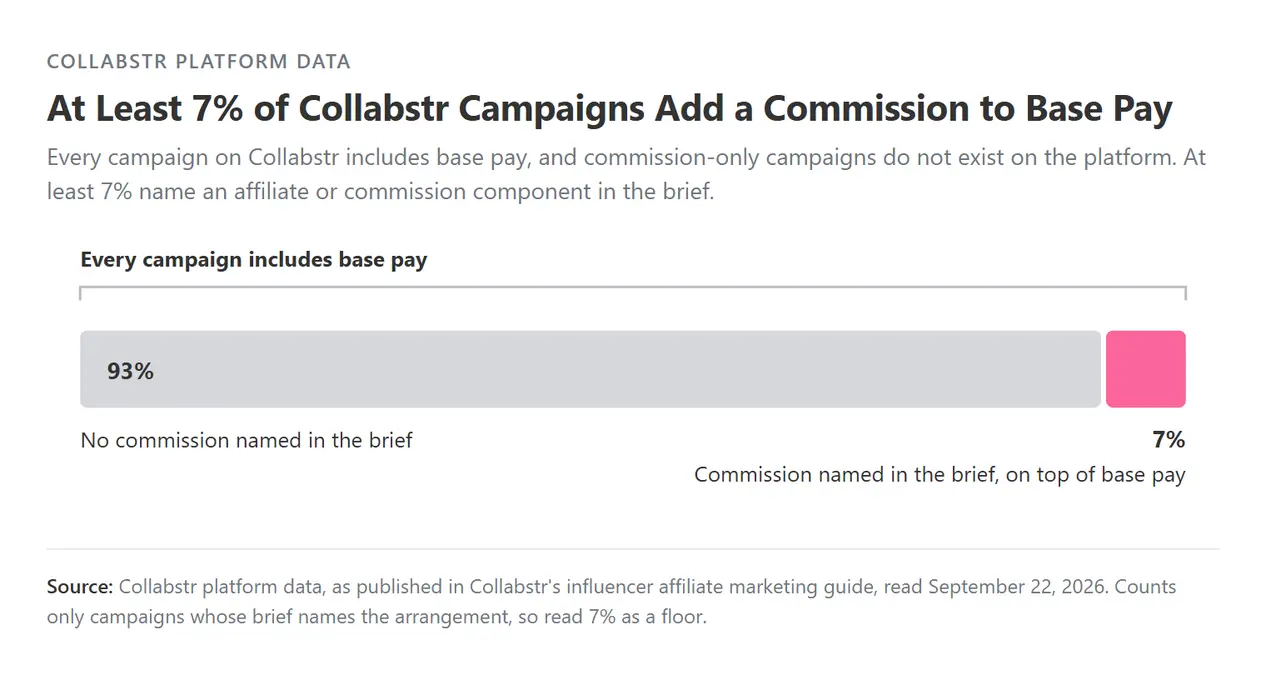
Performance-based influencer marketing ties some or all of a creator's pay to results, such as sales, views or ad performance, instead of paying one flat fee per post. In Collabstr's data, every campaign includes base pay, and 7% of the campaigns Collabstr can see name a commission component in their brief, so the true share is at least 7% (Collabstr, 2026). This guide covers the three ways to pay for performance and how to add them to base pay so creators say yes.
Key Takeaways
• There are three common performance structures: affiliate commission on sales, CPM deals that pay per 1,000 views, and whitelisting, where you run ads through the creator's handle.
• Commission-only offers ask creators to work for pay that may never arrive, which makes them easy to decline, especially from a brand the creator does not know.
• Every campaign on Collabstr includes base pay, and at least 7% add a commission on top (Collabstr, 2026). Base pay covers the content, and the performance layer rewards the extra effort.
• Rebook the creators whose content performs, and tell them up front how the incentive grows on the next booking.
[VIDEO EMBED: The Influencer Marketing Strategy Every Brand Will Be Using in 2027 | youtube.com/watch?v=8RyR007lAO0 | 3:38]
What Is Performance-Based Influencer Marketing?
Performance-based influencer marketing is a way of paying creators in which part or all of the fee depends on a measurable result. The result can be a sale through a tracked link or code, a number of views, or the performance of an ad built from the creator's content. The brand pays more when the content works and less when it does not.
It sits beside the flat fee, a set price per post. A flat fee buys a set deliverable at a set price, whatever it goes on to do. A performance deal adds a second price, tied to what the content achieves. Our guide to influencer marketing strategy covers where this decision fits in a full plan.
Why Add Performance Pay to a Flat Fee
A flat fee costs the same whatever the post does. Say you agree to $500 for a video, a hypothetical figure: you pay $500 whether 100 people see it or a million. Hire five creators on the same brief and their results can differ by a wide margin, so the same fee buys very different value from each one.
Performance pay closes that gap. Part of what the creator earns depends on what the content actually does, so the ones who deliver more are paid more.
Every Collabstr campaign starts with base pay, and most collaborations are small. Nearly 80% of collaborations on Collabstr cost under $300 in 2025 (Collabstr, 2026). At that size, paying for results is a way to reward the creators who deliver more, while keeping each booking's cost low.
The price a creator lists is also where the conversation starts. In the same report, Instagram creators' average posted price was $214 against an average cost of $193, while TikTok creators' average posted price was $182 against an average cost of $186 (Collabstr, 2026). Pay tied to results gives both sides something to agree on beyond that fixed price.
Three Ways to Pay for Performance
The three common structures are affiliate commission, CPM deals and whitelisting. Each pays for a different result, and each suits a different goal.
Affiliate Commission
With affiliate commission, the creator earns a commission, usually a percentage, on each sale tracked to their link or discount code. No sales means no commission. It suits products people buy online in one visit, where the link or code can show which creator drove the sale.
Say a creator is paid $200 for a video, with 10% commission on a $40 product, both hypothetical: they earn $4 on every sale on top of the base. Our guide to influencer affiliate marketing covers commission rates and tracking.
CPM Deals
A CPM deal pays the creator a set rate for every 1,000 views, or impressions if that is what you agree, so the fee grows with the size of the audience. At a hypothetical $10 per 1,000, a video seen 100,000 times earns the creator $1,000, and one that reaches a million earns $10,000. You know what each thousand people cost before the campaign starts.
These deals suit awareness campaigns, where reach is the goal. Agree in advance which number you are counting, over what window, and a cap if your budget needs one.
Whitelisting and Partnership Ads
Whitelisting means the creator gives you permission to run paid ads through their handle, using their content. The ad shows the creator's name, with their face and credibility, while your brand pays for and manages the ad. Meta calls these partnership ads (Meta for Developers, 2026), and TikTok calls its version Spark Ads, built from creators' organic posts with their authorization (TikTok, 2026). Agree in writing how long you can run the content and what you pay for that usage.
It suits brands that already run paid social and want creator content to carry their ad spend. Our guide to influencer whitelisting covers setup and usage terms.

Why Performance-Only Offers Get Passed Over
Commission-only offers are easy to turn down because they ask a creator to do the work now for pay that may never arrive. For a brand everyone knows, the creator can estimate the sales and decide the deal is worth it. For a brand the creator has never heard of, the likely commission is a guess, and many creators will not work for a guess.
A creator who declines does not always say why, so a brand sending commission-only offers can get few replies and no way to tell whether the product, the rate or the structure was the problem.
On Collabstr, every campaign includes base pay, so commission-only campaigns do not exist on the platform (Collabstr, 2026). Every deal is a paid deal, starting at a $50 minimum (Collabstr, 2026), so the base can be small without being nothing. Campaigns with a commission component do not see slower applications either. They get their first creator application in a median of 28 minutes, against 31 minutes across all campaigns (Collabstr, 2026).
How to Structure Base Pay Plus Upside
Structure a performance deal as base pay for the content, plus upside for results. Base pay gets the creator to take the job and covers the work of making the content. The upside rewards the creators whose content lands.
Follow these steps to set it up:
1. Set base pay at the creator's listed price or close to it, so the offer reads as a paid job.
2. Pick one performance measure that matches your goal: sales for commission, views for CPM, or ad results for whitelisting.
3. Write the terms into the offer: the rate, how results are tracked, the time window and when the bonus is paid.
4. Give the creator what they need to earn it: a unique link or code, a clear hook and permission to test.
5. Pay the bonus on schedule, since a late bonus can cost you the next booking.
In Collabstr's data, 7% of the campaigns Collabstr can see name a commission layer in their brief (Collabstr, 2026), so the structure is still uncommon, and a clear commission offer can give a creator one more reason to pick your campaign.
Rebook the Creators Who Land
Rebooking the creators whose content worked is an easy step to skip. A one-off booking buys one round of learning: the creator makes the content, gets paid and moves on.
Tell a creator at booking that the next round comes with a larger performance share, and the incentive changes. A returning creator knows your product better, can test new hooks against what worked last time, and has a reason to put in the extra effort. Our influencer marketing strategy guide covers how to turn one-off campaigns into a program.

How Ad Platforms Change the Math
Meta says its Advantage+ campaigns automate budget allocation, audience targeting and bid adjustments, and in December 2024 Meta described Andromeda, a personalized ads retrieval engine that narrows tens of millions of candidate ads to a few thousand relevant candidates for each person (Meta, 2024).
In our view, when the system handles targeting, more of a brand's advantage moves onto the content itself, because your creative is the main lever you still set yourself. Creator content can give an ad account more variations to test, and whitelisting runs that content through a real person's handle. For more on current shifts, see our overview of influencer marketing trends.
FAQ
What Is Performance-Based Influencer Marketing?
Performance-based influencer marketing pays creators partly or fully on results, such as sales, views or ad performance, instead of one flat fee per post. The three common structures are affiliate commission, CPM deals and whitelisting. On Collabstr, every campaign includes base pay, and at least 7% add a commission on top (Collabstr, 2026).
Is Commission-Only Influencer Marketing a Good Idea?
Commission-only offers work best for brands creators already know, because the creator can estimate what they will earn. For lesser-known brands, the likely commission is hard to estimate, which makes the offer easy to decline. Base pay plus a commission layer gives the creator a reason to say yes and a reason to promote harder.
How Do CPM Deals With Influencers Work?
A CPM deal pays the creator a set rate per 1,000 views, or per 1,000 impressions if the deal says so. At an illustrative $10 CPM, 100,000 views pays $1,000. Agree on the view source, the time window and any cap before the content goes live.
What Is Influencer Whitelisting?
Influencer whitelisting lets a brand run paid ads through a creator's handle, using the creator's content. The ad shows the creator's name while the brand pays for and manages the ad. Agree the usage period and its fee up front.
How Much Base Pay Should You Offer?
Start at or near the creator's listed price, so the offer reads as a paid job. Nearly 80% of collaborations on Collabstr cost under $300 in 2025 (Collabstr, 2026), so most collaborations start from a modest fixed cost, with the performance layer on top.
Methodology
• Base pay rule, commission share (7%) and time to first application (28 and 31 minutes): Collabstr platform data as published in Collabstr's influencer affiliate marketing guide, read September 22, 2026. Commission share is the share of the campaigns Collabstr can see whose brief names an affiliate or commission arrangement. Campaigns that agree a commission outside the brief are not counted, so 7% is a floor. Time to first application is the median time to a campaign's first creator application.
• Spend per collaboration and posted price vs cost by platform: Collabstr 2026 Influencer Marketing Report, based on 2025 marketplace data, read September 22, 2026. Posted price is the report's average rate by platform, which the report describes as the creator's own valuation. Cost is the report's average influencer cost by platform.
• Worked examples ($500 flat fee, $10 CPM, $200 base plus 10% commission): illustrative figures chosen to show the arithmetic.
• Meta Advantage+ and Andromeda: Engineering at Meta, December 2, 2024. Meta does not link automated targeting to creative; that link is Collabstr's reading.
• Partnership ads: Meta for Developers, Partnership Ads documentation, read September 22, 2026.