Influencer Vetting Means Checking That a Creator Is Real and Will Deliver
- Key Takeaways
- What Is Influencer Vetting?
- Is the Creator Real? Checking Authenticity
- Is the Creator a Fit for Your Brand?
- Will the Creator Deliver? Checking Reliability
- Questions to Ask a Creator Before You Book
- An Influencer Vetting Checklist
- What to Do When a Creator Fails a Check
- When to Run Each Check, and When to Re-Vet
- What This Means for Brands
- FAQ
- Methodology
Say a skincare brand books three creators for a March 1 launch. All three have real followers. One never answers the brief, one backs out a week later, and only one films on time. The brand checked that each creator was real, and skipped the check that mattered most for a launch date: whether they would deliver.
This guide is for brands about to hire a creator. It covers how to check that a creator is real, that they suit your brand and that they will deliver, with a checklist you can use before every booking.
Key Takeaways
• Vet three things before you book: that the creator's followers are real, that their audience matches your buyers, and that they reply and deliver on time.
• Fake engagement is common enough that platforms block it in the billions. TikTok says it prevented over 36 billion fake likes in the first half of 2024, and buying fake followers breaks Meta's and TikTok's rules and, since October 2024, can break US law.
• Use the signals a platform gives you, such as reviews and ratings from other brands, and pay in a way that holds the money until you approve the work.
What Is Influencer Vetting?
Influencer vetting is checking a creator before you pay them. Authenticity checks look at followers and engagement, fit checks look at the audience and past content, and reliability checks look at how the creator responds and what they have delivered before.
Is the Creator Real? Checking Authenticity
A real creator's follower count grows steadily, and their followers like and comment on posts. Fake followers and bought engagement break platform rules: Meta's spam policy prohibits "selling, buying, or exchanging for engagement, such as likes, shares, views, follows, clicks, use of specific hashtags, etc." (Meta, 2026).
Platforms block fake engagement at scale. TikTok says it does not allow fake engagement, "such as facilitating the trade or marketing of services that artificially increase engagement", and reported that it "prevented over 36 billion fake likes" in the first half of 2024 (TikTok, 2024). TikTok also says it removed more than 379 million fake likes that got through, so check every creator yourself.
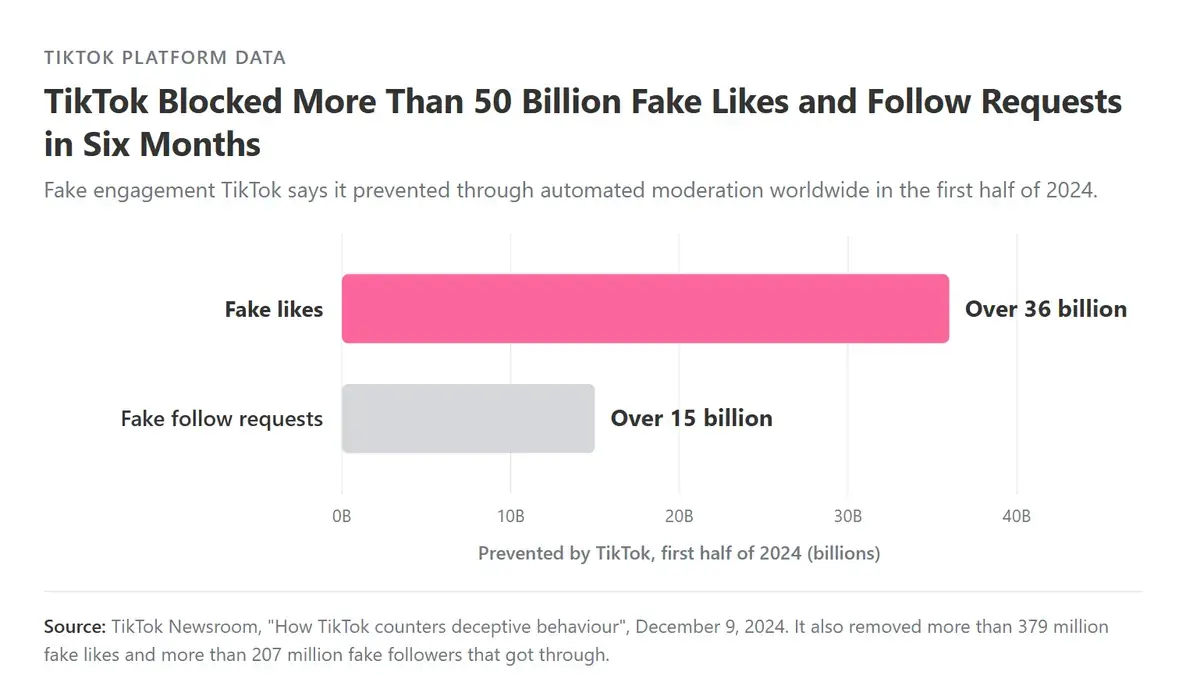
Those figures are for one platform over six months. Fake likes and followers already run into the billions, so a creator's numbers alone do not prove a real audience. Test whether that audience behaves like real people.
Follower Growth and Sudden Spikes
Look at how the follower count grew. Steady growth with occasional jumps after a popular post is normal. A large overnight jump with no post to explain it is a warning sign.
Engagement Rate
Engagement rate measures how much viewers interact with posts, such as likes and comments, compared with the number of followers. A rate far below that of similar creators can point to inactive or fake followers. Collabstr's Instagram engagement rate calculator and TikTok engagement rate calculator work out the rate from a handle.
Comment Quality
Read the comments on recent posts. Real comments respond to the content. Repeated emojis, generic praise from accounts with no posts, and the same phrases across many comments point to bots.
Use a Fake Follower Checker
A checker estimates how much of an audience looks suspicious, meaning accounts with irregular behavior or metrics. Run the creator through Collabstr's Instagram fake follower checker or TikTok fake follower checker, and treat the result as one signal among several.
A creator who buys fake followers to win paid work can also break US law. Since October 2024, the Federal Trade Commission's (FTC) rule on fake reviews and testimonials bans buying or selling fake indicators of social media influence, such as "followers or views generated by a bot or hijacked account", when the buyer knew or should have known they were fake and uses them to misrepresent their influence for a commercial purpose (FTC, 2024). Our guide to the FTC influencer guidelines covers the rule.
Is the Creator a Fit for Your Brand?
A good fit means the creator's audience looks like your buyers and their content sits well next to your brand. Three checks cover it.
Audience Location, Age and Gender
Ask for a screenshot of the creator's audience insights. Check that the countries, cities and age ranges match your buyers, since an audience outside your market is unlikely to buy.
Content History and Brand Safety
Scroll back through several months of posts. Check the tone, the topics and how the creator handles sponsored content, including whether they disclose it. Look for anything your brand would not want to sit beside.
Past Brand Deals and Exclusivity
Note which brands the creator has worked with recently, especially direct competitors. If you need exclusivity for a period, agree it in the contract. Our influencer contract template is a starting point.

Will the Creator Deliver? Checking Reliability
Reliability checks catch the creators who never reply or back out, which matters most when a campaign has a fixed date. Look at how the creator responds and what other brands say about their work.
• Response time: note how quickly and clearly the creator answers the pre-booking questions below. That reply previews how they will communicate once you book.
• Reviews: check reviews from other brands. On Collabstr, creator profiles show reviews from brands, with ratings for communication, timeliness and satisfaction.
• A clear quote: agree the content, the price and the posting date in writing before you book. On Collabstr, prices are shown before you hire.
• A deadline: set a delivery date on every booking, so both sides work to the same timeline.
• A backup: for anything tied to a launch date, book more than one creator.
Collabstr does some of this for you. The team manually reviews creators for engagement quality, content standards and past brand experience before they appear in search results (Collabstr), and your own checks build on that. Payment terms protect you if delivery falls short: Collabstr holds the payment and releases it to the creator when you approve the work (Collabstr).
Questions to Ask a Creator Before You Book
A short message before you book tests reliability and fills gaps the profile cannot. Ask these, and note how quickly and how fully the creator answers:
1. Are you free on these dates? Name the draft date and the posting date.
2. Have you made this kind of content before? Ask for links to two or three examples in your format.
3. Can you share your audience insights? A screenshot of location, age range and gender split.
4. Are you working with any competitors right now? Name the brands you would not want beside yours.
5. What is included in your price? Ask how many rounds of changes, and whether reuse in ads costs extra.
6. How do you disclose paid posts? Their answer shows whether they know the FTC's expectations.
A creator who answers all six clearly and on time has passed the response-time check.
An Influencer Vetting Checklist
Use this checklist before every booking.
|
Check |
Where to look |
Red flag |
|---|---|---|
|
Follower growth |
Follower history over several months |
A large jump with no post to explain it |
|
Engagement rate |
An engagement rate calculator |
Far below similar creators |
|
Comment quality |
Recent posts |
Generic praise, repeated emojis, empty accounts |
|
Fake followers |
A fake follower checker |
A high share of suspicious followers |
|
Audience location and age |
The creator's audience insights screenshot |
A different market from your buyers |
|
Content history |
Several months of posts |
Topics or tone your brand cannot sit beside |
|
Disclosure habits |
Past sponsored posts |
Paid posts with no clear label |
|
Competitor deals |
Recent sponsored posts |
A current deal with a direct competitor |
|
Response time |
Messages before booking |
Slow or unclear replies |
|
Track record |
Reviews from other brands |
Low ratings for communication or timeliness |
What to Do When a Creator Fails a Check
Ask about one failed check before you rule a creator out. A follower spike may have a viral post behind it, and a lower engagement rate is common on larger accounts.
Walk away when the answer does not explain the gap, when two or more checks fail together, or when a creator will not share audience insights. Do not book on a promise to fix it later, and keep a short note of why, so your team does not rebook the same creator next season.
When to Run Each Check, and When to Re-Vet
Run the basic check on every creator you consider: the two calculators, a look at recent comments and a message. Save the full check, with audience insights and several months of posts, for your shortlist.
Re-vet before each new campaign. Audiences change, creators take on new deals, and a creator who delivered last season may be busier now.
What This Means for Brands
Check that a creator is real, that their audience matches your buyers and that they reply and deliver, and book a backup for anything with a fixed date. Combine those checks with a clear brief, a set deadline and payment held until you approve the work, so problems show up before the content goes live. For how vetting fits a wider program, see our guide to creator marketing.
FAQ
How Do You Vet an Influencer?
Run three checks. Confirm the followers are real with an engagement rate calculator, a fake follower checker and a look at recent comments. Confirm fit with audience insights and content history. Confirm reliability with response time and reviews from other brands.
How Can You Tell If an Influencer Has Fake Followers?
Look for sudden follower jumps with no post to explain them, an engagement rate far below similar creators, and comments that are generic or repeated. A fake follower checker estimates the share of suspicious followers, to combine with those signs.
What Is a Good Engagement Rate When Vetting?
Run five creators of a similar size on the same platform through an engagement rate calculator, and question any creator whose rate is well below the rest. Comparing like with like matters more than any single number.
Is Buying Fake Followers Illegal?
In the US, the FTC's 2024 rule bans buying or selling fake indicators of social media influence in the circumstances set out above (FTC, 2024). It also breaks Meta's rules, and TikTok prohibits fake engagement. This is general information, not legal advice.
Methodology
• Platform and FTC sources: Meta Community Standards, Spam; TikTok newsroom, "How TikTok counters deceptive behaviour", December 9, 2024; FTC press release on the final rule banning fake reviews and testimonials, August 14, 2024.
• Collabstr product details: Collabstr's find-and-hire and approve-and-pay pages, creator profiles and search results, read on October 14, 2026.
• Worked example: the skincare brand and its three creators are hypothetical.