Every Paid Collaboration Needs a Disclosure: The FTC Influencer Guidelines for Brands
- Key Takeaways
- What Are the FTC Influencer Guidelines?
- Who Is Responsible for Disclosure, the Brand or the Creator?
- Every Paid Collaboration Needs a Label: What Collabstr's Data Shows
- What Counts as a Disclosure Under the FTC Guidelines?
- Disclosure by Collaboration Type
- Are Platform Labels Enough for FTC Compliance?
- What Changed in 2023 and 2024
- A Disclosure Workflow for Every Collaboration
- What This Means for Brands
- FAQ
- Methodology
Say a skincare brand pays a creator $400 for a TikTok video and adds a 10% discount code. The creator posts the video with #ad buried among 20 hashtags at the end of the caption, and says nothing about the code. That post is likely to fall short of the Federal Trade Commission's (FTC) guidance twice, and the brand shares responsibility for both.
This guide is for brands and marketers who hire creators in the US: what the FTC expects from you, and a disclosure check to build into every collaboration.
Key Takeaways
• Brands share responsibility with the creators they pay for disclosing that a post is paid, so you need a way to brief and check every post.
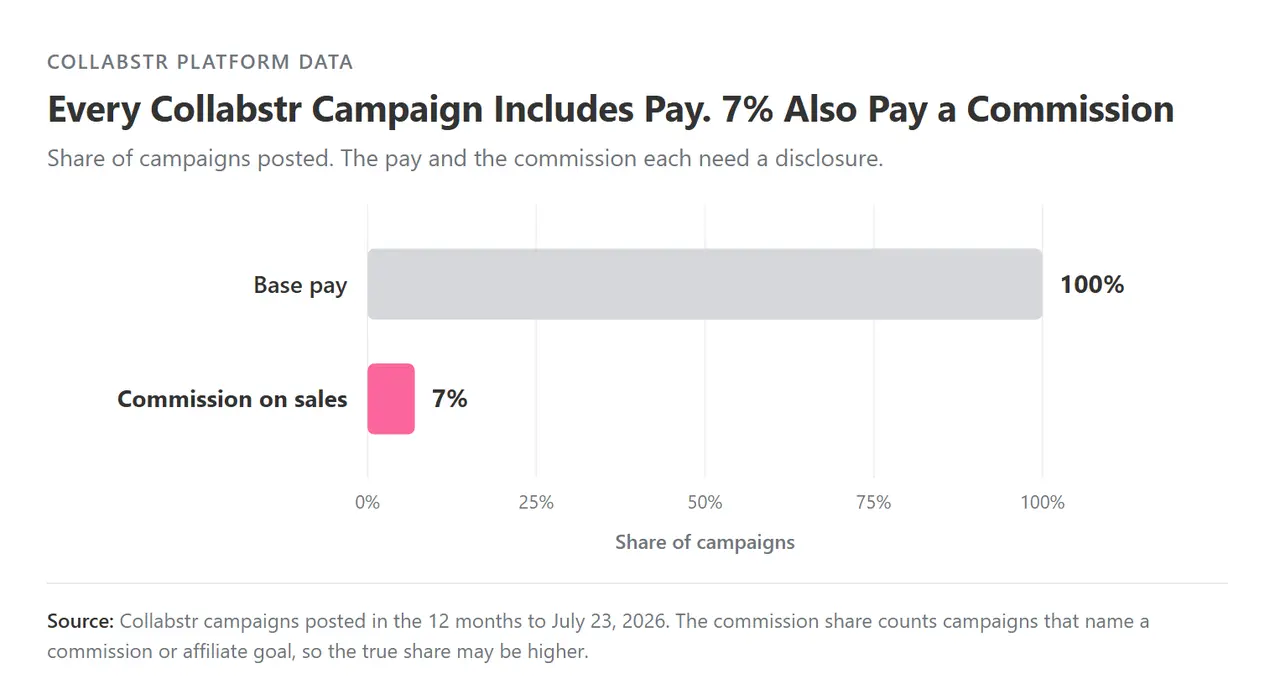
• Every Collabstr campaign includes pay, so every collaboration booked through Collabstr needs a disclosure. About 7% also pay a commission on sales, and that link or code needs its own label.
• Since July 2023, the FTC's guides define a good disclosure as "difficult to miss", and the FTC has said a platform's built-in label may fall short on its own.
The FTC influencer guidelines decide when a creator's post counts as advertising, and who answers for it when the label is missing. The answer to the second question includes the brand.
The test is whether the creator has a material connection to the brand, meaning any relationship, such as pay or free product, that could change how viewers judge the post. Every Collabstr campaign includes pay, so every collaboration booked through Collabstr has one.

What Are the FTC Influencer Guidelines?
The FTC influencer guidelines are the Guides Concerning the Use of Endorsements and Testimonials in Advertising, published at 16 CFR Part 255, plus the plain-language guidance the FTC publishes for creators and brands. The guides are the FTC's official reading of US advertising law. They are not a law themselves, and the FTC uses them to decide whether an ad misleads people.
The guides call for a clear and conspicuous disclosure whenever a creator has a material connection to the brand that the audience would not expect. They say material connections "can include a business, family, or personal relationship" (Federal Register, 2023). Payment, free product, commission and employment all count.
The FTC last revised the guides in 2023, announcing the update on June 29 and publishing it in the Federal Register on July 26 (FTC, 2023; Federal Register, 2023). For creators, the FTC's short version is "Disclosures 101 for Social Media Influencers" (FTC, 2019).
Who Is Responsible for Disclosure, the Brand or the Creator?
Both. The FTC says advertisers "need to have reasonable programs in place to train and monitor members of their network", and that the responsibility for disclosure "rests with the influencer and the brand" (FTC, Endorsement Guides FAQ).
The 2023 revision clarified the brand's side. Under the revised guides, advertisers "are subject to liability for misleading or unsubstantiated statements made through endorsements" (Federal Register, 2023). In the FTC's eyes, a creator's claim about your product is your claim.
Three jobs sit with the brand:
• Tell creators what to disclose. Put it in the contract and the brief.
• Check the disclosure before the post goes live. Review it the same way you review the product shots.
• Fix it when it goes missing. Ask for an edit as soon as you see a gap.
Every Paid Collaboration Needs a Label: What Collabstr's Data Shows
Every collaboration booked through Collabstr includes pay, so every collaboration needs a disclosure. A campaign cannot be published without base pay, and free product or a commission is always added to that pay (Collabstr; Collabstr).
A gifted post needs a label too. On Collabstr the product always comes with pay, so the post needs a paid label alongside the gift disclosure.
A commission adds a second thing to disclose. In Collabstr's data, 7% of campaigns also pay a commission on sales, a floor since only campaigns that name it are counted. The link or code in each of those posts needs its own label.
What Counts as a Disclosure Under the FTC Guidelines?
A disclosure counts when a viewer cannot miss it. The 2023 guides define "clear and conspicuous" as "difficult to miss" and "easily understandable by ordinary consumers" (Federal Register, 2023).
Placement matters as much as wording. The FTC says "the disclosure should be placed with the endorsement message itself" (FTC, 2019). A label buried in a block of hashtags, or behind a "more" link, is easy to miss.
Labels That Work and Labels to Avoid
Use short, plain labels. The FTC says "#ad," "Ad:," and "ad" at the beginning of a post "are probably all equal" (FTC, Endorsement Guides FAQ).
|
Use |
Avoid |
|---|---|
|
#ad, Ad:, ad at the start of the post |
sp, spon, collab |
|
"Sponsored" or "Promotion" at the start of the post |
"Thanks [Brand]" with no other context |
|
"Advertisement" |
A label hidden among many hashtags |
|
"Thanks to [Brand] for the free product" |
A disclosure only in the profile bio |
Source: FTC, Disclosures 101 for Social Media Influencers and Endorsement Guides FAQ.
Video, Stories and Live Streams
On video, the disclosure belongs in the video as well as the caption, because a viewer can watch the whole video without reading the caption. Say it out loud and put it on screen.
For live streams, the FTC says "the disclosure should be repeated periodically" so viewers who join late still see it (FTC, 2019). Stories follow the same rule as posts, and the FTC notes that you can superimpose a disclosure on Instagram Stories (FTC, Endorsement Guides FAQ).
Disclosure by Collaboration Type
The pay always needs a label. Free product, a commission or an ad made from the post each add something the label has to cover.
Paid Posts and Videos
A paid post needs a label that makes the payment clear, such as #ad or "Sponsored", placed with the endorsement. Every collaboration on Collabstr starts here. Our influencer rate card guide covers how those collaborations are priced.
Free Product on Top of Pay
Free product counts as a material connection on its own, so a gifted item needs disclosing. "Thanks to [Brand] for the free product" works for the product, alongside the paid label. See our guides to influencer gifting and PR packages.
Affiliate Links and Discount Codes
A commission is a separate material connection, so the link or code needs its own label. The FTC says "Paid link" right next to an affiliate link "should be an adequate disclosure" (FTC, Endorsement Guides FAQ). Our guides to influencer affiliate marketing and discount codes cover how to set these up.
Creator Content Run as Ads
An ad made from a creator's video is still an endorsement, and the brand can be held liable for what it says. Keep the #ad label in the ad as well as in the original post. That includes whitelisted ads, which a brand runs through the creator's own account, and TikTok Spark Ads, TikTok's format for running a creator's post as a paid ad. See influencer whitelisting for how those ads work.
Are Platform Labels Enough for FTC Compliance?
Use them, then add your own. The FTC tells creators, "Don't assume that a platform's disclosure tool is good enough" (FTC, 2019). Its 2023 update says a built-in tool "might not be an adequate disclosure" on its own (FTC, 2023).
Most major platforms offer a built-in label for paid partnerships. Turn it on for every paid post, and keep a clear label in the caption or on screen as well, so a viewer sees it with the endorsement.
What Changed in 2023 and 2024
Two updates matter for brands. The 2023 revision of the guides tightened what a disclosure is and who is liable, and a 2024 rule banned buying fake indicators of social media influence, such as followers and views.
The 2023 Endorsement Guides Update
The revised guides, published July 26, 2023, made four changes that affect brands (Federal Register, 2023):
• A definition of "clear and conspicuous": "difficult to miss" and "easily understandable by ordinary consumers".
• A wider definition of an endorser: one that "could be or appear to be an individual, group, or institution". The FTC's announcement ties this to virtual influencers.
• Advertiser liability clarified: brands answer for misleading or unsubstantiated statements made through endorsements.
• Children: endorsements in ads aimed at children "may be of special concern".
The 2024 Rule on Fake Reviews and Fake Followers
In August 2024, the FTC finalized a rule that "prohibits anyone from selling or buying fake indicators of social media influence", such as followers or views generated by bots or hijacked accounts (FTC, 2024). It applies when the buyer knew or should have known the indicators were fake and uses them to misrepresent their influence for a commercial purpose. The rule took effect on October 21, 2024, and the FTC can seek civil penalties against knowing violators.
Check creators before you hire them. Our Instagram fake follower checker and guide to influencer vetting show what to look for.
A Disclosure Workflow for Every Collaboration
Build disclosure into the steps you already run: the contract, the brief, the approval and the post. Five checks cover it.
1. Contract. Add a clause that requires the creator to disclose the relationship as the FTC describes. Our influencer contract template is a starting point.
2. Brief. Write the exact label and where it goes, for example "#ad as the first word of the caption, and said out loud in the first five seconds". The campaign brief template has a section for requirements.
3. Review before approval. Check the disclosure in the draft with the rest of the content. On Collabstr, payment is released when you approve the work, so make approval your disclosure checkpoint (Collabstr).
4. Check the live post. Confirm the label survived publishing, including on Stories and edited captions.
5. Fix it fast. If a label is missing, ask the creator to add it and record when it was fixed.
Our influencer agreement template guide covers the other clauses that sit alongside disclosure.

What This Means for Brands
Put the label in the contract and the brief, and check it before you approve the work. That covers most of what the FTC expects from a brand.
The FTC guides set general expectations. For regulated products, such as health, alcohol or anything aimed at children, check the specific campaign with counsel. For how disclosure fits a wider program, see our guide to creator marketing.
FAQ
Do Brands Have to Follow the FTC Influencer Guidelines?
Yes. The FTC holds brands responsible for the creators they work with, and its 2023 revision clarified that brands are liable for misleading or unsubstantiated statements made through endorsements.
Does Gifted Product Need a Disclosure?
Yes. Free product is a material connection, so the creator should disclose it even with no payment attached, for example "Thanks to [Brand] for the free product".
Is #ad in the Hashtags Enough?
It depends on where it sits. The FTC says the disclosure should be placed with the endorsement and should be hard to miss, so #ad at the start of the caption works and #ad hidden among many hashtags at the end may not (FTC, 2019).
Do Affiliate Links Need a Disclosure?
Yes. A commission is a material connection, and the FTC says "Paid link" next to an affiliate link should be adequate.
What Happens If an Influencer Does Not Disclose?
The FTC says its focus is usually on brands and their agencies, and it can also act against individual creators in some cases. The fastest fix is to ask the creator to edit the post as soon as you notice, and record the change.
Do the FTC Guidelines Apply to Creators Outside the US?
US law applies when it is reasonably foreseeable that a post will affect US consumers, wherever the creator lives (FTC, 2019). Other countries run their own rules, such as the UK's Advertising Standards Authority, so check the rules in each market you target.
Methodology
• Base pay and commission share: Collabstr campaigns posted in the 12 months to July 23, 2026. "Commission" means the campaign text mentions affiliate or commission, or the brand's goal is affiliate, so the 7% is a floor. Shares only, no counts. The base-pay rule and the 7% share also appear in Collabstr's published articles on gifting and affiliate marketing.
• FTC sources: read on ftc.gov and govinfo.gov on October 14, 2026. This article is general information, not legal advice.
• Worked example: the skincare brand, the $400 fee and the 10% code are hypothetical.