UGC More Than Doubled Its Share of Creator Marketing Campaigns on Collabstr
- Key Takeaways
- What Is Creator Marketing?
- Creator Marketing vs Influencer Marketing
- Content Is Taking a Bigger Share of Creator Campaigns
- How Creator Collaborations Are Structured
- How to Brief a UGC Creator
- Usage Rights: What You Can Do With Creator Content
- How to Build a Creator Marketing Program in Five Steps
- Creator Marketing by Industry
- What These Figures Can and Cannot Tell You
- What This Means for Brands
- FAQ
- Methodology
Say a coffee brand has $2,500 to spend with creators this quarter. It pays four creators $250 each to post about its new cold brew on their own accounts. It pays six more $250 each for short videos it will run as its own Instagram ads. Both purchases are creator marketing, and $1,500 of the $2,500 buys content the brand will run itself.
This guide is for brands deciding how to work with creators: what creator marketing is, how much of it is now about content, and how to build a program around it.
Key Takeaways
• Creator marketing is a brand paying creators for content, for reach on their own accounts, or both.
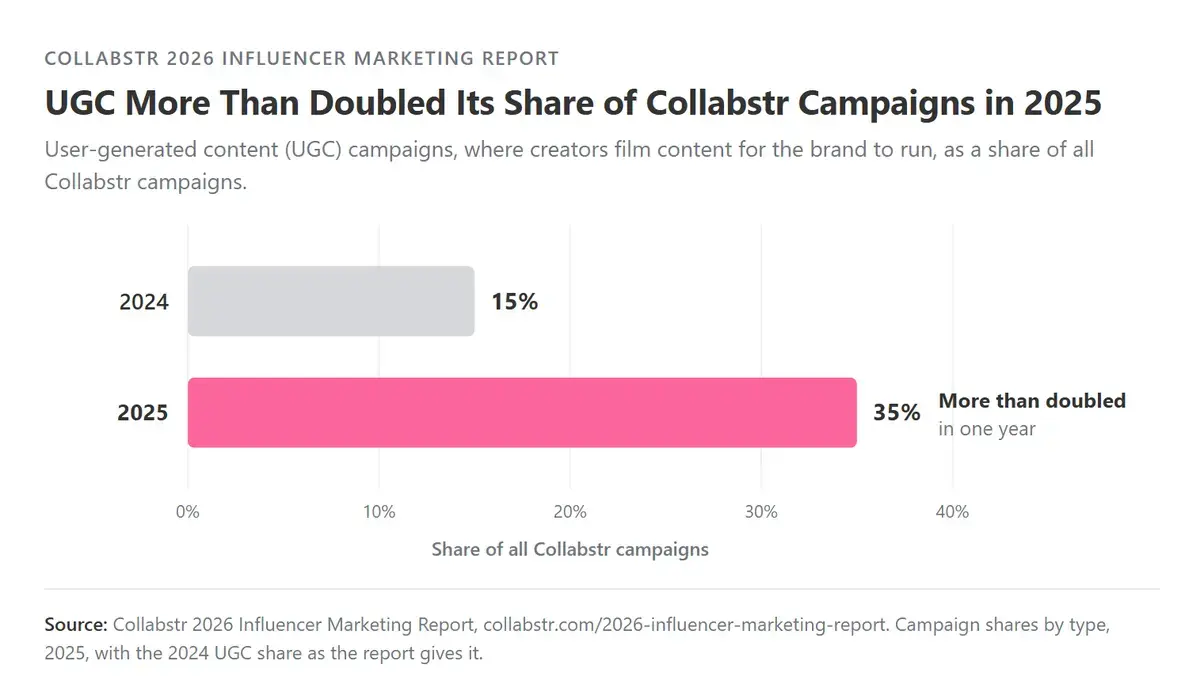
• Content is taking a bigger share. In Collabstr's 2026 Influencer Marketing Report, user-generated content (UGC) campaigns rose from 15% of all Collabstr campaigns in 2024 to 35% in 2025 (Collabstr, 2026).
• Every Collabstr campaign starts with pay, and adding free product to a paid campaign gets the fastest creator response, a median of 22 minutes to the first application.
What Is Creator Marketing?
Creator marketing is a brand paying independent creators for what they make and who they reach. The brand can buy a post on the creator's own account, a video to run as its own ad, or both, and it can own or license the content when the two agree usage rights, meaning how long and where the brand may run it.
Creator programs run on two kinds of collaboration. In a reach collaboration, the creator posts to their own followers. In a UGC collaboration, the creator films videos or photos for the brand to post or run as its own ads, and the creator may never post them on their own account.
Creator Marketing vs Influencer Marketing
Influencer marketing buys a creator's audience. Creator marketing covers that and the content itself, which the brand can reuse in its own ads, site and email. A program can run both. The difference shows up in what you pay for and how you judge it:
|
Reach collaboration (influencer marketing) |
UGC collaboration (content for ads) |
|
|---|---|---|
|
What you buy |
A post to the creator's followers |
Videos or photos for your own channels |
|
Who publishes |
The creator |
The brand, or the creator for a whitelisted ad |
|
How you judge it |
Views, reach, cost per 1,000 views |
Videos and photos approved, usage rights, ad results |
|
Who owns the content |
The creator, unless rights are agreed |
The brand, on the agreed usage terms |
A whitelisted ad is an ad the brand runs through the creator's own account. Our guide to content creators vs influencers covers the people side, and our guide to influencer marketing reporting covers how to report on each type.
Content Is Taking a Bigger Share of Creator Campaigns
UGC more than doubled its share of Collabstr campaigns in a year. In Collabstr's 2026 Influencer Marketing Report, UGC campaigns rose from 15% of all campaigns in 2024 to 35% in 2025 (Collabstr, 2026). UGC is now the second-largest campaign type on Collabstr, after Instagram.
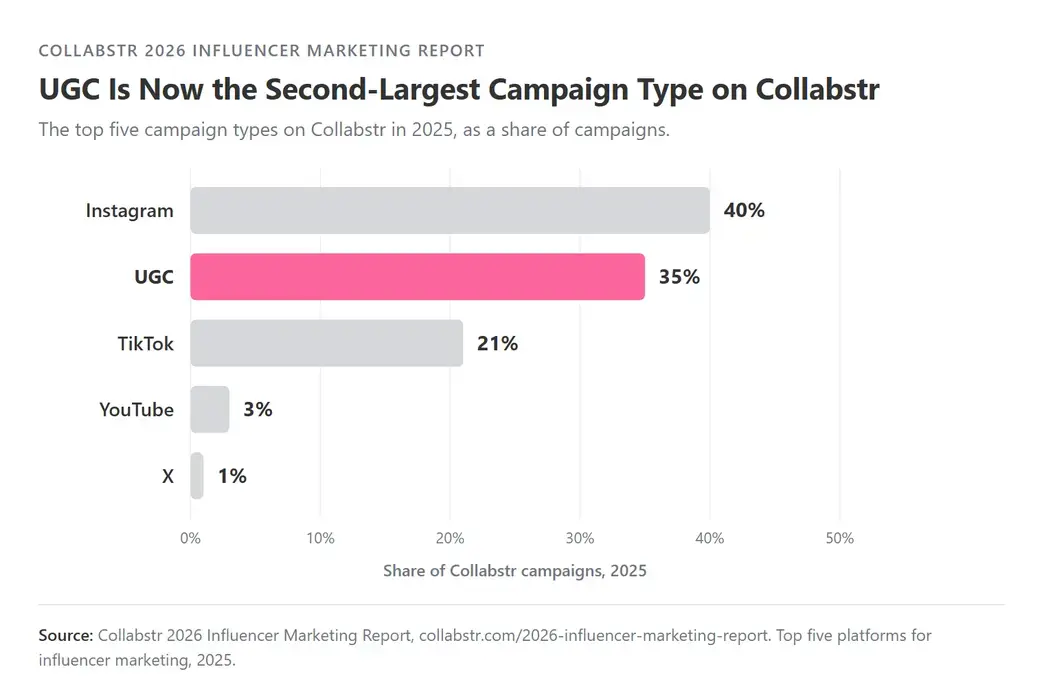
For a brand, that changes how you choose creators. When you are buying a video to run as an ad, judge the creator on the video they make for you, and agree usage rights before they film. Our guide to content usage rights covers the terms.
Orangetheory Fitness bought content for ads this way on Collabstr. Its brief asked for UGC for paid ads, and 23 creators delivered 45 paid-ready videos across two campaigns (Collabstr).
Spending on creators is also growing across the US market. The Interactive Advertising Bureau (IAB) projected US creator ad spend at $37 billion in 2025, up 26% on 2024, and found that nearly half (48%) of ad spenders consider creators a "must buy" (IAB, 2025). For a brand, a 26% rise in spend means more competition for the same creators, so book the ones you want early.
How Creator Collaborations Are Structured
Every collaboration on Collabstr starts with base pay. A campaign cannot be published without it, and free product or a commission on sales is added on top (Collabstr; Collabstr).
One-Off Collaborations
A one-off collaboration buys a single piece of content, such as a video or a post, at an agreed price. It lets you test a creator or a format for the price of one piece. Our influencer rate card guide covers how creators price them.
Ongoing Partnerships and Ambassadors
An ongoing partnership books the same creator for repeat content, such as one video a month. It suits brands that have found a creator whose content performs. See our guides to brand ambassador programs and influencer partnerships.
Commission on Sales
A commission pays the creator a share of the sales they drive, on top of their fee. In Collabstr's data, 7% of campaigns include one, a floor since only campaigns that name it are counted (Collabstr). Commission links need a clear disclosure, which our guide to the FTC influencer guidelines explains.
Free Product Plus Pay
When you need creators quickly, add free product to a paid campaign. Campaigns with a product or gifting component see their first creator application in a median of 22 minutes, meaning half of them get one within that time, the quickest of any campaign type (Collabstr).
How to Brief a UGC Creator
A UGC brief asks for an ad asset the brand will run, so the creator needs to know where the video will run and what it has to do there. Six items cover most briefs:
1. The video's job. Say where it will run, such as a paid social ad or a product page, and what you want viewers to do next.
2. The opening. The first few seconds matter most in a short ad, so ask for two or three opening lines you can test against each other.
3. Format and length. Give the aspect ratio and length for each placement, such as a vertical video of 15 to 30 seconds for short-form ads.
4. What to show and say. List the product points to cover and any claims to avoid.
5. The files you need. Ask for the raw footage and a version without music or captions, so your team can edit and test cuts.
6. Usage. State where you will run the video and for how long, as set out below.
Usage Rights: What You Can Do With Creator Content
Usage rights decide what you can do with a video after the creator delivers it. Agree them before the creator films, because they change the price. Our guide to content usage rights covers the terms in full.
|
Usage type |
What it lets you do |
What to agree |
|---|---|---|
|
Organic use |
Repost the content on your own social accounts, site and email |
Which channels, and whether you must credit the creator |
|
Paid use |
Run the content as ads from your own account |
How long, and on which ad platforms |
|
Whitelisting |
Run ads through the creator's own account |
How long you have access, and spend or approval limits |
|
Exclusivity |
Stop the creator working with direct competitors for a period |
Which brands count as competitors, and for how long |
Ask for usage priced as its own line in the quote. You can then compare creators on the content and the rights separately, and extend the rights later if a video performs.
How to Build a Creator Marketing Program in Five Steps
1. Decide what you are buying. Content for your own ads, reach on the creator's account, or both. This sets the budget split and how you will judge results.
2. Pick creators for the content you need. Judge a creator on the type of video or post you want, as well as their followers. Our guide to influencer vetting covers the checks.
3. Brief and agree usage rights. State what you want made, the format, the disclosure and how long you can reuse the content. Start from the campaign brief template.
4. Approve, then pay. On Collabstr, payment is released when you approve the work, so review the content against the brief before it goes live (Collabstr).
5. Measure content and reach differently. Judge reach on views and cost per 1,000 views, and judge content on what it does when you run it. Our guide to influencer marketing measurement sets out the metrics by goal.
Creator Marketing by Industry
Our industry guides apply the same approach to three categories:
• Fitness: fitness influencer marketing, where brand searches for creators grew 76% in 2025.
• Fashion: fashion influencer marketing, one of the five niches brands search for most.
• Travel: travel influencer marketing, new to the top five niches by brand searches.
What These Figures Can and Cannot Tell You
The campaign mix counts campaigns, so it shows what brands set out to book, and a campaign counts once whatever it costs. The figures describe brands that book through Collabstr, a self-serve marketplace, so read them as a pattern in that market. The IAB figures describe the US market as a whole.

What This Means for Brands
Plan creator budgets in two lines: content you will reuse, and reach you will measure. Each line has its own brief and its own way of judging success.
Content is the faster-growing line. Start your program by deciding what you will do with each video or photo, and choose creators who make that kind of content well. To find and book creators directly, see Collabstr's creator marketing platform.
FAQ
What Is the Difference Between Creator Marketing and Influencer Marketing?
Influencer marketing pays a creator to reach their followers. Creator marketing includes that and also pays creators for content the brand reuses in its own ads and channels.
What Is Creator-Led Marketing?
Creator-led marketing means a brand books the same creators again and again for its ads and posts, instead of hiring new ones for each campaign.
How Do You Choose the Right Creator?
Start from the content you need, then look at creators who already make it well. Check their past work in that format, whether their followers match your buyers, and whether the followers are real, before you book.
How Do You Measure Creator Marketing?
Measure reach and content separately. Judge reach collaborations on views and cost per 1,000 views, and content collaborations on the videos and photos approved, the usage rights secured and how the content performs when you run it as an ad.
Methodology
• Campaign mix: Collabstr's 2026 Influencer Marketing Report, covering 2025, with UGC's 2024 share as the report gives it.
• Base pay, commission share and time to first application: Collabstr's published articles on gifting and affiliate marketing.
• Orangetheory: Collabstr's published case study.
• Creator ad spend: IAB, 2025 Creator Economy Ad Spend & Strategy Report, press release of November 20, 2025.
• Worked example: the coffee brand and its budget are hypothetical.