
How to Run a UGC Campaign, From Brief to Payout
A UGC campaign is a campaign that collects user-generated content (UGC), the photos, videos and reviews made by customers or creators instead of your brand team. This guide covers the paid version: you hire creators to make content your brand can post and run as ads. It walks through what one costs in Collabstr's data and the eight steps from brief to payout.
Key Takeaways
• UGC campaigns grew from 15% to 35% of Collabstr campaigns in 2025, and the average UGC campaign cost $197 (Collabstr, 2026).
• Over 40% of UGC campaigns come from companies spending less than $5,000, so a first campaign does not need a large budget.
• Most of the work in a UGC campaign is admin: messages, contracts, revisions, invoices, payouts and tax forms. Keep all of it attached to the campaign.
• Hire several creators, compare cost per 1,000 views (CPM) and engagement, then rebook the creators whose content performed.
What Is a UGC Campaign?
A UGC campaign is a planned effort to get content about your product made by people outside your company, then use it on your channels. The content can come from customers who post on their own, or from creators you pay to make it. Both kinds read as a real person's experience with the product, which is why brands use them in ads, product pages and social posts.
Organic UGC and Paid UGC
Organic UGC is content customers make without being paid, usually prompted by a hashtag, contest or review request. You do not control when it arrives, what it shows or whether you have the rights to reuse it.
Paid UGC is content you commission from a creator for an agreed price, format and deadline. You write the brief, approve the result and agree usage rights up front. The rest of this guide covers paid UGC, the kind you can plan a launch around.
What a UGC Campaign Costs in Collabstr's Data
A UGC campaign on Collabstr cost $197 on average in 2025, down 5.7% from $209 the year before (Collabstr, 2026). The cost fell while UGC's share of campaigns grew. UGC made up 35% of campaigns in 2025, up from 15%, more than twice its share a year earlier.
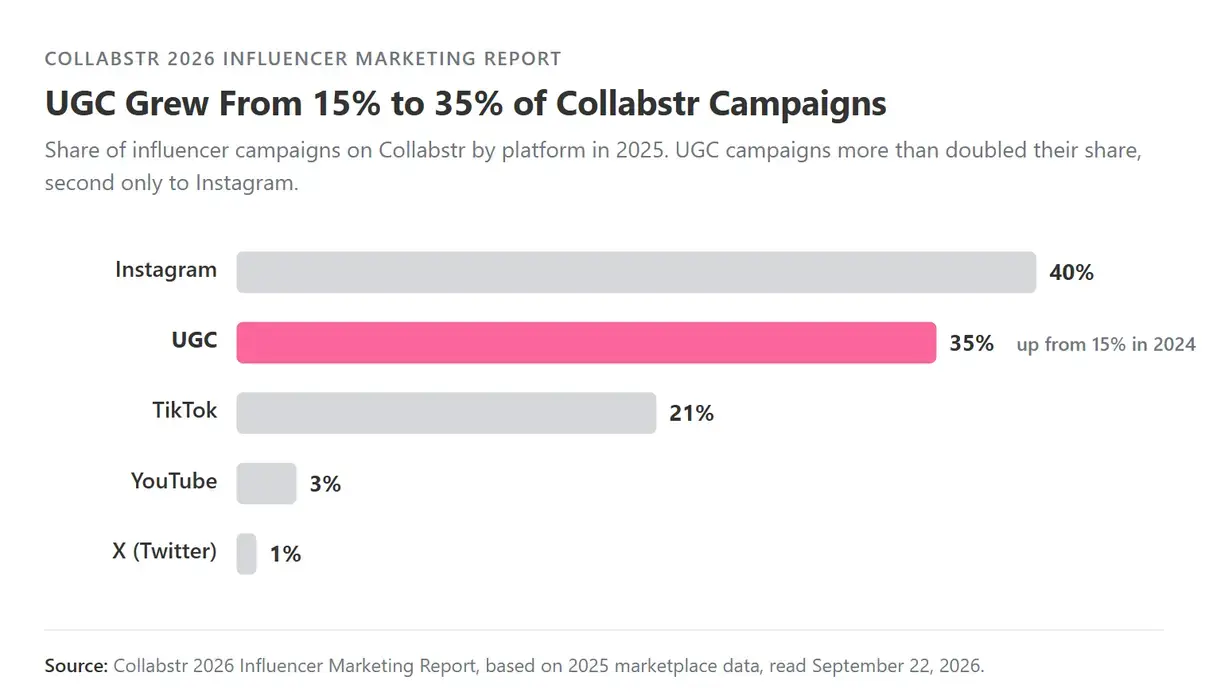
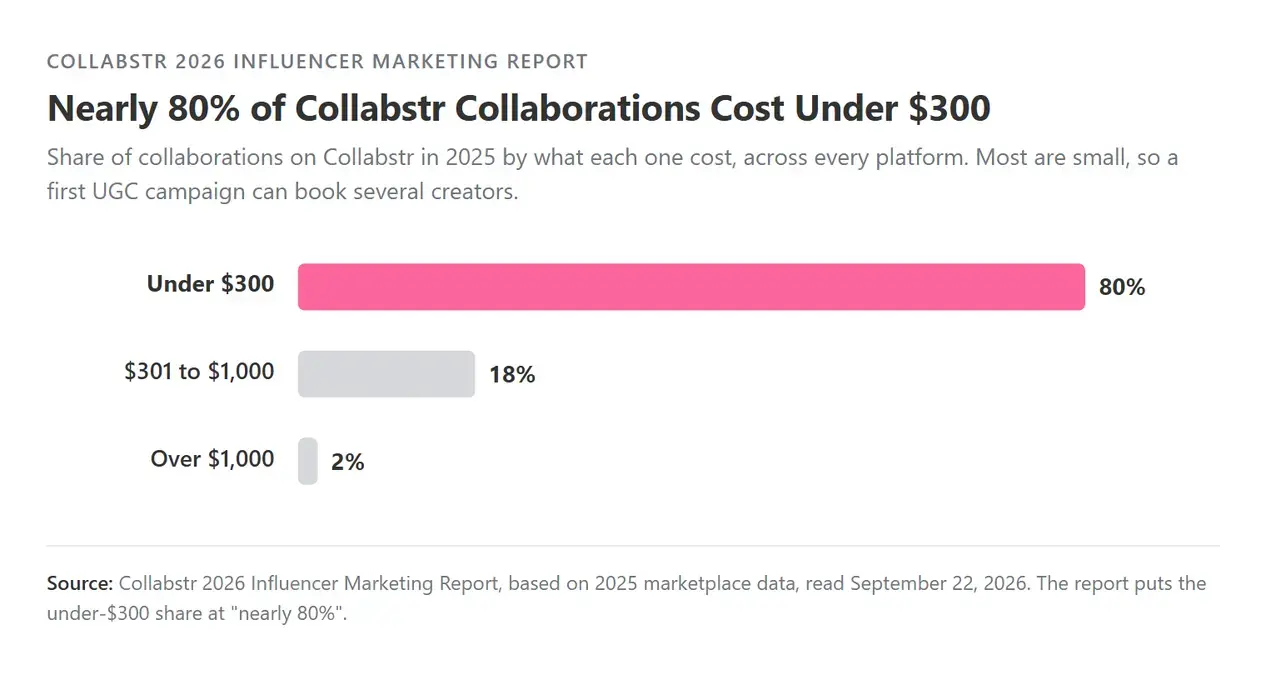
The report finds UGC is driven primarily by smaller brands with smaller budgets. Over 40% of UGC campaigns come from companies spending less than $5,000. Across every platform, nearly 80% of Collabstr collaborations in 2025 cost under $300.
Read these as marketplace-wide figures. The report notes that a creator's posted rate reflects their audience size, engagement and niche, so a video from a creator with a large, engaged audience usually costs more than a set of photos from a newer creator. Browsing creators is free, and the smallest package on Collabstr is $50 (Collabstr, 2026), so a first campaign can start with one or two creators and grow from there.
How to Run a UGC Campaign in Eight Steps
To run a UGC campaign, set a goal, find and vet creators, hire with payment held in escrow, brief once, review the work, release payment and report on results. Keeping each step's paperwork in one place is what keeps a campaign with ten creators manageable.
1. Set the Goal and the Deliverable
Decide what the content is for before you look at a single creator, because an ad and a product page need different things. Write down four details and the brief writes itself:
• Format: video, photo set or review.
• Length: runtime for video, number of shots for photos.
• Where it runs: paid social, your product page, your own channels.
• How long you can use it: the usage window you are buying.
2. Find Creators by Platform, Niche and Price
Search creators by platform, niche, audience and budget instead of sending cold outreach. On Collabstr, creators list packages with posted prices, so you see a starting price before you hire, and you can send a custom offer when a package does not fit (Collabstr, 2026). Shortlist more creators than you plan to book, since some will be unavailable.
3. Check Real Work Before You Hire
Look at a creator's past content, the kind of work you are paying for, instead of their follower count alone. Check that their lighting, pacing and on-camera delivery fit your brand. For UGC made for your own ads, the creator's audience size matters less than the quality of what they make.
4. Hire and Hold Payment in Escrow
Book the creator and pay through the platform. You are charged when the creator accepts the order, and the money is held in escrow until you approve the work (Collabstr, 2026). Creators have 72 hours to accept before an order expires, and you are not charged if they decline (Collabstr, 2026). If a creator does not deliver, the brand receives a full refund (Collabstr, 2026), and Collabstr covers the cost of any product you shipped for the collaboration (Collabstr, 2026). Agree the deadline when you hire, so it is on record from day one.
5. Brief Once, in One Place
Send one written brief that covers the product, the key message, the hook, what to avoid, the format and the deadline. Keep the brief, the messages and every file in one place instead of spread across email threads. On Collabstr, deliverables and communication sit together in the creator chat (Collabstr, 2026). Our guide to briefing a UGC creator covers what to put in it, and the campaign brief template gives you a starting file.

6. Review, Request Revisions and Approve
When the creator submits, review the content against the brief. On Collabstr, you have up to 72 hours after the work is submitted to ask for a revision or open a dispute (Collabstr, 2026). Approve the work once it matches what you agreed.
7. Release Payment
Approval releases the money held in escrow, and Collabstr pays the creator out through the platform (Collabstr, 2026). You do not collect an invoice or send a transfer yourself.
8. Report on Reach, Engagement and CPM
Once the content is live, pull reach and engagement for every creator in the campaign, and work out CPM from what you paid. Collabstr's dashboards show reach, engagement and ROI across every creator (Collabstr, 2026). Compare creators side by side, then decide who to rebook.
The Admin Nobody Warns You About: Invoices, Payouts and Tax Forms
The part of a UGC campaign that grows fastest is payment admin, because every creator you hire adds an invoice, a payout and a tax record. One creator sends a clean invoice, another has never made one. One wants a bank transfer, another a payment app, and some ask for half up front. With ten creators, tracking those payments becomes a job of its own.
Tax season adds forms. In the US, a business generally files Form 1099-NEC for each non-employee it paid at least $2,000 in 2026 in the course of its business, and payments to corporations are generally exempt (IRS, 2026). Payments made by credit or debit card, or through a third-party payment network, are left off Form 1099-NEC, and the payment company reports them on Form 1099-K when those rules apply (IRS, 2026). So how you paid each creator decides which form applies.
On Collabstr, payouts and tax forms to 150 countries are handled automatically once you approve the work (Collabstr, 2026).
Why Hire Creators in Batches
Hire several creators for the same brief, because you cannot tell in advance which one's content will perform best. Two creators with the same brief and similar quality can post very different results. Nobody can call the winner ahead of time, including the creator.
A batch turns that uncertainty into a test. With four or five creators on one brief, the results show you which hooks, formats and creators work for your product. Rebook the strongest performers for the next campaign, since a creator who has made your content once already knows the product.
A batch also fits the budgets in Collabstr's data. Nearly 80% of Collabstr collaborations cost under $300 in 2025 (Collabstr, 2026), so several creators can fit inside a modest first budget. Our guide to UGC ads covers how to run the winning content as paid social.
How to Measure a UGC Campaign
Measure a UGC campaign on cost per 1,000 views (CPM) and engagement for each creator, then on what the content does when you run it. CPM is the price divided by views, times 1,000, and it lets you compare a $150 creator with a $400 creator on equal terms. Engagement shows whether viewers responded.
For content you run as ads, the ad platform adds the numbers that matter most to a performance team: click-through rate, cost per acquisition and return on ad spend. Track each creator's content as its own ad so you can see which one earned its cost. Our guide to influencer marketing ROI covers the full measurement setup.
Keep the rest of the admin light. On Collabstr, status emails, payment approvals and manual reporting run automatically, which Collabstr says cuts 40 hours of work to 1 hour (Collabstr, 2026). That leaves your time for the brief and the results, the two parts that decide whether the campaign works.
FAQ
What Is a UGC Campaign?
A UGC campaign is a campaign that collects user-generated content about your product, made by customers or by creators you hire. Paid UGC campaigns set the format, price and deadline up front, and the brand gets content it can post on its own channels and run as ads.
How Much Does a UGC Campaign Cost?
The average UGC campaign on Collabstr cost $197 in 2025, down from $209 the year before (Collabstr, 2026). Over 40% of UGC campaigns come from companies spending less than $5,000, and across every platform nearly 80% of Collabstr collaborations in 2025 cost under $300.
How Many Creators Should a UGC Campaign Have?
Start with enough creators to compare results, usually several on the same brief. Results vary between creators with similar briefs and quality, so a batch shows which content performs before you commit more budget. Rebook the strongest performers for the next round.
How Do You Pay UGC Creators?
Pay UGC creators through a platform that holds the payment in escrow and releases it when you approve the work. On Collabstr, you are charged when the creator accepts, the money waits in escrow until you approve (Collabstr, 2026), and payouts and tax forms to 150 countries are handled automatically (Collabstr, 2026).
Do You Need to Send a 1099 to UGC Creators?
In the US, a business generally files Form 1099-NEC for each non-employee, non-corporate contractor it paid at least $2,000 in 2026 in the course of its business. Card payments and third-party payment network transactions are left off Form 1099-NEC (IRS, 2026). Collabstr handles tax documentation for creator payouts made through the platform, and your accountant can tell you what your business still needs to file.
Methodology
• UGC campaign share, cost and buyer mix: Collabstr 2026 Influencer Marketing Report, based on 2025 marketplace data, read September 22, 2026. Campaign share is the share of influencer campaigns on Collabstr by platform, with UGC counted as its own campaign type. Average UGC campaign cost is the report's average cost of a UGC campaign. The report also lists separate averages for UGC posted rates and costs by platform, which measure different things.
• Platform terms (packages and custom offers, escrow, 72-hour windows, fees, payouts and tax forms to 150 countries, creator chat, dashboards, 40 hours to 1 hour): Collabstr's homepage, pricing page and FAQ, read September 22, 2026.
• Tax forms: IRS Instructions for Forms 1099-MISC and 1099-NEC, read September 22, 2026. The article gives general information and is not tax advice.