Good Influencer Onboarding Starts With a Deadline on Record
- Key Takeaways
- What Influencer Onboarding Covers
- Why the Deadline Is the First Thing to Set
-
The Influencer Onboarding Checklist, Step by Step
- 1. Send a Welcome Message the Day You Hire
- 2. Share a Brief That Answers Questions Before They Are Asked
- 3. Spell Out Deliverables and Specs
- 4. Set the Deadline on the Collaboration and Agree a Posting Date
- 5. Ship Product Early and Share Tracking
- 6. Agree Usage Rights and Disclosure in Writing
- 7. Define Approval and Revisions
- 8. Confirm Payment Terms
- 9. Keep Communication in One Channel
- 10. Set Reporting Expectations
- A Welcome Message and Brief You Can Copy
- Common Influencer Onboarding Mistakes
- What This Means for Brands
- FAQ
- Methodology
If you hire creators and then manage the work, this guide is your checklist for the days between the hire and the first approved post.
Key Takeaways
• In 42% of completed collaborations, no deadline was recorded (Collabstr platform data, July 2026). Set the draft deadline on the day you hire.
• Payment on Collabstr is held until you approve the work, so write down what "approved" means before the creator starts making anything.
• This onboarding checklist covers 10 steps, from the welcome message to reporting.
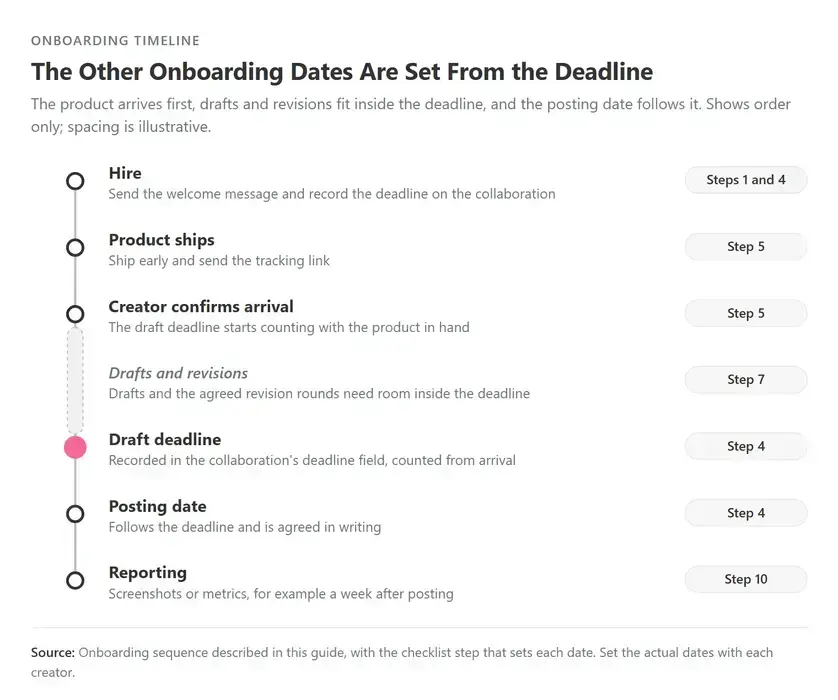
Influencer onboarding is the stretch between hiring a creator and approving their first delivery. Here is what it looks like for one hypothetical Reel:
• March 1: you hire the creator and send a welcome message.
• March 2: the product ships, with tracking.
• March 5: the creator confirms it arrived.
• March 15: the draft is due, 10 days after arrival.
• March 20: the post goes live.
• March 27: the creator sends results, a week after posting.
Every date after March 1 depends on the draft deadline being written down. Across collaborations completed in the 12 months to July 23, 2026, 42% had no deadline on record (Collabstr platform data, July 2026). The checklist below covers what goes in the brief, how to handle product and usage rights, and how approval and payment fit together.
What Influencer Onboarding Covers
Influencer onboarding is the process that runs from the day you hire a creator to the day you approve their first deliverable. Finding, vetting and agreeing a price come before it, and reporting comes after.
Its job is to answer the questions a creator would otherwise have to ask: what to make, by when, with what product, under what rights, and how payment works. A brand that answers them late gets a draft built on guesses.
Why the Deadline Is the First Thing to Set
Every other date in that timeline counts from the draft deadline, and it is often left unrecorded.
Brands Skip the Deadline on 42% of Collaborations
Across collaborations completed in the 12 months to July 23, 2026, 58% had a deadline on record and 42% had none (Collabstr platform data, July 2026).
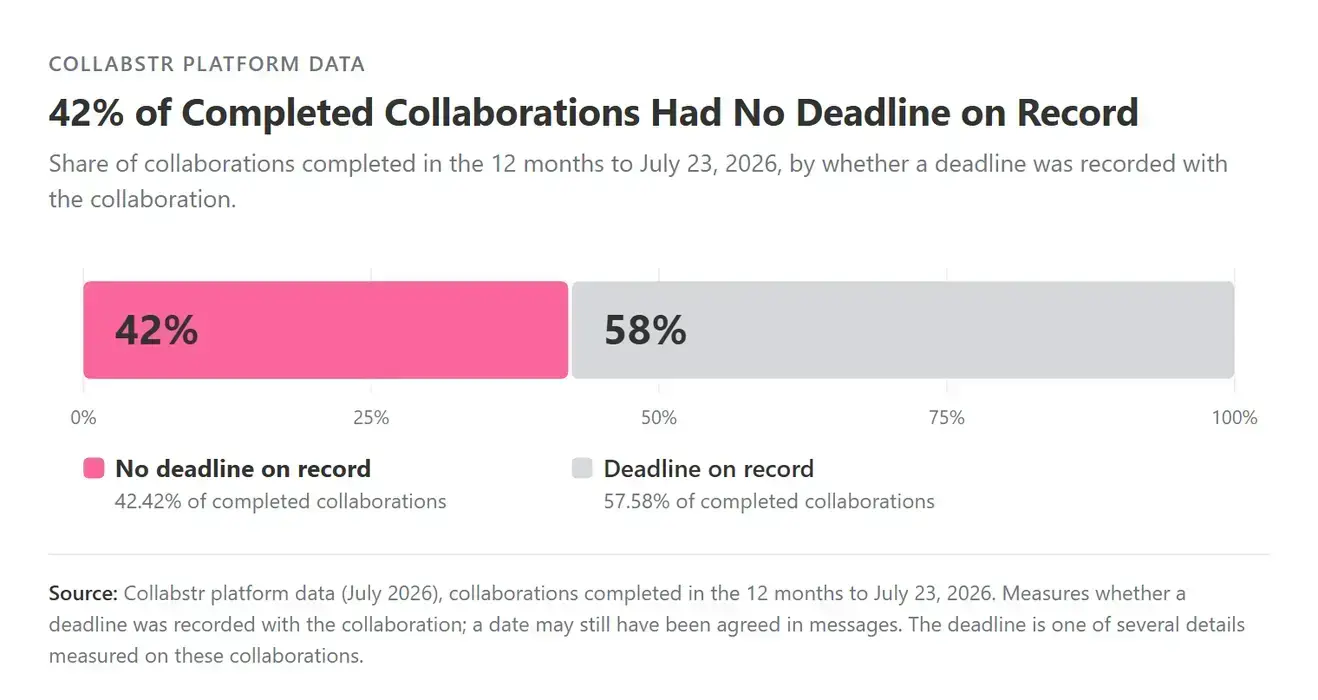
That figure does not tell you those collaborations ran late. It tells you the date was not recorded with the collaboration, which is the part a brand controls.
It matters because every other date is measured against the deadline. If the draft is due March 15, the product has to arrive with days to spare, revisions have to fit before it, and the post goes up after it. With no date in the file, nobody can say whether a draft that lands on March 20 is late.
Shipping Product Moves the Deadline
When a collaboration ships a product, the creator cannot start until it arrives, so the draft deadline counts from the arrival date rather than the hire date. That is step 5 of the checklist below, and it is the most common reason a deadline set at hire turns out to be wrong.
On Collabstr, payment is held until you approve the work, and if a creator does not deliver, the brand receives a full refund (Collabstr, 2026). Onboarding covers the parts you can set up: a product that arrives on time, a scope agreed in writing, and approval criteria set before the creator starts.
What the Figure Can and Cannot Tell You
The 42% counts collaborations where no deadline was set when the work was booked. Some of those brands may have agreed a date later in messages. Either way, the date was not on record where both sides could check it. The checklist below fixes that first, then works through the nine other steps.
The Influencer Onboarding Checklist, Step by Step
This influencer onboarding checklist has 10 steps: welcome message, brief, deliverables and specs, deadlines, product shipping, usage rights and disclosure, approval and revisions, payment terms, communication channel and reporting.
|
Onboarding step |
What to set |
|---|---|
|
1. Welcome message |
The deliverable, the date and one contact, sent the day you hire |
|
2. Brief |
Goal, key message, points to include and avoid, examples |
|
3. Deliverables and specs |
Format, count, length, aspect ratio, who posts |
|
4. Deadlines and posting dates |
The draft deadline recorded with the collaboration, and a posting date agreed in writing |
|
5. Product shipping and tracking |
Tracking link, arrival confirmation, draft deadline counted from arrival |
|
6. Usage rights and disclosure |
Where and how long you can reuse content, and the disclosure you expect |
|
7. Approval and revisions |
What "approved" means and how many revision rounds are included |
|
8. Payment terms |
Amount, what triggers release, any bonus terms |
|
9. Communication channel |
One thread, one named contact, your review time on drafts |
|
10. Reporting expectations |
Which screenshots or metrics, and when |
1. Send a Welcome Message the Day You Hire
A welcome message confirms what you hired the creator to make, when it is due and who to contact. Send it the day you hire and keep it short, because the brief carries the detail.
2. Share a Brief That Answers Questions Before They Are Asked
A brief states the goal, the one message that has to land, what to avoid, and two or three examples you like. Leave room for the creator's style, because their audience follows them for it. Start from the campaign brief template, or for content-only work, see briefing user-generated content (UGC) creators.
3. Spell Out Deliverables and Specs
Deliverable specs name the format, count, length and aspect ratio, and say whether the creator posts the content or delivers the file to you. The most-requested formats in 2025 were Instagram Reels, Instagram posts, TikTok videos, YouTube Shorts and YouTube videos (Collabstr, 2026), and each carries its own specs.
4. Set the Deadline on the Collaboration and Agree a Posting Date
Set two dates: when the draft is due and when the content goes live. Record the draft deadline with the collaboration, and put the posting date in writing where you and the creator can both find it later. Brands skip this on 42% of collaborations (Collabstr platform data, July 2026).
5. Ship Product Early and Share Tracking
Ship early, send the tracking link, and count the draft deadline from the day the creator confirms arrival. Product is sent on top of the creator's fixed fee, called base pay, which every Collabstr campaign includes (Collabstr, 2026). Influencer gifting explains why free product on its own falls short.
6. Agree Usage Rights and Disclosure in Writing
Usage rights set where you can reuse the content, such as reposts, your website or paid ads, and for how long. Use content usage rights as a guide, and put formal terms in an influencer contract template.
The Federal Trade Commission (FTC) expects a paid or gifted relationship to be obvious in the post itself (FTC, 2019). Name the disclosure you expect in the brief and point creators to the FTC's Disclosures 101 guide.
7. Define Approval and Revisions
Tell the creator what "approved" means before the first draft: the key message is present, the specs are met and the disclosure is visible. Agree the number of revision rounds at the same time, so feedback points back to that written checklist.
8. Confirm Payment Terms
Payment terms state the amount, what triggers payment and any bonus terms. On Collabstr, the funds are held in escrow, meaning Collabstr keeps them until you approve the deliverable (Collabstr, 2026), so the budget is set aside up front and you pay for approved content. For more on payment, see paying influencers.
9. Keep Communication in One Channel
Keep onboarding in one thread with one named contact, and say how quickly you review drafts. When a date changes in one place and stays the same in another, the creator may work to the old one.
10. Set Reporting Expectations
Reporting expectations name the screenshots or metrics you want and when you want them, for example a week after posting. Creators can see built-in insights, such as views, viewers and saves, in their own account analytics, so ask for them at onboarding. Log each date and deliverable in one influencer tracking spreadsheet so both deadlines stay visible.
A Welcome Message and Brief You Can Copy
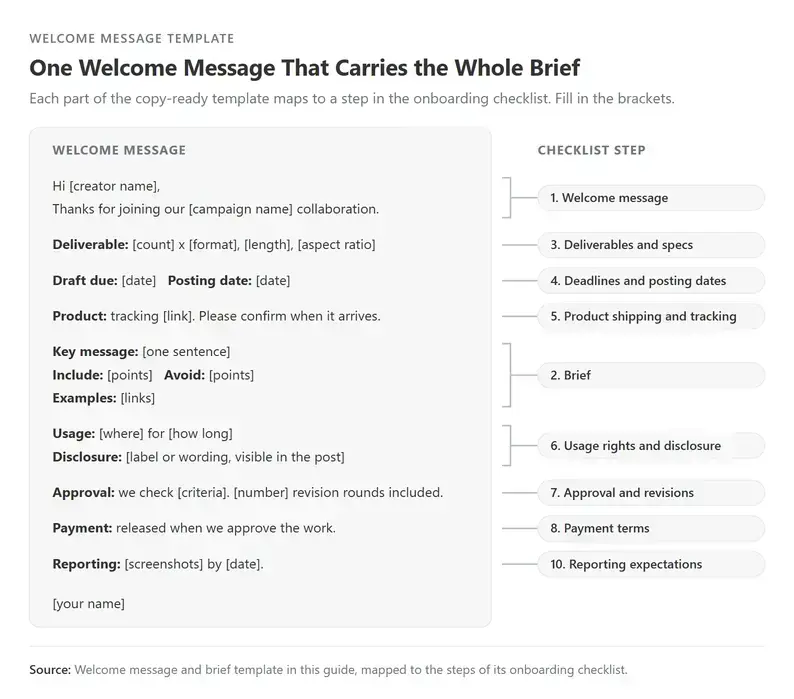
A welcome message can carry the whole brief in one note: the deliverable, both dates, product tracking, key message, usage, disclosure, approval criteria, payment trigger and reporting. Copy the template below and fill in the brackets.
Hi [creator name],
Thanks for joining our [campaign name] collaboration. Everything is in one place below.
Deliverable: [count] x [format], [length], [aspect ratio]
Draft due: [date] Posting date: [date]
Product: tracking [link]. Please confirm when it arrives.
Key message: [one sentence]
Include: [points] Avoid: [points]
Examples: [links]
Usage: [where] for [how long]
Disclosure: [label or wording, visible in the post]
Approval: we check [criteria]. [number] revision rounds included.
Payment: released when we approve the work.
Reporting: [screenshots] by [date].
[your name]
Common Influencer Onboarding Mistakes
Five onboarding mistakes are easy to prevent at hire. Each one maps to a step in the checklist above.
• Leaving the deadline only in a message. Record it with the collaboration, then confirm it in messages.
• Counting the deadline from the hire date. Count the draft deadline from the day the product arrives.
• Scripting the post line by line. Give the message and the limits, then let the creator make it.
• Leaving usage rights until you want to run an ad. Agree them at hire, when they are part of the price.
• Treating approval as taste. Written criteria make feedback faster to give and easier to act on.
Reminders and payment release can run on rules. Our guide to influencer marketing automation shows which onboarding steps to hand off.

What This Means for Brands
For brands, the steps that make a collaboration run well are mostly administrative: set a deadline, confirm product arrival and write down what "approved" means. Each costs little at hire and saves a round of back-and-forth later.
Collabstr keeps the deadline and approval on the collaboration, and payment is released when you approve the work. Before your next creator starts, run through the checklist above and see how approve-and-pay works.
FAQ
What Is Influencer Onboarding?
Influencer onboarding is the process of giving a creator everything they need after you hire them and before their first delivery. It covers a welcome message, the brief, deliverable specs, deadlines, product shipping, usage rights and disclosure, approval criteria, payment terms, one communication channel and reporting. Done well, it answers a creator's questions before they have to ask.
What Should an Influencer Onboarding Checklist Include?
This checklist covers 10 items: welcome message, brief, deliverables and specs, deadline and posting date, product shipping and tracking, usage rights and disclosure, approval and revision rounds, payment terms, communication channel and reporting. Set the deadline in writing at hire, since brands skip it on 42% of collaborations (Collabstr platform data, July 2026).
What Goes in an Influencer Brief?
An influencer brief states the goal, the one message that has to land, the points to include and avoid, and two or three examples you like. It leaves room for the creator's style, because their audience follows them for it. Name the disclosure you expect in the brief as well.
When Should an Influencer's Deadline Start?
Count the draft deadline from the day the creator confirms the product has arrived. Ship early and send the tracking link, so the deadline starts counting with the product in hand. Record the deadline with the collaboration, and confirm it with the creator in Collabstr's messages, which are open on all plans once the creator accepts (Collabstr, 2026).
What Should Influencers Report After Posting?
Agree at onboarding which screenshots or metrics the creator sends and when, for example a week after posting. Creators can see built-in insights, such as views, viewers and saves, in their own account analytics. Asking at hire makes reporting part of the agreed work.
Do Influencers Have to Disclose Gifted Products?
Yes, in the United States. The FTC treats free or discounted products as a material connection, the same as payment, so the relationship should be clear in the post itself (FTC, 2019). Brands and creators both carry responsibility, so state the disclosure you expect in the brief.
Methodology
• Deadline coverage: Collabstr production data, collaborations completed in the 12 months to July 23, 2026. Measures whether a deadline was recorded with the collaboration (57.58% had one). The 42% with no deadline on record is 100% minus that share. A date agreed only in messages is not counted.
• Content formats: Collabstr 2026 Influencer Marketing Report, covering 2025.
• Disclosure: FTC, Disclosures 101 for Social Media Influencers (November 2019).
• Internal and test accounts are excluded throughout. Figures as of July 2026.