Most Brands Never Build a Brand Ambassador Program, Here’s What the Data Shows
Key Takeaways
-
A brand ambassador program is an ongoing relationship with creators who represent your brand over time, not a series of one-off posts. That difference is where the value is.
-
Most brands never build one. In the campaigns we can see, only 7% carry an ongoing performance component such as affiliate or commission, the kind of arrangement ambassador programs run on. The default is a one-off, not a relationship.
-
Repetition is what pays. In 2025, 61% of consumers said they trust influencer endorsements more than traditional ads, and a familiar creator's third post reads as a real preference rather than an ad.
-
The barrier is habit, not budget. Most collaborations are small and frequent, 80% cost under $300 in our 2026 report, so building a repeat program is a matter of habit, not cost.
-
Building a brand ambassador program is mostly a decision to stop starting over.
What a Brand Ambassador Program Is, and Why Most Brands Skip It
A brand ambassador program is a structured, ongoing relationship with people who represent your brand over time. Classically the ambassadors were loyal customers. Today they're just as often creators you hire again and again, so their audience sees a consistent voice attached to your brand rather than a one-time mention. The defining feature isn't the reward or the contract. It is the word ongoing.
That is exactly the part most brands skip. The structures that support an ongoing relationship are rare. In the campaigns we can see, only 7% carry a performance component, such as an affiliate or commission arrangement, the kind of setup that keeps a creator invested past a single post. That figure is a floor, since it counts only campaigns that name the arrangement in their brief, but even allowing for some that do not, the large majority run without one. Each new campaign tends to start cold, with a new search, a new creator, and an audience that has never heard the brand from that voice before.
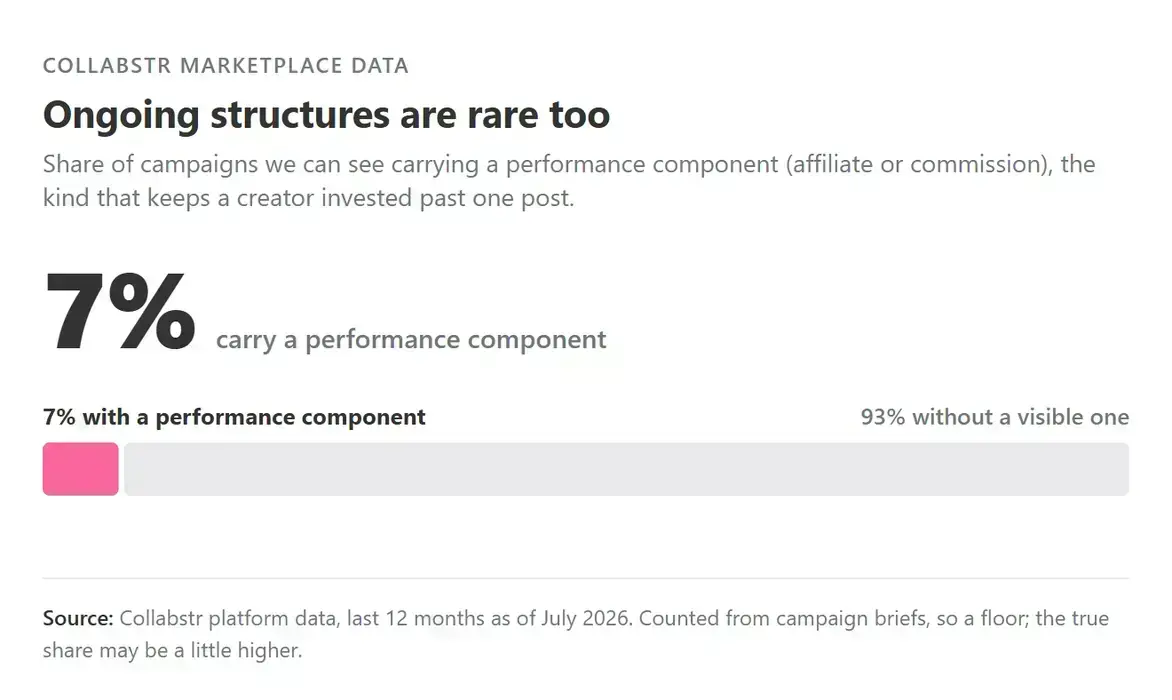
Share of campaigns carrying a performance component (affiliate or commission). Collabstr platform data, last 12 months.
None of this is hard or expensive to set up. The market already runs on small, frequent bookings: 80% of collaborations cost under $300 in our 2026 report, which is the natural shape of an ongoing program. The barrier to a brand ambassador program isn't effort or cost. It is the habit of starting over.
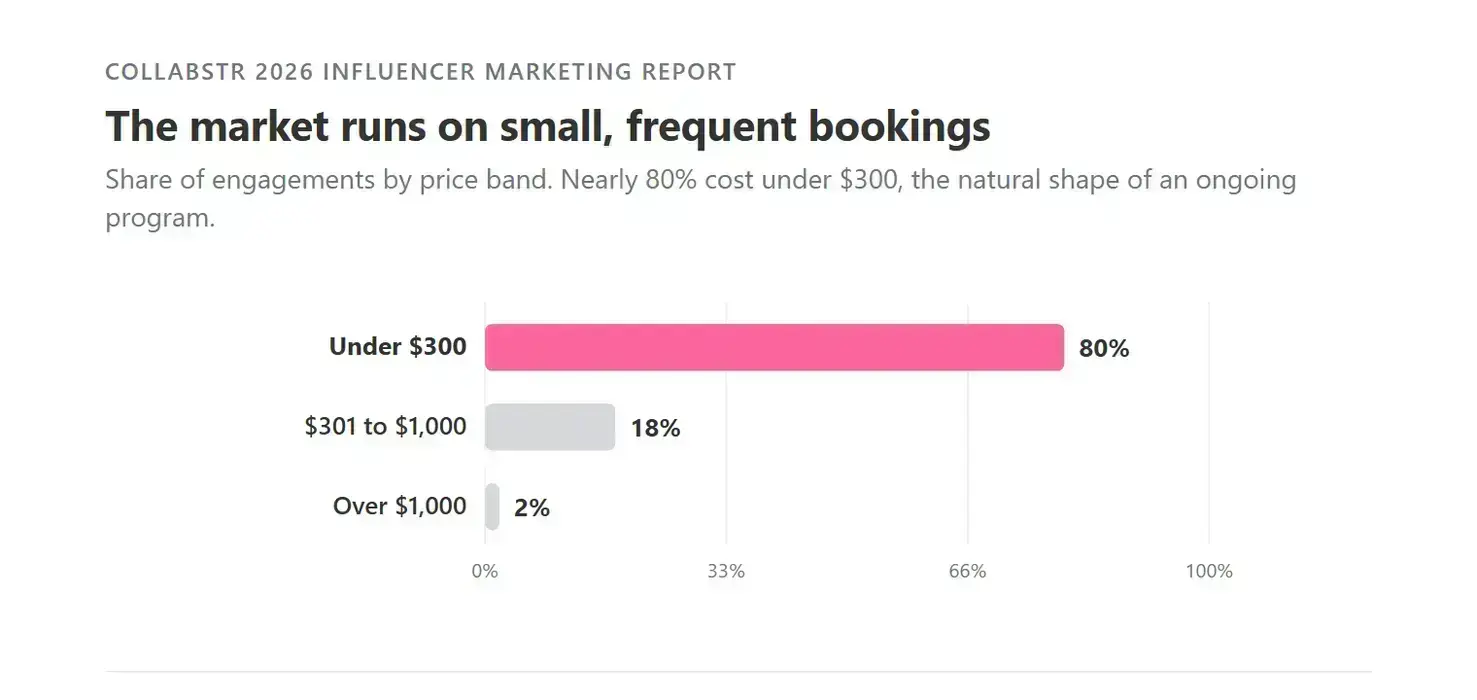
Share of marketplace engagements by price band. Small, frequent bookings are the natural shape of a program. Collabstr 2026 Influencer Marketing Report.
Why the Cold Start Costs More Than It Looks
A cold start is expensive in ways that don't show up on the invoice. You pay again to find and vet a creator you've never worked with. You lose the trust the last creator had already built with their audience. And your brand shows up in a different voice each time, which is the opposite of what makes a message stick. An ambassador relationship compounds where a one-off resets. The second post from a creator lands on an audience that remembers the first.
Three hidden costs sit inside every fresh start.
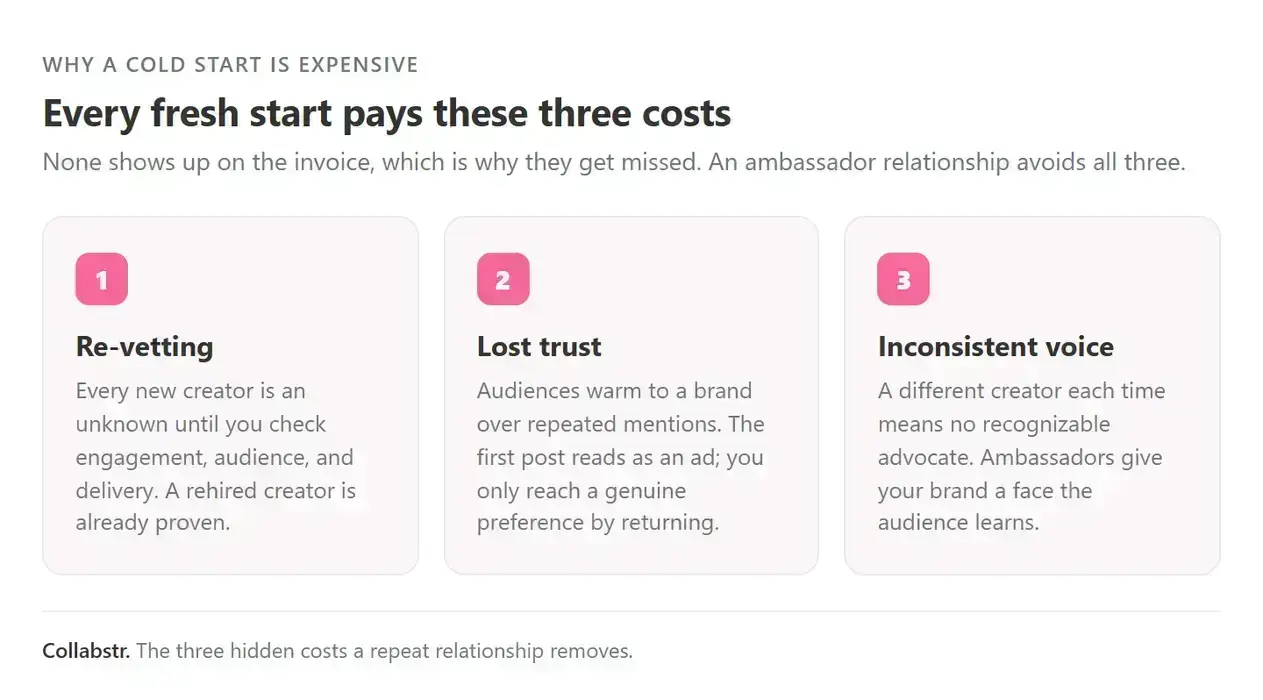
The three hidden costs a repeat relationship removes. Collabstr.
The first is re-vetting. Every new creator is an unknown until you check their engagement, their audience, and their delivery. A creator you've already worked with is a known quantity, which is the value you throw away when you move on.
The second is lost trust. A creator's audience warms to a brand over repeated, genuine mentions, not a single sponsored post. Nielsen's research on trust in advertising finds that recommendations from people we know are the most trusted form of marketing, well ahead of ads. The first time a creator names your brand, the audience files it as an ad. The third time, it reads as a real preference. You only reach the third time if you rehire.
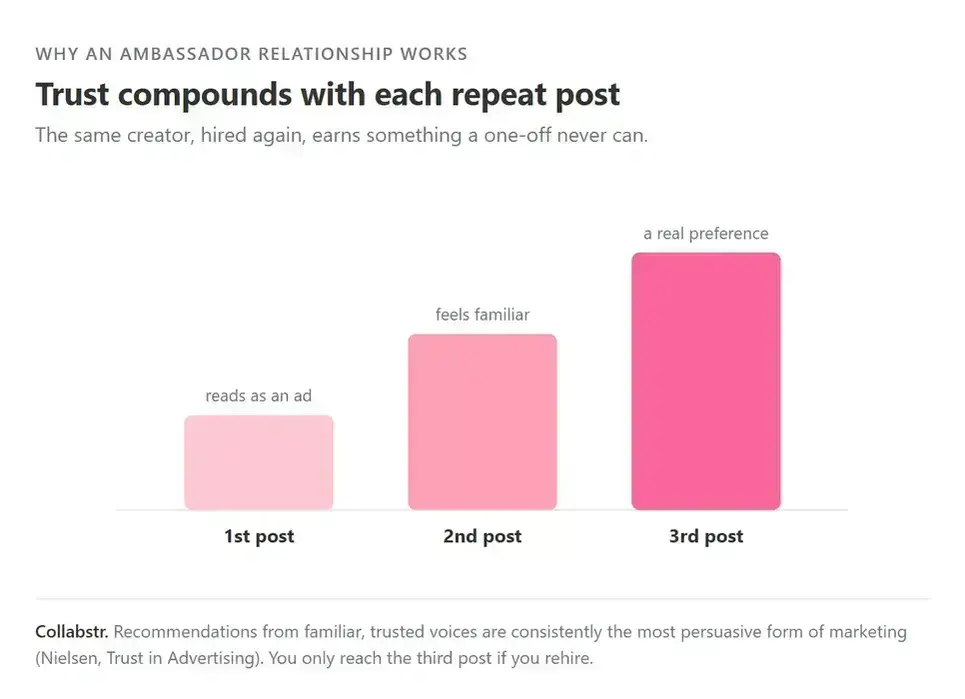
Trust compounds with each repeat post. Nielsen, Trust in Advertising.
The third is an inconsistent voice. When every campaign uses a different creator, your brand has no recognizable advocate. An ambassador program gives your brand a face that the audience learns to associate with you, which is the entire point of the exercise.
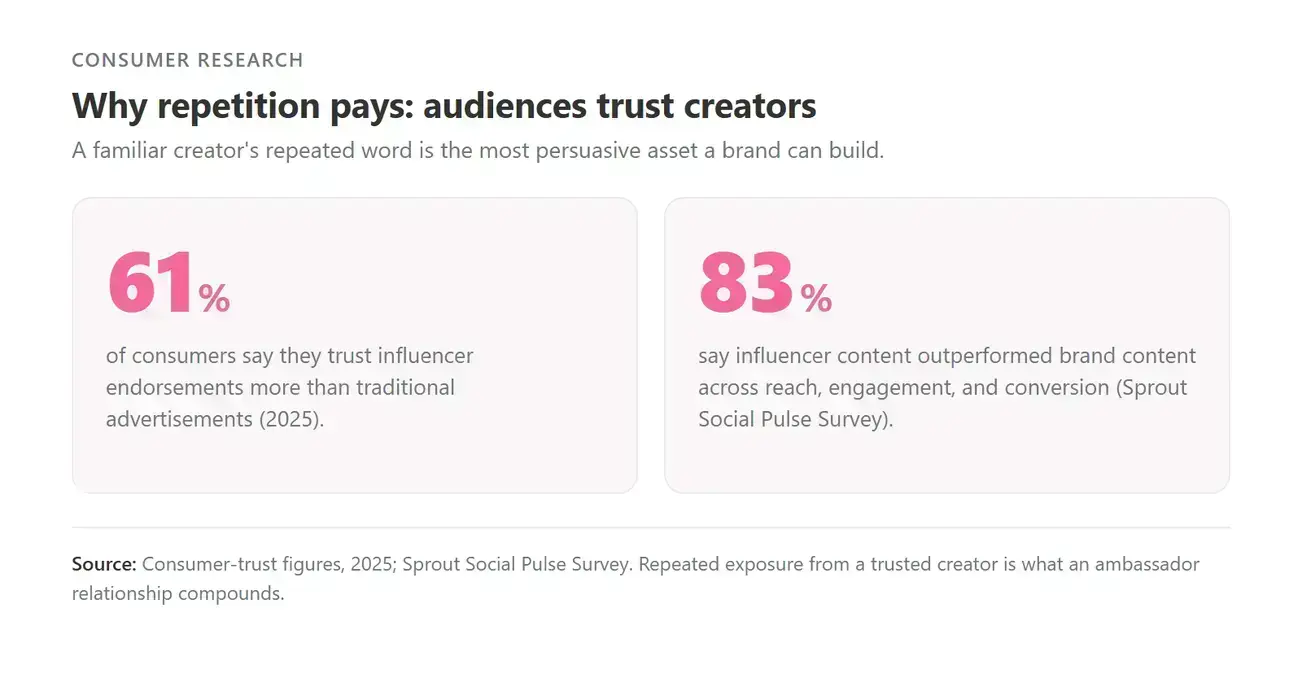
Audiences trust creators more than ads, and trust compounds with repetition. Consumer research, 2025; Sprout Social.
How a Brand Ambassador Program Differs From What You Already Do
It helps to place the ambassador program next to the two things it is often confused with.
It isn't a one-off influencer campaign. A single sponsored post buys a moment of reach. An ambassador program buys a relationship that pays out over many posts, with a creator who gets better at representing you each time.
It isn't only a customer-advocacy program. The classic version rewards loyal customers for referrals. That still works, but the creator-ambassador model adds reach the customer version can't: a partner who already has an audience and knows how to make content for it. Many brands run both, with customers driving referrals and creators driving reach.
How to Build One
You don't need new software to start. You need a shortlist and a cadence.
Start with paid, then repeat. Hire two or three creators the normal way, judge who delivered and whose audience responded, and rehire the best of them. On Collabstr you can rehire a creator you've already worked with in minutes, with the price shown up front and payment held until you approve the work.
Set a cadence rather than a campaign. Decide how often each ambassador posts, monthly or quarterly, so the relationship has a rhythm the audience can feel. Consistency is what turns a creator into an ambassador.
Add a performance component when it fits. An affiliate or commission arrangement, layered on top of base pay, gives a creator a reason to keep promoting between scheduled posts. Only 7% of the campaigns we can see use one, so it is also a way to stand out. On Collabstr every campaign includes base pay, so a performance component is an addition, not a replacement, and creators are never asked to work for exposure alone.
Systematize the repeat. The whole program is really one habit: when a creator works, hire them again. That single change is what separates the brands with an ambassador program from the majority that start over every campaign.
How to Measure It
Measure the program on whether your relationships are actually repeating. If you're rebooking the creators who perform and keeping them on a cadence, the program is working, and the share of your spend going to returning creators should climb over time. That trend, tracked against your own baseline, is the clearest sign the habit is taking hold.
Then track each ambassador over time. Watch whether a creator's cost per thousand views improves across repeated posts as their audience warms to your brand, and whether engagement holds. A good ambassador should get more efficient the longer you work together. That improvement is the return a cold start can never earn.
Frequently Asked Questions
What is a brand ambassador program?
It is an ongoing relationship with people who represent your brand over time, increasingly creators you rehire on a regular cadence rather than hire once. The defining feature is that it repeats.
How is it different from influencer marketing?
Influencer marketing often means a single sponsored post. A brand ambassador program is the repeat version: the same creators, posting for your brand again and again, so their audience sees a consistent voice.
How do I pay brand ambassadors?
Most brands pay a base rate per post and can add a performance component, such as affiliate commission, on top. On Collabstr every campaign includes base pay, so ambassadors are always paid for the work, with any commission layered on.
How many ambassadors should I have?
Start small. Hire two or three creators, keep the ones who deliver and whose audience responds, and grow the roster from there. A focused program beats a large, inconsistent one.
How long should the relationship last?
Long enough to compound. The value shows up on the second and third post, when the audience already knows the creator and the brand together, so plan in months and quarters, not single campaigns.
How fast can I start?
Immediately. There is no special setup: hire two or three creators the normal way, keep the ones who perform, and rebook them on a cadence. The whole program is that one habit, and most collaborations cost under $300, so it stays within a small budget.
Stop Starting Over
A brand ambassador program is less a new tactic than a decision to stop starting over. The data says ongoing structures are rare, which means the brands that rehire and build real creator relationships are competing against a field that mostly resets itself every campaign. And the stakes are rising: HypeAuditor projects the global influencer market will reach $31 billion by 2027, so the habit you build now compounds as budgets grow. The next step is to hire a creator, see who delivers, and hire them again.
Methodology: The performance-component share compares campaigns with an affiliate or commission component against those without, counted from campaign briefs over the last 12 months as of July 2026, so it is a floor. The price-band distribution is from Collabstr's 2026 Influencer Marketing Report. Consumer-trust research: Nielsen and Sprout Social. Market projection: HypeAuditor.