How to Build an Influencer Rate Card Around What Brands Request Most
If you are a creator, this guide shows what to put on your card and in what order. If you are a brand, it gives you a five-step check for any quote. Our influencer price guide explains what drives rates, and this article adds a rate card template and the checks.
Key Takeaways
• In 2025, the five content types brands requested most on Collabstr were Instagram Reels, Instagram posts, TikTok videos, YouTube Shorts and YouTube videos, in that order (Collabstr, 2026). List those formats first.
• User-generated content (UGC), videos and photos a creator makes for the brand to post itself, rose from 15% to 35% of campaigns on Collabstr in 2025 (Collabstr, 2026), so a UGC line is worth adding.
• A good rate card clearly separates price of the content from extras, such as usage rights. Listing them apart lets a brand compare your base fee with another creator's.
• Check any quote in five steps: format, base fee, extras, cost per 1,000 views (the fee divided by typical views, times 1,000) and creator fit.
An influencer rate card is a creator's price list: what they make, on which platform, and what costs extra. The formats worth listing first are the ones brands ask for. In 2025, Instagram Reels were the most requested content type on Collabstr, followed by Instagram posts, TikTok videos, YouTube Shorts and YouTube videos (Collabstr, 2026).
What an Influencer Rate Card Is
Brands use a rate card to budget a campaign and compare creators. Creators use it to answer collaboration requests the same way every time, rather than pricing each one from scratch.
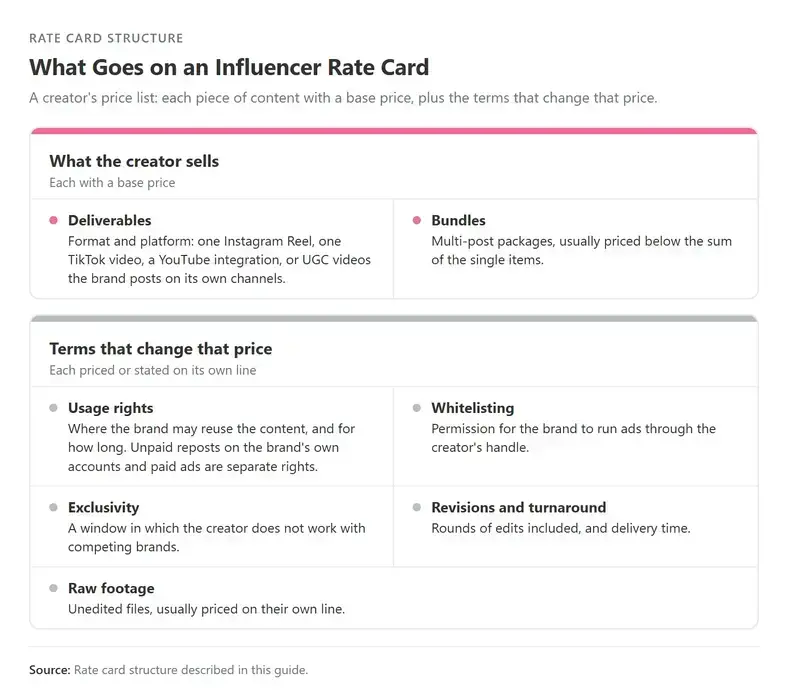
What Goes on a Rate Card
A complete rate card covers deliverables, bundles, usage rights, whitelisting, exclusivity, revisions and turnaround, and raw footage. Each item is priced or stated on its own line, as set out in the rate card template later in this article:
• Deliverables. Format and platform: one Instagram Reel, one TikTok video, a YouTube integration, or UGC videos the brand posts on its own channels.
• Bundles. Multi-post packages, usually priced below the sum of the single items.
• Usage rights. Where the brand may reuse the content, and for how long. Unpaid reposts on the brand's own accounts and paid ads are separate rights. Our guide to content usage rights covers how to state channels and duration.
• Whitelisting. Permission for the brand to run ads through the creator's handle. See influencer whitelisting.
• Exclusivity. A window in which the creator does not work with competing brands.
• Revisions and turnaround. Rounds of edits included, and delivery time.
• Raw footage. Unedited files, usually priced on their own line.
What Brands Request Most
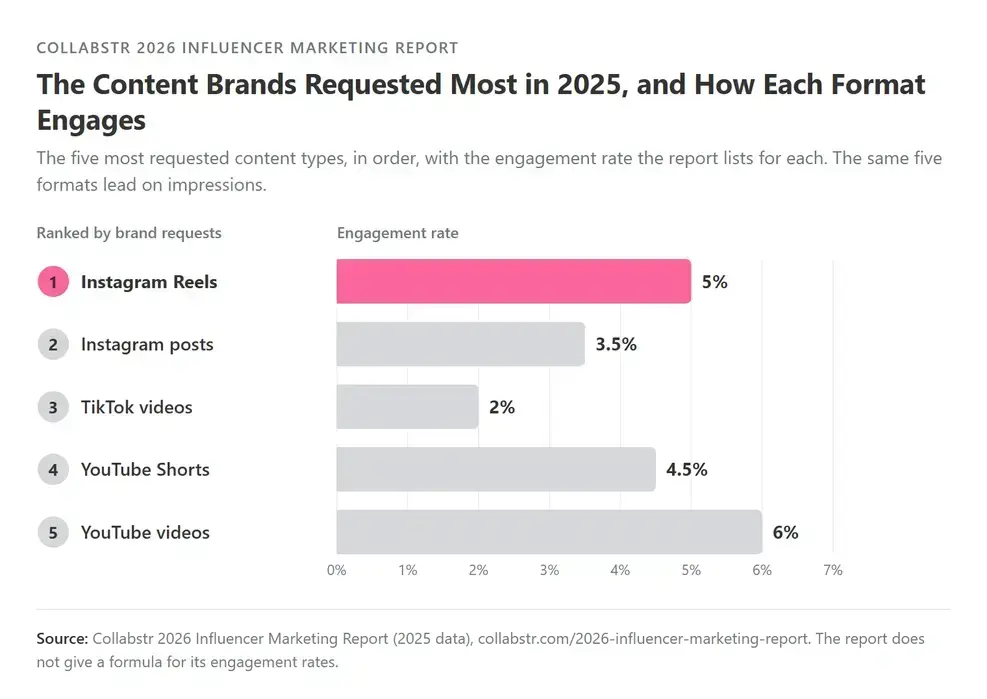
The five content types brands requested most in 2025 are ranked in Table 1, from Instagram Reels at the top to YouTube videos at fifth. The same five formats, in the same order, drew the most impressions, meaning the number of times content was shown (Collabstr, 2026).
Table 1. The Five Most Requested Content Types in 2025
|
Rank by brand requests |
Content type |
Engagement rate in the report |
|---|---|---|
|
1 |
Instagram Reels |
5% |
|
2 |
Instagram posts |
3.5% |
|
3 |
TikTok videos |
2% |
|
4 |
YouTube Shorts |
4.5% |
|
5 |
YouTube videos |
6% |
Source: Collabstr 2026 Influencer Marketing Report. Rank is by brand requests in 2025. Engagement rate is a separate measure of how actively audiences respond, such as by liking or commenting.
Order Formats by Demand, Then Pitch Your Engagement
Put the most requested formats at the top of the card, since those are the lines brands look for first. The formats brands request most are not always the ones that draw the most engagement. YouTube videos ranked fifth by requests but carry the highest engagement rate in the report, at 6%, while TikTok videos ranked third but had the lowest rate of the five, at 2% (Collabstr, 2026).
The report attributes YouTube's lead to viewers who choose longer content being more invested, so a creator with strong long-form results can lead with those results when pitching a YouTube integration. The report names the interactions it counts but gives no formula, so use its rates to compare formats with each other.
Add a UGC Line
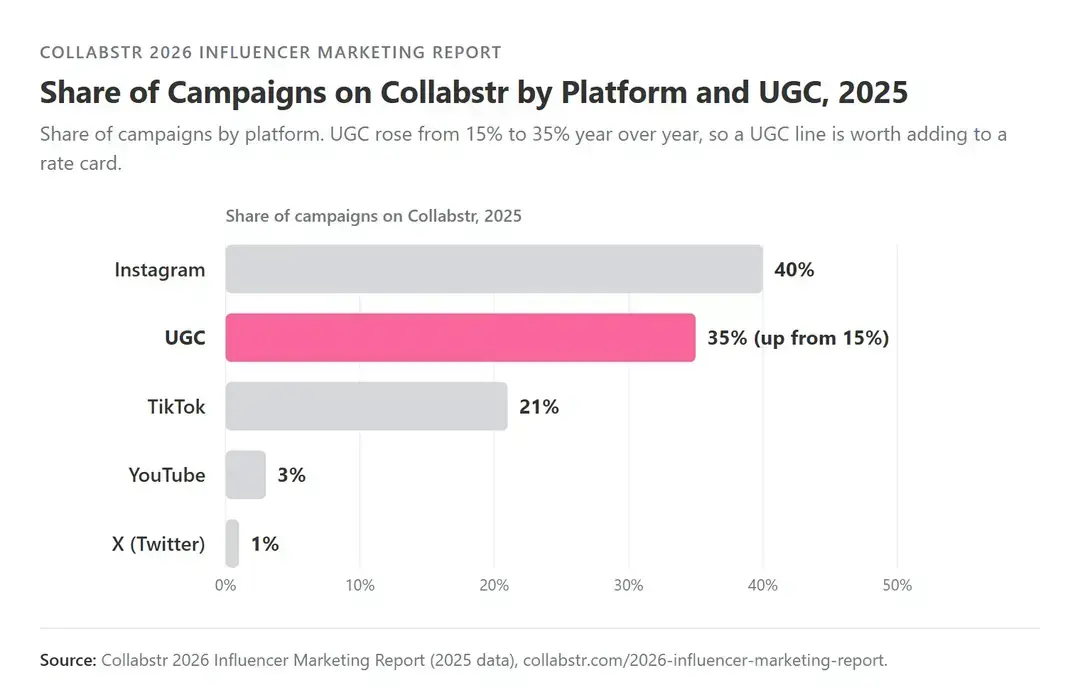
UGC made up 35% of campaigns on Collabstr in 2025, up from 15% the year before, while Instagram held 40% (Collabstr, 2026). Because UGC runs on the brand's own channels and ads, price the line on the files: the number of videos, the usage rights and the delivery time.
How to Price the Lines on a Rate Card
Start each line at what brands have already paid you for that format. Before you share the card, check that number against what other creators charge. Collabstr's influencer price calculator gives the average rate for a platform, category and follower range, and every creator profile on Collabstr shows a starting price for each content type (Collabstr). If your rate sits far above those, the card needs a reason for it, such as usage rights or a bundle.
Follower Count by Platform
The price calculator filters by platform, category and follower range. Check each line of your card against the platform that line is for, and enter your follower count on that platform only, since a creator can sit in a different follower range on each one.
Bundles
Price a bundle below the sum of its single items, and name what it contains. A bundle of two short-form videos plus three Stories is easier to compare than a vague campaign package. The Bundle row in the rate card template later in this article shows how that looks on the card.
How to Check Whether an Influencer Rate Card Is Fair
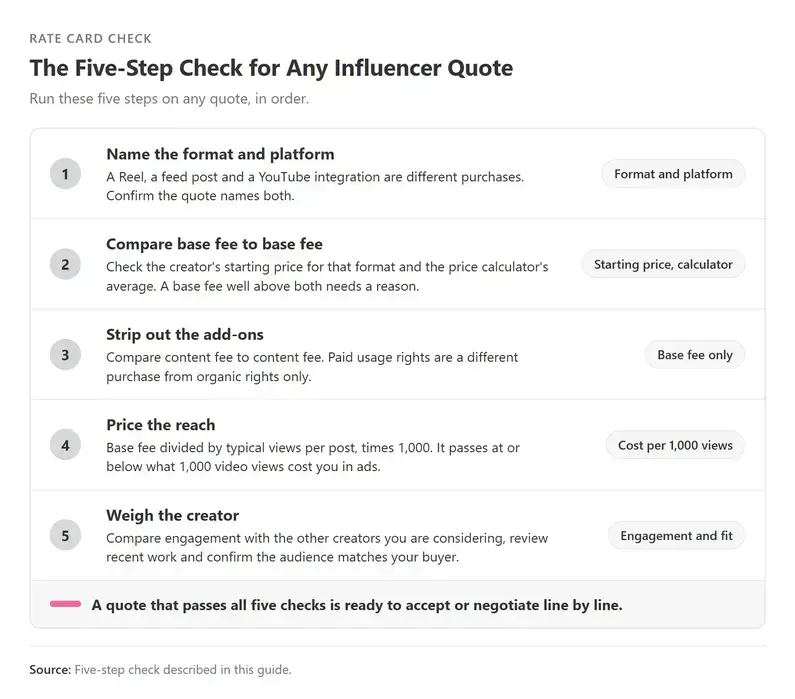
To check whether an influencer rate card is fair, confirm the format and platform, compare base fee to base fee, strip out add-ons, work out the cost per 1,000 views and weigh the creator's fit. A quote that passes all five checks is ready to accept or negotiate line by line.
The Five-Step Check
Run these five steps on any quote, in order.
1. Name the format and platform. A Reel, a feed post and a YouTube integration are different purchases, so confirm the quote names both.
2. Compare base fee to base fee. The base fee is the price of the content itself, before extras. Check the creator's starting price for that format, and the price calculator's average for the platform, category and follower range. A base fee well above both needs a reason on the quote.
3. Strip out the add-ons. Compare content fee to content fee. A quote that includes 90 days of paid usage rights is a different purchase from a single Reel with organic rights only.
4. Price the reach. Divide the base fee by the creator's typical views per post and multiply by 1,000. For example, a hypothetical $250 quote from a creator who averages 2,000 views works out to $125 per 1,000 views. It passes when the result is at or below what 1,000 video views cost you in ads.
5. Weigh the creator. Check engagement with the Instagram engagement calculator and compare it with the other creators you are considering. Review recent work and confirm the audience matches your buyer.
When a High Quote Is Still Fair
A high quote can be fair when add-ons or a bundle account for the difference. Ask for the itemized version, then run the five steps on the base fee.
How to Price Add-Ons Like Usage Rights, Whitelisting and Exclusivity
Each add-on should be named, limited to a stated period and priced on its own line. Add-ons are where similar-looking quotes drift apart.
Paid usage should name the ad channels. Whitelisting should name the duration and who controls the ad account. Exclusivity should name the category and the end date.
"Usage rights included" with no channel or duration is a question to ask before you agree. Write every add-on into an influencer contract template.
If content runs as an ad from the creator's handle, the relationship still needs a clear disclosure. The Federal Trade Commission (FTC) staff guide Disclosures 101 for Social Media Influencers sets out the basics (FTC, 2019).

A Rate Card Template for Creators
A rate card template for creators lists three to five core deliverables, one bundle, and add-ons on separate lines, each with a base rate. Start from what you have been paid, list the most requested formats you make first, such as Reels and Instagram posts, then check each rate against the price calculator for your platform, category and follower range.
Content Rates
The content section of an influencer rate card template names each deliverable, its platform, what the base rate includes and the price. Copy this table and fill in the brackets.
Rate Card Template: Content
|
Deliverable |
Platform |
Includes |
Base rate |
|---|---|---|---|
|
One short-form video |
[Reels / TikTok / Shorts] |
Concept, one revision round, delivery in [X] days |
$[ ] |
|
One feed post |
[Instagram] |
[Photo or carousel], caption, one revision round |
$[ ] |
|
One long-form integration |
[YouTube] |
[60 to 90] second segment, link in description |
$[ ] |
|
UGC video set |
Brand's own channels |
[3] videos, no posting to your account |
$[ ] |
|
Bundle |
[Platform] |
[2] short-form videos plus [3] Stories |
$[ ] |
Add-On Rates
The add-on section prices every extra on its own line, with its terms stated beside it. Paid usage rights, whitelisting and exclusivity each need a stated duration.
Rate Card Template: Add-Ons
|
Add-on |
Terms to state |
Price |
|---|---|---|
|
Paid usage rights |
[Channels], [30 / 60 / 90] days |
$[ ] |
|
Whitelisting |
Ads from your handle, [duration] |
$[ ] |
|
Exclusivity |
[Category], [duration] |
$[ ] |
|
Extra revision round |
Per round |
$[ ] |
|
Rush delivery |
Under [X] days |
$[ ] |
|
Raw footage |
Unedited files |
$[ ] |
How Often to Update a Rate Card
Review a rate card every quarter. Update it sooner when your follower count on a platform moves into a new range in the price calculator, or when you add a new format. Brands should re-check the calculator before each campaign.
What This Means for Brands
For brands, a rate card is a starting point. A quote that passes the five checks is ready to accept or negotiate, and one that does not deserve a line-by-line conversation with the creator. Once you agree a price, our influencer onboarding checklist covers the steps from hire to the first approved post.
On Collabstr, each creator profile shows a starting price for each content type before you hire, and payment is released when you approve the work. See plans on Collabstr.
FAQ
What Should an Influencer Rate Card Include?
Include your platforms and formats, a base rate for each, and at least one bundle. List add-ons on separate lines: paid usage rights, whitelisting, exclusivity, extra revision rounds, rush delivery and raw footage. State what each base rate includes, such as the number of revisions and the delivery time.
What Content Should an Influencer Rate Card List First?
List the formats brands request most. In 2025, the most requested content types on Collabstr were Instagram Reels, Instagram posts, TikTok videos, YouTube Shorts and YouTube videos, in that order, and UGC made up 35% of campaigns (Collabstr, 2026).
How Much Do Influencers Charge per Post or Collaboration?
It depends on the platform, format, follower count and add-ons. Collabstr's influencer price calculator shows the average rate for a platform, category and follower range, and each creator profile on Collabstr shows a starting price for each content type. Add-ons such as paid usage rights are priced on top.
Is a High Influencer Quote Fair?
It can be, when add-ons such as paid usage rights or a bundle account for the difference. Ask for the itemized version, compare the base fee with the creator's starting price and the price calculator, and work out the cost per 1,000 views.
How Often Should an Influencer Update Their Rate Card?
Review an influencer rate card every quarter. Update it sooner when your follower count on a platform moves into a new range, when you add a new format, or when production time changes.
Methodology
• Content requests, reach ranking and engagement by format come from Collabstr's 2026 Influencer Marketing Report, which covers 2025. The report ranks the content types brands requested most and those with the most impressions, and lists an engagement rate for each format, naming the interactions it counts without giving a formula. Read from the live report on September 16, 2026.
• Platform shares (Instagram 40%, UGC 35%, TikTok 21%, YouTube 3% and X 1%, with UGC up from 15% the year before) come from the same report.
• Starting prices are described on Collabstr's find and hire page, and the price calculator's filters (platform, category and follower range) on its own page, both read September 16, 2026.