Let Influencer Marketing Automation Run the Logistics and Keep Your Team on the Decisions
If your team runs several campaigns at once, this guide shows which steps to automate, which to keep human and where the time actually goes.
Key Takeaways
• When you publish a campaign on Collabstr, matching creators are invited to apply to it automatically. Of the campaigns that got at least one application, half got their first within 31 minutes (Collabstr platform data, July 2026).
• A first hire takes longer. Half of the brands that made their first hire in the 12 months to July 23, 2026 did so within 2.91 days of signing up, just under three days (Collabstr platform data, July 2026), and that time includes their own setup and shortlisting.
• Collabstr holds your payment until you approve the work, then releases it to the creator right away (Collabstr, 2026).
• Automate the steps that follow the same rule every time: invites, reminders, payment release and pulling results into one report. Keep creator fit, the brief, creative approval and the relationship with people on your team.
Teams look into influencer marketing automation when they are running more campaigns than they have hours to manage. Say you run three campaigns with 10 creators each. That is 30 invites, 30 follow-ups, 30 payments and 30 report pulls: 120 tasks done the same way every time, and those are the tasks worth automating.
Deciding who fits, what to ask for and whether the content is right is judgment work worth keeping human. This guide covers what to automate, what to keep manual and how to start.
What Influencer Marketing Automation Is
Influencer marketing automation is software that runs the repeatable steps of a creator campaign, so nobody does them by hand each time. Invites that go out on publish, payments that release on a rule and performance numbers that pull into one report are all examples.
Which Tasks Software Can Run
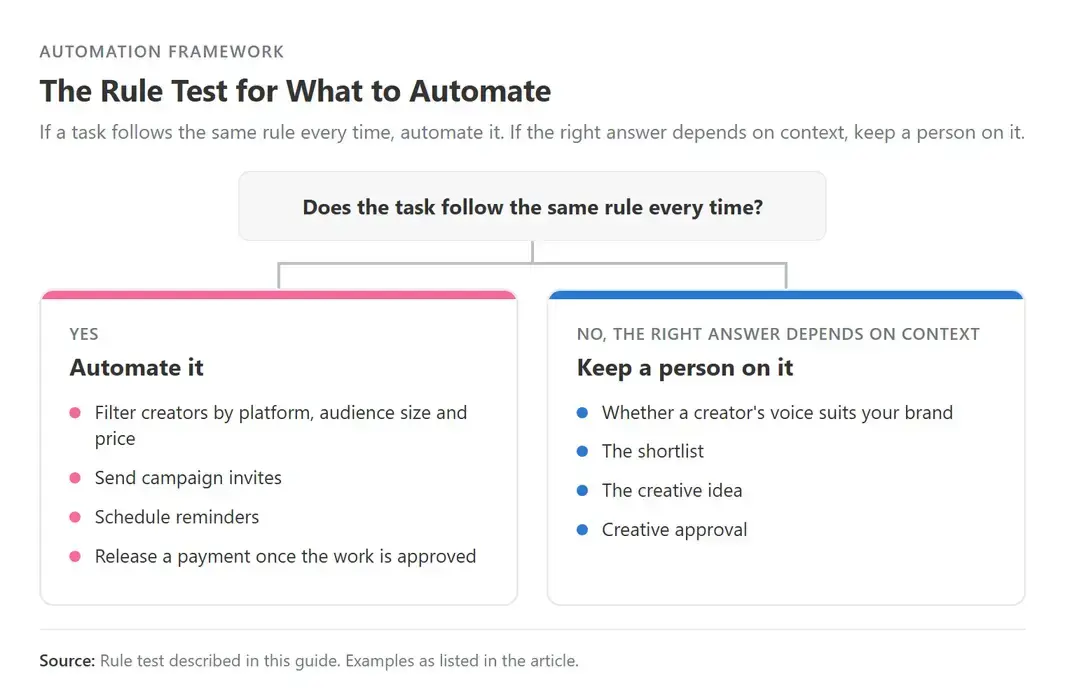
Software can run tasks that follow the same rule every time. It can filter creators by platform, audience size and price, send campaign invites, schedule reminders and release a payment once the work is approved.
Judgment is a different kind of work. Software cannot tell you whether a creator's voice suits your brand. A useful test: if a task follows the same rule every time, automate it, and if the right answer depends on context, keep a person on it.
Why Admin Grows With Every Collaboration
Admin time grows with every collaboration you add. When a campaign has many low-cost collaborations, the time spent on each one's paperwork adds up to a real share of the cost. The invite, the reminder, the payment and the report are good places to begin, because each one runs the same way for the 10th creator as for the first.
Where the Time Goes in an Influencer Campaign
On Collabstr, the steps that run on rules are fast, and the step that depends on the brand takes days. Half of the campaigns that got at least one application got their first within 31 minutes, and half of the brands making their first hire did so within 2.91 days of signing up (Collabstr platform data, July 2026).
Run influencer marketing by hand and much of the calendar goes to coordination: cold messages sent one at a time, rates agreed over email, agreements signed by hand, invoices processed one by one. Across the 120 tasks in the example above, those small waits stack up.
|
Step |
Manual norm |
On Collabstr |
|---|---|---|
|
Find creators and agree on price |
Scroll each platform, copy profiles into a spreadsheet, negotiate rates over email or direct messages (DMs) |
Search creator profiles in one place, with prices shown before you hire |
|
Reach out |
Send individual messages, then send each follow-up by hand |
Creators are invited to apply when you publish. Half of campaigns with applications got their first within 31 minutes |
|
Hire |
Confirm terms, collect details, schedule the work |
Half of brands made their first hire within 2.91 days of signing up (first hires in the 12 months to July 23, 2026) |
|
Pay |
Collect payment details, process invoices |
The creator is paid the moment you approve the work, with no invoices to process |
|
Revisions |
Collect feedback over email |
Request revisions before you approve, and no payment is released until you do |
Steps Automation Already Runs
On Collabstr, invites and payouts already run on rules. Creators are invited to apply as soon as you publish a campaign, and our influencer gifting guide breaks the time to a first application down by campaign type.
Payment runs on a rule too. Collabstr holds the payment in escrow, meaning it keeps the funds until you approve the deliverable, then pays the creator right away, with no invoices or transfers to arrange. You can request revisions before approving (Collabstr, 2026). Our guide to paying influencers covers payment options more broadly.
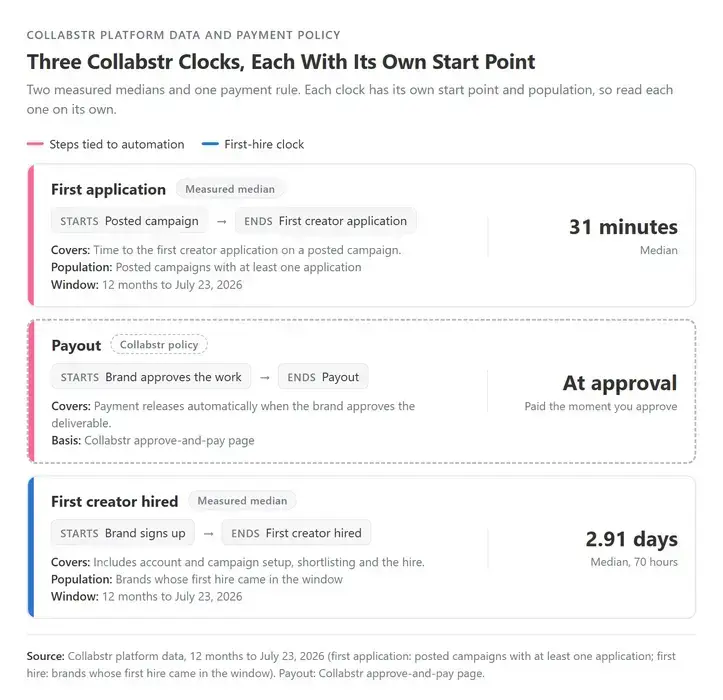
The chart below compares three of these timings. Each is a separate clock, with its own start and end point, so the three cannot be added together.
What the Timings Show
• First application: from publishing a campaign to the first creator application. Half of the campaigns that got at least one application got it within 31 minutes. Campaigns with no applications are left out.
• Payment: Collabstr releases payment when you approve the work, under its published policy.
• First hire: from a brand signing up to its first hire. Half of the brands whose first hire came in the 12 months to July 23, 2026 hired within 2.91 days (Collabstr platform data, July 2026). This clock includes the brand's own setup and shortlisting.
Creators are invited to apply when you publish. Half of campaigns with applications got their first within 31 minutes. A first hire takes days because it includes your own setup and shortlisting, so a clearer brief, a tighter shortlist and a steady approval habit are the places to save time. Our influencer onboarding checklist covers the setup steps that follow each hire.
What to Automate and What to Keep Manual
Automate the work that follows a rule, such as filters, invites, reminders, payment release and pulling results into one report. Keep manual the work where judgment changes the result, such as the shortlist, the creative idea and creative approval.
|
Workflow stage |
Automate |
Keep manual |
|---|---|---|
|
Discovery |
Filters for platform, audience size, price |
The final shortlist and brand fit |
|
Outreach |
Campaign invites, follow-up reminders |
The first message to a priority creator, answers to their questions |
|
Brief |
Template fields, deliverables, deadlines |
The creative idea, the angle, the must-say points |
|
Contract |
Standard terms, usage rights fields, signatures |
Non-standard usage rights, exclusivity |
|
Content |
Collecting submissions, deadline reminders |
Creative approval and feedback |
|
Payment |
Release on approval |
Scope changes and bonuses |
|
Reporting |
Pulling views, engagement and spend into one place |
Deciding what the numbers mean for the next campaign |
|
Relationship |
A reminder to check in |
The check-in itself |
Templates for the Brief and Contract
Templates turn the repeatable parts of the brief and contract into rule-based work. Two free templates cover those rows: the campaign brief template and the influencer contract template. Read up on content usage rights before you make them a standard field.
Reporting That Feeds the Next Campaign
Automated reporting gathers views, engagement and spend in one place, so the numbers are ready when a campaign ends. Agree your influencer marketing key performance indicators (KPIs) first, so the automated pull collects numbers you will use.
Reading those numbers stays human work. A person decides what the results mean for the next brief, the next shortlist and the next campaign.
The Risks of Over-Automating Influencer Marketing
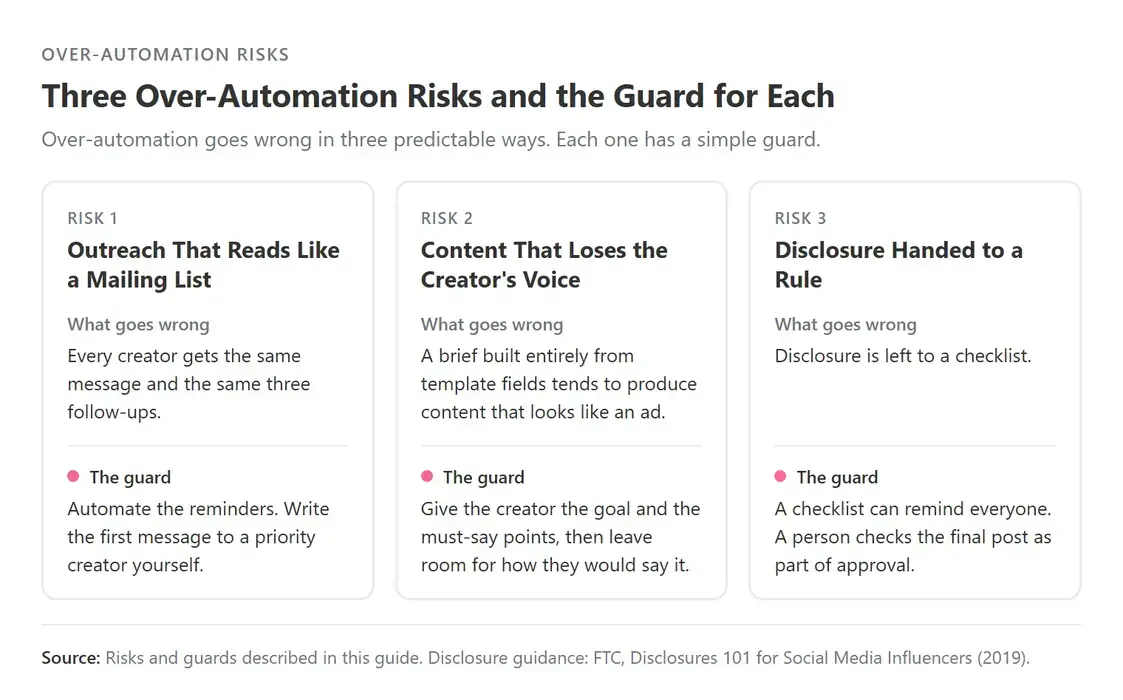
Over-automation goes wrong in three predictable ways: outreach that reads like a mailing list, content that loses the creator's voice and disclosure left to a checklist. Each one has a simple guard.
Outreach That Reads Like a Mailing List
Influencer outreach automation reads like a mailing list when every creator gets the same message and the same three follow-ups. The guard is to automate the reminders and write the first message to a priority creator yourself. A generic pitch is easy to spot and easy to ignore.
Content That Loses the Creator's Voice
A brief built entirely from template fields tends to produce content that looks like an ad. Give the creator the goal and the must-say points, then leave room for how they would say it. Our guide to user-generated content (UGC) creator briefs shows the balance.
Disclosure Handed to a Rule
Disclosure needs a person's check at approval. The Federal Trade Commission (FTC) asks for clear disclosure whenever a brand and creator have a material connection, in its Disclosures 101 for Social Media Influencers guidance (FTC, 2019).
A checklist can remind everyone. A person should check the final post as part of approval.
How to Start Automating Your Influencer Marketing Workflow
Start with one campaign and one bottleneck. Map the workflow, time the waits, automate the slowest logistics step and re-time after the next campaign.
1. Map one campaign end to end. List every step from idea to final report, and who did it.
2. Time the waits. Note how much of each step was waiting on someone else.
3. Pick the bottleneck. Automate the slowest logistics step first. Common candidates are outreach follow-ups and payment admin.
4. Write the rule before you choose the tool. If you cannot state it, such as "release payment when the content is approved", the step is not ready.
5. Name an owner for every judgment step. Fit, brief, approval and the relationship each need a person.
6. Re-time after one campaign. Then move to the next bottleneck.
Influencer Marketing Automation Checklist
Use this checklist to confirm that the rule-based steps run on their own and that every judgment step has an owner. Run it before each campaign goes live.
• Creators are invited to apply automatically when a campaign is published.
• Reminders are scheduled. First messages to priority creators are written by a person.
• Briefs and contracts start from templates, with usage rights stated.
• Submissions, deadlines and results live in one place.
• A named person approves every piece of content and checks the disclosure.

What This Means for Brands
For a team running more campaigns than it can manage by hand, the answer is to move rule-based steps out of inboxes and spreadsheets. The saved hours go into the decisions that shape results: who you hire, what you ask for and what you approve.
That is the split Collabstr is built on, under the homepage line "Replace 10 tools with 1 platform", with hiring, payment and reporting in the same place. Creators are invited when you publish, prices are shown before you hire, and payment is released when you approve the work. When you are ready, find and hire creators, see how approval and payment work, or compare plans and pricing.
FAQ
What Is Influencer Marketing Automation?
Influencer marketing automation is software that runs the repeatable steps of an influencer campaign, such as creator invites, reminders, contracts, payments and reporting pulls. The judgment calls stay with people: choosing creators, writing the brief and approving content.
Can Influencer Outreach Be Automated?
Yes, in part. Campaign invites and follow-up reminders automate well. On Collabstr, creators are invited to apply as soon as you publish, and half of the campaigns that got an application got their first within 31 minutes (Collabstr platform data, July 2026). First messages to creators you especially want are better written by a person, since a generic pitch is easy to spot and easy to ignore.
What Should You Not Automate in Influencer Marketing?
Keep creator fit, the creative brief, content approval and the ongoing relationship manual. These steps depend on context: your brand's voice, the creator's audience and whether a piece of content is right.
Does Automation Make Influencer Marketing Less Authentic?
Automating the logistics leaves the parts an audience sees in human hands. Payments, reminders and reporting run behind the scenes, and the creator's voice, the brief and the approval stay with people.
Where Should You Start With Influencer Marketing Workflow Automation?
Start with the slowest logistics step in one campaign, such as outreach follow-ups or payment admin. Write the rule first, automate that step, then re-time the next campaign.
Methodology
Collabstr platform figures come from a read-only production data report generated July 23, 2026. Windows are the 12 months to July 23, 2026. Time to first application is the median (the middle value) across published campaigns that received at least one application. Time to first hire is the median across brands whose first hire came in the window, measured from signup. Payout timing and revisions come from Collabstr's approve-and-pay page, read September 15, 2026. Figures as of July 2026.